Comprehensive Guide on How Does a Pool Heat Pump Work

How Does a Pool Heat Pump Work

A pool heat pump is the most energy-efficient way to heat a swimming pool, but unlike a gas or electric heater, it doesn’t actually make heat. It moves it. Using the same proven refrigeration technology found in your refrigerator or air conditioner, a pool heat pump captures warmth that already exists in the outside air and transfers it into your pool water, delivering several units of heat for every single unit of electricity it consumes.

That simple difference is why heat pump owners routinely cut their pool-heating costs by 50% or more compared to traditional heaters. In this article, I will explain exactly how does a pool heat pump work, walk you through the full process from installation to maintenance, and show you how to choose the right heat pump.

What Is a Pool Heat Pump?

A pool heat pump is an electrically powered device that heats (and, in many modern units, cools) swimming pool and spa water by transferring heat from the surrounding air into the water. It does not burn fuel and does not use electric resistance elements as its primary heat source. Instead, electricity simply powers a fan, a compressor, and a circulation system that relocates free heat from the air.

If you already own an air conditioner, a dehumidifier, or a refrigerator, you already own a heat pump. They all rely on the same sealed refrigerant-compression cycle to move heat from one place to another. A pool heat pump is purpose-built to do this for recreational water: in-ground pools, above-ground pools, spas, hot tubs, and swim spas.

This is fundamentally different from a gas heater, which produces heat by combustion, or an electric resistance heater, which converts electricity directly into heat at roughly a one-to-one ratio. Because a heat pump moves heat rather than generating it, it can deliver three to six units of heat energy for every unit of electrical energy it draws, an efficiency no combustion or resistance heater can approach.

Benefits of Using a Heat Pump for Pool Heating

Before we know how heat pumps work, let’s see why you should consider using heat pumps for your pool heating.

Useful All Year Round

Because a quality cold-climate heat pump keeps working even when the air is near or below freezing, it dramatically extends your usable swimming season, opening earlier in spring and staying warm later into fall. 

In milder climates, that can mean year-round swimming. A unit with intelligent defrost technology will automatically manage frost on the coil in cold weather so heating stays consistent.

Cools Your Pool

Many modern heat pumps are reversible. By running the refrigeration cycle in the opposite direction, the unit pulls heat out of the pool water and releases it to the air, chilling an over-warm pool during a heat wave.

This is a genuine comfort and water-quality advantage: pool water that gets too hot encourages algae growth and throws off chemical balance, costing you more in treatment. Inverter pool heat pumps with dual-zone capability can even heat a hot tub while cooling the pool at the same time.

Saves Energy

It is one of the biggest benefits because a heat pump moves heat rather than burning fuel; it can cut heating costs by 50–80% compared with gas or propane heaters.

The U.S. Department of Energy notes that running an average heat pump year-round can save hundreds of dollars annually versus conventional heating, and inverter-driven models push savings even higher by ramping output up and down to match demand instead of cycling fully on and off.

Long Lifespan and Durability

Because it transfers heat instead of generating it through combustion, a heat pump runs under far less internal stress than a gas heater.

Heat pumps commonly last 10–20 years, compared with roughly 5–10 years for a typical gas heater. Models built with a titanium heat exchanger resist corrosion from chlorine and salt, making them ideal for saltwater pools and extending service life further.

Environmentally Friendly

A heat pump produces no on-site combustion and no carbon monoxide. Paired with a clean electricity supply or rooftop solar, it can heat your pool with a very low carbon footprint. Newer units also use R32 refrigerant, which has a lower global-warming potential than older refrigerants.

Quietly Operates

Inverter compressors and brushless DC fan motors allow premium units to run noticeably quieter than older single-stage pumps, an underrated benefit when the equipment sits near a patio or a neighbor’s property line.

Works With Every Pool Type

Heat pumps are made for in-ground and above-ground pools alike. For an above-ground pool, a compact heat pump is usually the simplest and most cost-effective option; it connects to the same circulation line as an in-ground system. Whatever the pool, correct sizing (covered below) matters more than the pool’s construction type.

How Does a Pool Heat Pump Work?

At its core, a pool heat pump runs a continuous four-stage refrigeration cycle. The “magic” is that even cool-feeling outdoor air contains usable heat energy, and the refrigerant inside the unit boils at such a low temperature that it can absorb that heat readily. Here is the full process, stage by stage.

Understanding The Four Key Components

Every pool heat pump relies on four main parts working in a closed loop:

  • Evaporator Coil: A finned coil on the outside of the unit where refrigerant absorbs heat from the air.
  • Compressor: The heart of the system; it compresses the refrigerant gas, dramatically raising its temperature and pressure.
  • Condenser/Heat Exchanger: Where the hot refrigerant gives up its heat to the pool water flowing through.
  • Expansion Valve: A metering device that drops the refrigerant’s pressure, cooling it sharply so the cycle can begin again.

A fan and the refrigerant (modern units use environmentally friendly R32) complete the system, while your existing pool pump pushes water through the heat exchanger.

The Heating Cycle, Step by Step

If you understand its four key components, this is how does a pool heat pump work.

  • Air Intake. A fan draws outside air, warmed by the sun, even on cool days, across the evaporator coil.
  • Heat Absorption. Cold liquid refrigerant inside the evaporator absorbs heat from that air and evaporates into a low-temperature gas.
  • Compression. The gas passes into the compressor, which squeezes it to high pressure. Compression concentrates the heat, and the refrigerant’s temperature climbs sharply, often above 200 °F (93 °C).
  • Heat Transfer to Water. The very hot gas flows into the heat exchanger (condenser). Meanwhile, your pool pump circulates pool water, already filtered, through the other side of the exchanger. Heat passes from the refrigerant into the water, typically raising it 3–5 °F (about 2–3 °C) on each pass before the warmer water returns to the pool.
  • Condensation and Reset. Having surrendered its heat, the refrigerant condenses back into a liquid, flows through the expansion valve where its pressure and temperature drop, and returns to the evaporator to repeat the cycle.

Because the water is warmed only a few degrees per pass and recirculated continuously, a heat pump heats gradually, usually raising the whole pool by about 1–3 °F per hour depending on pool size and unit output. That steady, low-effort approach is exactly what makes it so efficient at maintaining temperature over a long season.

Installation and Maintenance Process

The pool heat pump installation and maintenance process is quite easy. Just follow the method, and you can use a top-quality pool heat pump for a long time.

How a Pool Heat Pump Is Installed

Adding a heat pump to an existing pool is more straightforward than most owners expect. The unit is plumbed into the circulation system after the pool filter (and, where a chlorinator or salt cell is used, before that device, so corrosive treated water doesn’t sit in the exchanger). The typical installation involves:

  • A Level Base 

Pour a small concrete pad or set a manufactured base so the unit sits level with adequate airflow clearance on all sides, usually a couple of feet of open space around the coil and unobstructed air above.

  • Plumbing Connection 

Connect the unit to the return line after the filter using rigid PVC, and install a bypass valve assembly. The bypass lets you fine-tune water flow through the heat pump and isolate it for service without shutting down the pool.

  • Electrical Supply

A heat pump needs a dedicated circuit, commonly a 50–60-amp breaker, wired and grounded by a licensed electrician to meet local code.

  • Startup 

Fill and prime the system, purge air from the lines, set your target temperature on the controller, and let the unit begin its gradual heating cycle.

If you’re replacing an existing gas or propane heater, installation is even simpler because the plumbing and pad are often already in place.

Maintenance Process

One of the quiet advantages of a heat pump is how little upkeep it needs. A short, consistent maintenance routine keeps it running at peak COP for years:

  • Maintain water flow. Low flow is the most common cause of heat pump problems, and it’s almost always a dirty filter. Keep your pool filter clean and check skimmer and pump baskets so the unit gets the circulation it needs.
  • Keep the coil clear. The evaporator coil can collect leaves, grass clippings, and dust pulled in with the air. Periodically power down the unit and gently clear debris; hose the coil if it looks dirty.
  • Check connections. Inspect plumbing fittings and electrical connections for leaks or wear. Note that water around the base is often harmless condensation rather than a leak.
  • Watch the controller. Modern units display fault codes and performance data; a WiFi controller lets you monitor temperature and catch issues from your phone.
  • Book an annual check. A yearly professional inspection catches small faults early and protects the unit’s lifespan.

Maintenance in Winter

If you close your pool for winter, drain the water from the heat pump using its drain plug to prevent freeze damage inside the heat exchanger, and fit a winter cover to protect the casing from snow and debris. Units with built-in anti-freeze protection add another layer of safety in cold storage.

How to Select a High-Quality Heat Pump Pool Heater

Choosing the best heat pump for your swimming pool comes down to matching the unit’s size, efficiency, and features to your pool and climate.

Size

An undersized unit will struggle to reach temperature; an oversized one costs more than necessary. Size is driven by your pool’s surface area and the temperature rise you need (your target temperature minus the average air temperature in the coldest month you’ll swim). Wind exposure, humidity, and cool nights all increase the load; windy, dry, low-humidity sites need more capacity.

The U.S. Department of Energy’s quick formula for an outdoor pool is:

Pool surface area (sq ft) × temperature rise (°F) × 12 = required BTU/hr output

As a fast reference by pool volume:

Pool VolumeSuggested Minimum Heat Output
Up to 10,000 gallons60,000 BTU
Up to 15,000 gallons90,000 BTU
Up to 20,000 gallons (average pool)120,000 BTU
25,000 gallons or more140,000 BTU+

These figures assume a roughly 1–1.25 °F rise per hour. A pool cover is the single best companion to any heat pump; it cuts overnight heat loss dramatically, letting a smaller unit keep up and slashing running costs. Because the variables add up, it’s worth running your numbers through a dedicated pool sizing tool rather than guessing.

Efficiency

Compare units on COP; higher is better, and prioritize inverter-driven models. A DC inverter compressor varies its speed to match the exact heating demand, instead of switching fully on and off like a single- or two-stage unit.

It delivers higher real-world efficiency (often around 50% better than fixed-speed pumps), steadier water temperature, and much quieter operation. Brushless DC fan motors add further efficiency and noise reduction.

Cold-Climate Capability

If you live anywhere with cool shoulder seasons, the single most important spec is the unit’s low-ambient operating range. Seasonal pumps that quit at 50 °F give you a short season. A cold-climate-rated unit that operates well below freezing, Arctic’s run to –20 °C (–4 °F) — is what actually extends your swimming months, with an automatic backup option for the coldest spells.

Check Features

When comparing the best heat pump swimming pool options, look for:

  • DC inverter compressor for efficiency and quiet running
  • Titanium (ideally spiral) heat exchanger for corrosion resistance and saltwater compatibility
  • Cold-climate rating with intelligent defrost
  • Reversible heat/chill, and dual-zone control if you run a pool and spa
  • Environmentally friendly R32 refrigerant
  • A smart WiFi controller for remote monitoring
  • A strong warranty

Costs

A pool heat pump typically costs more to buy than a gas heater but far less to run, so the lifetime cost usually favors the heat pump, often paying back the difference within a few seasons.

Budget for three things: the unit itself, installation (electrical plus plumbing), and ongoing electricity. Because running costs are where heat pumps win, the efficiency of the unit you choose directly determines your long-term savings. Check for local rebates and incentives, which are increasingly available for efficient electric heating.

To Conclude

Did you get your answer to ” How Does a Pool Heat Pump Work? A pool heat pump works by capturing free heat from the air and concentrating it into your pool water through a simple, durable refrigeration cycle, delivering several units of heat for every unit of electricity.

The payoff is a longer swimming season, dramatically lower running costs, optional summer cooling, and a unit that can last two decades. To get all of that, choose a properly sized, high-COP inverter unit, and if you swim in a cold climate, insist on a cold-climate-rated model.

If you are ready to find the right fit for your pool, use Arctic’s pool heat pump sizing tool for a custom recommendation, or explore the full range of Arctic Heat Pumps, DC inverter units that heat to 104 °F, cool on demand, and run efficiently down to –20 °C.

Frequently Asked Questions

It uses a fan to pull in outside air, extracts the heat from that air using a refrigerant, compresses that heat to a high temperature, and transfers it into your pool water through a heat exchanger, then repeats. It moves existing heat rather than creating it, which is why it’s so efficient.

Standard units lose efficiency below about 45–50 °F and may shut off. Cold-climate inverter models are specifically engineered to keep heating in freezing conditions, down to –20 °C (–4 °F) on the best units, making them suitable for northern climates and winter hot-tub use.

Heat pumps heat gradually, typically raising water temperature about 1–3 °F per hour depending on pool size and unit output. Using a pool cover to hold heat overnight significantly shortens the time to reach and maintain your target temperature.

Yes, reversible models run the cycle backward to chill an over-warm pool, which also helps prevent algae growth and chemical imbalance during heat waves. Dual-zone units can heat a spa and cool a pool simultaneously.

Absolutely. Compact heat pumps are an excellent, cost-effective match for above-ground pools and connect to the same circulation line as in-ground systems. Sizing it correctly for your water volume is what matters most.

Yes, provided it has a titanium heat exchanger. Titanium resists corrosion from salt and chlorine, making it the right choice for saltwater pools and spas.

Size depends on your pool’s surface area, the temperature rise you want, and local conditions like wind and humidity. Use the DOE formula (area × temperature rise × 12 = BTU/hr) or a dedicated sizing calculator, and round up for windy or exposed sites.

Significantly. With a COP of 5–6, a heat pump delivers several dollars of heat per dollar of electricity, while gas heaters deliver less heat than the fuel they burn. Most owners cut heating costs by 50–80%.

Pool Heat Pump vs Gas Heater: Which Saves More in 2026

arcticheatpumps

You are standing at your pool equipment pad with a contractor quote in hand. You are staring at two numbers that do not seem to make sense. The gas heater costs $2500. The heat pump costs 4800 $. Your neighbor swears by their gas heater. However your coworker says their heat pump paid for itself in two years. Who is actually right?

The confusion between upfront cost and long term value is a major pain point. Making a $5000 decision feels risky when you hear conflicting advice. Your friends and the internet often provide different answers. By the end of this guide you will know exactly which heater fits your situation.

This is not about a generic best pick. This is about what makes sense for your climate and your budget.

How They Actually Work: The Simple Version

Before we dive into the costs we must remove the tech confusion. These two machines handle heat in completely different ways.

Pool Heat Pumps: The Heat Thieves

A pool heat pump does not generate heat. It extracts heat from the outside air. You can think of it as a reverse air conditioner. It uses electricity to move heat rather than create it. Think of it as stealing warmth from the air and dropping it into your pool. This process involves heat transfer through a specialized compressor technology. It relies on the ambient air temperature to function. The efficiency of this unit is measured by the COP or Coefficient of Performance.

Gas Heaters: The Fast Burners

Gas heaters burn natural gas or propane to produce warmth. They generate heat through direct combustion inside a combustion chamber. This heat is transferred to the water through a heat exchanger. They work exactly like the water heater in your home. They are the speed champions of the pool world but they are also fuel guzzlers.

The Key Difference:

  • Heat Pump: Takes 24 to 72 hours to heat a pool. It runs on pennies per hour.
  • Gas Heater: Heats a pool in 3 to 6 hours. It costs $4 to $9 per hour to run.

The Real Cost Breakdown: Not The Marketing BS

You need actual numbers to make an informed choice. Marketing materials often hide the true total cost of ownership.

Initial Investment

Equipment Type
Equipment Cost
Installation Cost
Total Upfront
Pool Heat Pump
$2,800 to $5,500
$800 to $1,500
$3,600 to $7,000
Gas Heater
$1,500 to $3,500
$500 to $2,000
$2,000 to $5,500

Operating Costs Reality Check

For Daily Swimmers aiming for an 80 degree target over a six month season:

  • Heat Pump: $100 to $150 per month. This totals $600 to $900 per season.
  • Gas Heater: $250 to $400 per month. This totals $1,500 to $2,400 per season.
  • Annual Savings with Heat Pump: $900 to $1,500 .

For Weekend Warriors heating only 8 to 12 days per month:

  • Heat Pump: $40 to $60 per month. It still takes 2 to 3 days to reach the target.
  • Gas Heater: $80 to $120 per month. It is ready in a few hours.

The Break-Even Timeline

If you are a daily swimmer the pool heat pump pays for itself in 2 to 3 years. This is a solid ROI calculation. If you only heat once a week for pool parties the math favors gas. The payback period is much longer if the unit sits idle most of the time.

Hidden Costs Nobody Mentions

Most contractors will not tell you that heat pumps need air above 50 degrees to work. Below 45 degrees they are essentially useless. Gas heaters work in any weather conditions. However a gas heater has a shorter life cycle cost. You can expect 5 to 10 years of life from gas. A heat pump usually lasts 10 to 15 years with basic care. Gas heaters also require annual service permits and cost 150 to 300 $ to maintain. Heat pumps need minimal maintenance but require a larger electrical circuit.

Speed vs Savings: What Actually Matters for YOUR Pool

Help yourself identify your use case by looking at these common profiles.

Use Case 1: The Daily Swimmer

You use your pool 4 to 7 days per week. You want a consistent temperature of 80 to 85 degrees.

  • Best Choice: Pool Heat Pump.
  • Why: You are heating constantly anyway. Slow heating does not matter because you maintain the temperature. Your electricity bill stays steady while your neighbor cringes at their gas bill.
  • Real Example: Sarah in Phoenix runs her heat pump from March through November. Her initial cost was $4,200. Her monthly cost is $95. She saved $1,400 in her first year.

Use Case 2: The Weekend Warrior

On Friday afternoon you decide to heat the pool for a Saturday party.

  • Best Choice: Gas Heater.
  • Why: You need heat now. A heat pump needs up to 3 days to prepare. A gas heater gets you swimming ready in 4 to 6 hours. You only heat 15 times per year so the $9 hourly cost is manageable.
  • Real Example: Mike in Austin heats his pool about 12 weekends per year. His gas heater cost $2,100. His total annual cost is $540. A heat pump would be cheaper to run but he would have to plan 2 days ahead every single time.

Use Case 3: The Year-Round Swimmer in Cold Climates

You live in the Midwest or Northeast and want to swim in December.

  • Best Choice: Gas Heater or a Hybrid System.
  • Why: When it is 35 degrees outside your heat pump becomes an expensive lawn ornament. Gas heaters function at any v temperature.

The Climate Question: Does Your Location Decide for You?

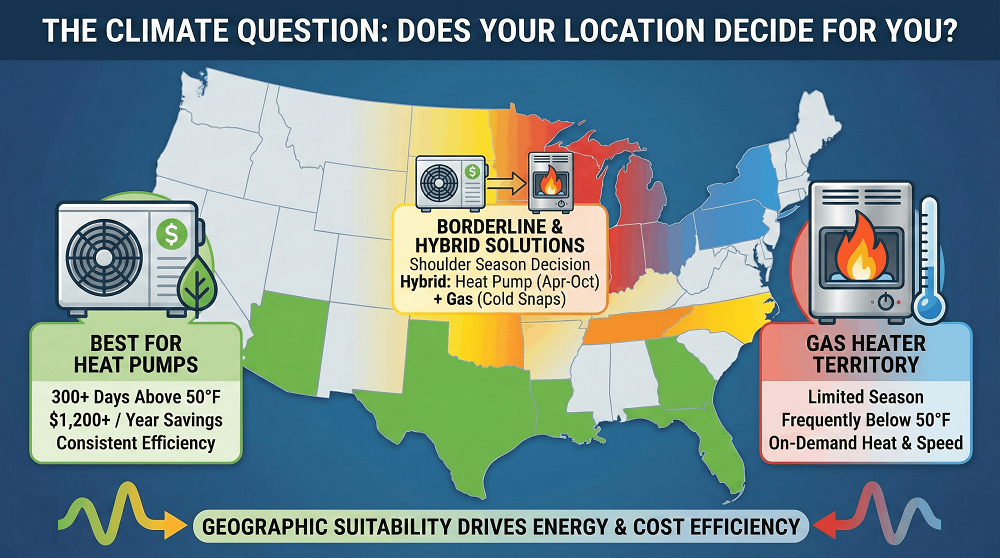
Pool heating climate comparison banner showing heat pump friendly states, gas heater regions, and hybrid solution with $1200 annual savings potential

Your geographic suitability is a major factor in energy consumption.

  • Best States for Heat Pumps: Florida, Texas, Arizona, Georgia, and Louisiana. These areas have 300 days above 50 degrees. You can expect savings of 1,200 $ per year over gas.
  • Borderline States: North Carolina, Tennessee, and Oklahoma. These states have about 250 good heating days. Your decision depends on how much you swim during the shoulder seasons.
  • Gas Heater Territory: Michigan, Minnesota, and Wisconsin. The season is limited and temperatures frequently drop below 50 degrees. Heat pumps struggle to maintain a consistent temperature here.

The Hybrid Solution: Some owners in borderline climates install both. Use the heat pump from April to October. Switch to gas for the cold snaps. This maximizes both savings and functionality.

7 Things Salespeople Won’t Tell You

  1. The 50 Degree Wall: Most salespeople gloss over efficiency drops. Below 50 degrees your heat pump loses its edge. At 40 degrees it might not heat the water at all.
  2. Installation Location Matters: Heat pumps have strict sizing requirements for airflow. You need 24 inches of side clearance and 48 inches on top. Obstructed airflow causes a 20 percent efficiency loss.
  3. Inverter Tech is Better: Inverter heat pumps cost 30 percent more upfront. However they use 25 percent less electricity and last longer.
  4. Your Pool Pump Matters: Heat pumps need specific minimum flow rates. If your pump is undersized the heater will not stay on.
  5. The Sizing Game: Contractors often try to oversell BTU output. For most residential pools 90K to 120K BTU is plenty.
  6. Gas Heaters Hate Salt Water: Salt pools corrode gas heat exchangers quickly. Expect a 40 percent shorter lifespan for a gas unit in a salt pool. Heat pumps use titanium which is salt resistant.
  7. The Payback Period is Relative: Sales pitches claim a 2 year payback. This is only true if you compare it to a very old and inefficient gas model.

Making Your Decision: The Simple 3-Question Test

How many days per month will I actually heat my pool?

  • 15 or more days: The heat pump is the financial winner.
  • Under 8 days: The gas heater is likely better for your lifestyle.

What is the lowest outdoor temperature when I want to swim?

  • Rarely below 55 degrees: Heat pumps are perfect.
  • Frequently below 45 degrees: You need a gas heater.

Can I wait 48 hours for my pool to heat up?

  • Yes, I plan ahead: Choose the heat pump.
  • No, I am spontaneous: Choose the gas heater.

Our Recommendation Based on 15 Years of Experience

tic Heat Pumps has installed thousands of systems. Here is our honest guidance for 2026.

Choose a Pool Heat Pump if you live south of Virginia and use your pool 3 times a week. It is the best choice for a 9 month swimming season. Choose a Gas Heater if you live in a cold state or heat only for specific events. It is the better choice for on demand needs or small spas.

For 70 percent of US pool owners a quality heat pump is the smarter long term investment. However gas heaters are not wrong. They are just right for different situations.

The debate is not about which tech is better. It is about which fits your life. Heat pumps win on operating expenses. Gas heaters win on speed. Before you sign a contract calculate your actual monthly usage. Check your local climate patterns.

Need help deciding? Our specialists can run a custom analysis for your pool. We install both systems so we have no bias. We only care about what actually works for you.

Get Your Free Pool Heating Assessment

Arctic Heat Pumps has installed over 2,400 systems. We do not sell you what we want. We recommend what you actually need to enjoy your pool.

Frequently Asked Questions

A pool heat pump is significantly cheaper to operate, costing pennies per hour compared to $4-$9 per hour for a gas heater. For a daily swimmer, a heat pump can save $900 to $1,500 per season.

A gas heater is much faster, heating a pool in 3 to 6 hours. A heat pump is slower and can take 24 to 72 hours to heat a pool, making it better for maintaining a constant temperature.

Heat pumps rely on extracting heat from the outside air. Their efficiency drops significantly below 50°F (10°C), and they may not work at all when temperatures fall below 45°F. Gas heaters work in any weather condition.

A pool heat pump typically lasts longer, with a lifespan of 10 to 15 years with basic care. A gas heater generally lasts 5 to 10 years and may have a shorter life in salt water pools.

A gas heater is generally the better choice for a weekend warrior because it can heat the pool quickly on demand. A heat pump would require planning days in advance.

In northern climates like the Midwest or Northeast, a heat pump’s season will be limited by cold temperatures. A gas heater or a hybrid system that uses both is often a better solution for extending the swimming season in these areas.

The Ultimate Guide to Energy Efficient Pool Heat Pumps in 2026

Energy-Efficient Pool Heating Banner

For most pool owners, swimming has always been governed by the weather. You either accept a short season or you accept the bills that come with a gas heater running through spring and autumn. An energy efficient pool heat pump changes that arithmetic. Instead of burning fuel or forcing electricity through a heating element, it extracts ambient heat from the air and transfers it into your water which is why the same pool costs a fraction as much to keep warm.

This guide covers what to look for when choosing one: how COP is measured and what a good figure looks like, how running costs compare against gas and electric resistance, which capacity suits your pool size and climate, and the maintenance that keeps efficiency high over a 15 to 20 year lifespan.

energy efficiency

Introduction: Swim Year-Round Without Breaking the Bank

With the winter months fast approaching, swimming usually stops for homeowners who rely on the sun or expensive gas heaters. But in 2026, that’s no longer the case.

Modern Pool Heat Pumps have revolutionized the industry, allowing you to maintain a warm, comfortable pool even when the temperature drops without any high utility bills.

If you are considering an upgrade this year, this guide covers everything you need to know about energy-efficient pool heating, how it lowers your carbon footprint, and which models are leading the market in 2026.

Comparing Heat Pumps to Gas and Electric Heaters

Why Choose a Pool Heat Pump?

  • Energy Efficiency: Uses up to 80% less energy than standard electric heaters.
  • All-Season Use: Capabilities to heat your pool, extending your swim season into spring and autumn.
  • Eco-Friendly: Zero emissions on-site, unlike propane or natural gas heaters.

How Heat Pumps Work: The Science of Savings (COP)

The technology inside a pool heat pump is similar to your refrigerator or air conditioner—but in reverse.

  1. Capture: A fan pulls in ambient air across an evaporator coil.
  2. Absorb: The refrigerant inside the coil absorbs the heat from the air and turns into a gas.
  3. Compress: The compressor squeezes this gas, intensifying the heat.
  4. Transfer: This super-heated gas passes through a heat exchanger, transferring its heat to your pool water.

Understanding COP (Coefficient of Performance)

Efficiency is measured by COP.

  • COP of 1.0: For every 1kW of electricity used, you get 1kW of heat (Standard Electric Heater).
  • COP of 6.0: For every 1kW of electricity used, you get 6kW of heat (Arctic Heat Pump).
    Bottom Line: A higher COP means lower monthly bills. In 2026, Arctic models are achieving industry-leading COP ratings.

Comparison: Heat Pumps vs. Gas vs. Electric

Is a heat pump right for you? Compare the technologies below:

Feature
Arctic Heat Pump
Gas Heater (Propane/Nat)
Electric Resistance
Energy Source
Electricity + Air
Fossil Fuel
Electricity
Efficiency (COP)
High (4.0 – 6.0)
Low (0.80 – 0.95)
Very Low (1.0)
Operating Cost
Lowest ($50-$100/mo)
High ($300-$500/mo)
Highest ($600+/mo)
Speed
Steady & Consistent
Fast Heating
Fast Heating
Lifespan
15-20 Years
5-10 Years
10-15 Years

Top Energy-Efficient Pool Heat Pump Models of 2026

To help you choose, here are the top-rated models from Arctic Heat Pumps for 2026. All models use full DC inverter technology and titanium heat exchangers the two features that separate an efficient pool heat pump from a cheap one.

1.Arctic Titanium Heat Pump 060ZA/B (Best for Temperate Climates)

  • Capacity: 95,500 BTU / 28 KW
  • Best For: Standard pools, hot tubs, and spas.
  • Key Feature: Its smart control system allows you to switch between heating and cooling effortlessly. It is the workhorse for families in moderate climates.

2. Arctic Titanium Heat Pump 015ZA/B (Best for Hot/Summer Use)

  • Capacity: 23,000 BTU / 6.7 KW
  • Best For: Smaller pools or swim spas in hotter regions.
  • Key Feature: This unit is a master of cooling. It can achieve output temperatures as low as -4°F (-20°C), making it perfect for cooling down a pool in the scorching summer heat.
  • Efficiency: COP range of 3.6 – 13.0 (Incredibly efficient).

3. Arctic Heat Pump 035ZA/B (Cold Climate Specialist)

  • Capacity: 29,000 BTU
  • Best For: Frigid climates and extended seasons.
  • Key Feature: Optimized for colder locations where other pumps freeze up. When sized correctly for your pool, this unit can save you more than 70% on energy costs compared to traditional heating methods.

Maintenance Tips to Maximize Efficiency

Even the best machine needs care. Follow these simple tips to keep your COP high and bills low:

  • Check Refrigerant Levels: Ensure your system is charged correctly. Low refrigerant reduces heat absorption capability.
  • Clean the Filters & Coils: A dirty air filter or clogged evaporator coil restricts airflow, forcing the fan to work harder and use more electricity.
  • Inspect Electrical Connections: Check controls and wires annually for signs of wear or corrosion to prevent efficiency drops.
  • Use a Pool Cover: A heat pump adds heat, but a cover keeps it there. Using a solar cover can reduce heat loss by 50%, doubling your system’s effectiveness.

Conclusion

Energy-efficient pool heat pumps are making life more enjoyable for people who want to swim beyond the summer months. While the initial investment in 2026 might be higher than a gas heater, the ROI (Return on Investment) is quick and often pays for itself in savings within 2-3 years.

With advanced models like the Arctic Titanium Series, there’s never been a better time to stop using fossil fuels and invest in a sustainable, cost-effective swimming experience.

Frequently Asked Questions (FAQs)

Standard heat pumps work well down to 40°F (4°C). However, Arctic’s Cold Climate Heat Pumps are designed to operate efficiently in much lower temperatures, making them suitable for extending the season into late autumn and early winter.

Most homeowners save 60% to 80% on their operating costs compared to propane or natural gas heaters. For an average pool, this can mean saving $1,500 to $2,000 per year.

With proper maintenance, a high-quality pool heat pump like an Arctic model can last 15 to 20 years, which is nearly double the lifespan of a typical gas heater (5-10 years).