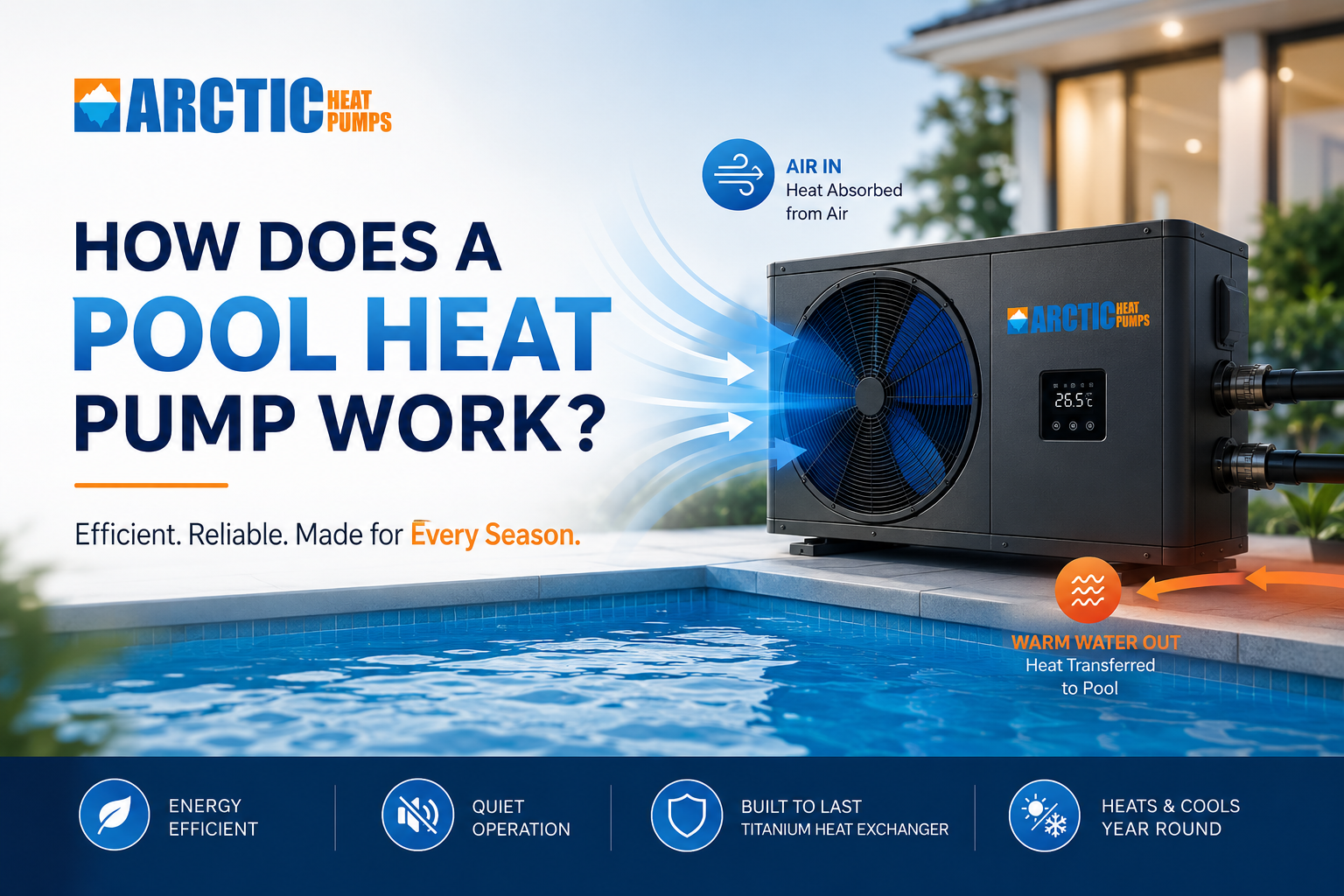
A pool heat pump is the most energy-efficient way to heat a swimming pool, but unlike a gas or electric heater, it doesn’t actually make heat. It moves it. Using the same proven refrigeration technology found in your refrigerator or air conditioner, a pool heat pump captures warmth that already exists in the outside air and transfers it into your pool water, delivering several units of heat for every single unit of electricity it consumes.
That simple difference is why heat pump owners routinely cut their pool-heating costs by 50% or more compared to traditional heaters. In this article, I will explain exactly how does a pool heat pump work, walk you through the full process from installation to maintenance, and show you how to choose the right heat pump.
What Is a Pool Heat Pump?
A pool heat pump is an electrically powered device that heats (and, in many modern units, cools) swimming pool and spa water by transferring heat from the surrounding air into the water. It does not burn fuel and does not use electric resistance elements as its primary heat source. Instead, electricity simply powers a fan, a compressor, and a circulation system that relocates free heat from the air.
If you already own an air conditioner, a dehumidifier, or a refrigerator, you already own a heat pump. They all rely on the same sealed refrigerant-compression cycle to move heat from one place to another. A pool heat pump is purpose-built to do this for recreational water: in-ground pools, above-ground pools, spas, hot tubs, and swim spas.
This is fundamentally different from a gas heater, which produces heat by combustion, or an electric resistance heater, which converts electricity directly into heat at roughly a one-to-one ratio. Because a heat pump moves heat rather than generating it, it can deliver three to six units of heat energy for every unit of electrical energy it draws, an efficiency no combustion or resistance heater can approach.
Benefits of Using a Heat Pump for Pool Heating
Before we know how heat pumps work, let’s see why you should consider using heat pumps for your pool heating.
Useful All Year Round
Because a quality cold-climate heat pump keeps working even when the air is near or below freezing, it dramatically extends your usable swimming season, opening earlier in spring and staying warm later into fall.
In milder climates, that can mean year-round swimming. A unit with intelligent defrost technology will automatically manage frost on the coil in cold weather so heating stays consistent.
Cools Your Pool
Many modern heat pumps are reversible. By running the refrigeration cycle in the opposite direction, the unit pulls heat out of the pool water and releases it to the air, chilling an over-warm pool during a heat wave.
This is a genuine comfort and water-quality advantage: pool water that gets too hot encourages algae growth and throws off chemical balance, costing you more in treatment. Inverter pool heat pumps with dual-zone capability can even heat a hot tub while cooling the pool at the same time.
Saves Energy
It is one of the biggest benefits because a heat pump moves heat rather than burning fuel; it can cut heating costs by 50–80% compared with gas or propane heaters.
The U.S. Department of Energy notes that running an average heat pump year-round can save hundreds of dollars annually versus conventional heating, and inverter-driven models push savings even higher by ramping output up and down to match demand instead of cycling fully on and off.
Long Lifespan and Durability
Because it transfers heat instead of generating it through combustion, a heat pump runs under far less internal stress than a gas heater.
Heat pumps commonly last 10–20 years, compared with roughly 5–10 years for a typical gas heater. Models built with a titanium heat exchanger resist corrosion from chlorine and salt, making them ideal for saltwater pools and extending service life further.
Environmentally Friendly
A heat pump produces no on-site combustion and no carbon monoxide. Paired with a clean electricity supply or rooftop solar, it can heat your pool with a very low carbon footprint. Newer units also use R32 refrigerant, which has a lower global-warming potential than older refrigerants.
Quietly Operates
Inverter compressors and brushless DC fan motors allow premium units to run noticeably quieter than older single-stage pumps, an underrated benefit when the equipment sits near a patio or a neighbor’s property line.
Works With Every Pool Type
Heat pumps are made for in-ground and above-ground pools alike. For an above-ground pool, a compact heat pump is usually the simplest and most cost-effective option; it connects to the same circulation line as an in-ground system. Whatever the pool, correct sizing (covered below) matters more than the pool’s construction type.
How Does a Pool Heat Pump Work?
At its core, a pool heat pump runs a continuous four-stage refrigeration cycle. The “magic” is that even cool-feeling outdoor air contains usable heat energy, and the refrigerant inside the unit boils at such a low temperature that it can absorb that heat readily. Here is the full process, stage by stage.
Understanding The Four Key Components
Every pool heat pump relies on four main parts working in a closed loop:
- Evaporator Coil: A finned coil on the outside of the unit where refrigerant absorbs heat from the air.
- Compressor: The heart of the system; it compresses the refrigerant gas, dramatically raising its temperature and pressure.
- Condenser/Heat Exchanger: Where the hot refrigerant gives up its heat to the pool water flowing through.
- Expansion Valve: A metering device that drops the refrigerant’s pressure, cooling it sharply so the cycle can begin again.
A fan and the refrigerant (modern units use environmentally friendly R32) complete the system, while your existing pool pump pushes water through the heat exchanger.
The Heating Cycle, Step by Step
If you understand its four key components, this is how does a pool heat pump work.
- Air Intake. A fan draws outside air, warmed by the sun, even on cool days, across the evaporator coil.
- Heat Absorption. Cold liquid refrigerant inside the evaporator absorbs heat from that air and evaporates into a low-temperature gas.
- Compression. The gas passes into the compressor, which squeezes it to high pressure. Compression concentrates the heat, and the refrigerant’s temperature climbs sharply, often above 200 °F (93 °C).
- Heat Transfer to Water. The very hot gas flows into the heat exchanger (condenser). Meanwhile, your pool pump circulates pool water, already filtered, through the other side of the exchanger. Heat passes from the refrigerant into the water, typically raising it 3–5 °F (about 2–3 °C) on each pass before the warmer water returns to the pool.
- Condensation and Reset. Having surrendered its heat, the refrigerant condenses back into a liquid, flows through the expansion valve where its pressure and temperature drop, and returns to the evaporator to repeat the cycle.
Because the water is warmed only a few degrees per pass and recirculated continuously, a heat pump heats gradually, usually raising the whole pool by about 1–3 °F per hour depending on pool size and unit output. That steady, low-effort approach is exactly what makes it so efficient at maintaining temperature over a long season.
Installation and Maintenance Process
The pool heat pump installation and maintenance process is quite easy. Just follow the method, and you can use a top-quality pool heat pump for a long time.
How a Pool Heat Pump Is Installed
Adding a heat pump to an existing pool is more straightforward than most owners expect. The unit is plumbed into the circulation system after the pool filter (and, where a chlorinator or salt cell is used, before that device, so corrosive treated water doesn’t sit in the exchanger). The typical installation involves:
- A Level Base
Pour a small concrete pad or set a manufactured base so the unit sits level with adequate airflow clearance on all sides, usually a couple of feet of open space around the coil and unobstructed air above.
- Plumbing Connection
Connect the unit to the return line after the filter using rigid PVC, and install a bypass valve assembly. The bypass lets you fine-tune water flow through the heat pump and isolate it for service without shutting down the pool.
- Electrical Supply
A heat pump needs a dedicated circuit, commonly a 50–60-amp breaker, wired and grounded by a licensed electrician to meet local code.
- Startup
Fill and prime the system, purge air from the lines, set your target temperature on the controller, and let the unit begin its gradual heating cycle.
If you’re replacing an existing gas or propane heater, installation is even simpler because the plumbing and pad are often already in place.
Maintenance Process
One of the quiet advantages of a heat pump is how little upkeep it needs. A short, consistent maintenance routine keeps it running at peak COP for years:
- Maintain water flow. Low flow is the most common cause of heat pump problems, and it’s almost always a dirty filter. Keep your pool filter clean and check skimmer and pump baskets so the unit gets the circulation it needs.
- Keep the coil clear. The evaporator coil can collect leaves, grass clippings, and dust pulled in with the air. Periodically power down the unit and gently clear debris; hose the coil if it looks dirty.
- Check connections. Inspect plumbing fittings and electrical connections for leaks or wear. Note that water around the base is often harmless condensation rather than a leak.
- Watch the controller. Modern units display fault codes and performance data; a WiFi controller lets you monitor temperature and catch issues from your phone.
- Book an annual check. A yearly professional inspection catches small faults early and protects the unit’s lifespan.
Maintenance in Winter
If you close your pool for winter, drain the water from the heat pump using its drain plug to prevent freeze damage inside the heat exchanger, and fit a winter cover to protect the casing from snow and debris. Units with built-in anti-freeze protection add another layer of safety in cold storage.
How to Select a High-Quality Heat Pump Pool Heater
Choosing the best heat pump for your swimming pool comes down to matching the unit’s size, efficiency, and features to your pool and climate.
Size
An undersized unit will struggle to reach temperature; an oversized one costs more than necessary. Size is driven by your pool’s surface area and the temperature rise you need (your target temperature minus the average air temperature in the coldest month you’ll swim). Wind exposure, humidity, and cool nights all increase the load; windy, dry, low-humidity sites need more capacity.
The U.S. Department of Energy’s quick formula for an outdoor pool is:
Pool surface area (sq ft) × temperature rise (°F) × 12 = required BTU/hr output
As a fast reference by pool volume:
| Pool Volume | Suggested Minimum Heat Output |
|---|---|
| Up to 10,000 gallons | 60,000 BTU |
| Up to 15,000 gallons | 90,000 BTU |
| Up to 20,000 gallons (average pool) | 120,000 BTU |
| 25,000 gallons or more | 140,000 BTU+ |
These figures assume a roughly 1–1.25 °F rise per hour. A pool cover is the single best companion to any heat pump; it cuts overnight heat loss dramatically, letting a smaller unit keep up and slashing running costs. Because the variables add up, it’s worth running your numbers through a dedicated pool sizing tool rather than guessing.
Efficiency
Compare units on COP; higher is better, and prioritize inverter-driven models. A DC inverter compressor varies its speed to match the exact heating demand, instead of switching fully on and off like a single- or two-stage unit.
It delivers higher real-world efficiency (often around 50% better than fixed-speed pumps), steadier water temperature, and much quieter operation. Brushless DC fan motors add further efficiency and noise reduction.
Cold-Climate Capability
If you live anywhere with cool shoulder seasons, the single most important spec is the unit’s low-ambient operating range. Seasonal pumps that quit at 50 °F give you a short season. A cold-climate-rated unit that operates well below freezing, Arctic’s run to –20 °C (–4 °F) — is what actually extends your swimming months, with an automatic backup option for the coldest spells.
Check Features
When comparing the best heat pump swimming pool options, look for:
- DC inverter compressor for efficiency and quiet running
- Titanium (ideally spiral) heat exchanger for corrosion resistance and saltwater compatibility
- Cold-climate rating with intelligent defrost
- Reversible heat/chill, and dual-zone control if you run a pool and spa
- Environmentally friendly R32 refrigerant
- A smart WiFi controller for remote monitoring
- A strong warranty
Costs
A pool heat pump typically costs more to buy than a gas heater but far less to run, so the lifetime cost usually favors the heat pump, often paying back the difference within a few seasons.
Budget for three things: the unit itself, installation (electrical plus plumbing), and ongoing electricity. Because running costs are where heat pumps win, the efficiency of the unit you choose directly determines your long-term savings. Check for local rebates and incentives, which are increasingly available for efficient electric heating.
To Conclude
Did you get your answer to ” How Does a Pool Heat Pump Work? A pool heat pump works by capturing free heat from the air and concentrating it into your pool water through a simple, durable refrigeration cycle, delivering several units of heat for every unit of electricity.
The payoff is a longer swimming season, dramatically lower running costs, optional summer cooling, and a unit that can last two decades. To get all of that, choose a properly sized, high-COP inverter unit, and if you swim in a cold climate, insist on a cold-climate-rated model.
If you are ready to find the right fit for your pool, use Arctic’s pool heat pump sizing tool for a custom recommendation, or explore the full range of Arctic Heat Pumps, DC inverter units that heat to 104 °F, cool on demand, and run efficiently down to –20 °C.
Frequently Asked Questions
How does a swimming pool heat pump work in simple terms?
It uses a fan to pull in outside air, extracts the heat from that air using a refrigerant, compresses that heat to a high temperature, and transfers it into your pool water through a heat exchanger, then repeats. It moves existing heat rather than creating it, which is why it’s so efficient.
Does a pool heat pump work in cold weather?
Standard units lose efficiency below about 45–50 °F and may shut off. Cold-climate inverter models are specifically engineered to keep heating in freezing conditions, down to –20 °C (–4 °F) on the best units, making them suitable for northern climates and winter hot-tub use.
How long does a pool heat pump take to heat a pool?
Heat pumps heat gradually, typically raising water temperature about 1–3 °F per hour depending on pool size and unit output. Using a pool cover to hold heat overnight significantly shortens the time to reach and maintain your target temperature.
Can a pool heat pump cool my pool?
Yes, reversible models run the cycle backward to chill an over-warm pool, which also helps prevent algae growth and chemical imbalance during heat waves. Dual-zone units can heat a spa and cool a pool simultaneously.
Can I use a heat pump on an above-ground pool?
Absolutely. Compact heat pumps are an excellent, cost-effective match for above-ground pools and connect to the same circulation line as in-ground systems. Sizing it correctly for your water volume is what matters most.
Will a heat pump work with a saltwater pool?
Yes, provided it has a titanium heat exchanger. Titanium resists corrosion from salt and chlorine, making it the right choice for saltwater pools and spas.
What size pool heat pump do I need?
Size depends on your pool’s surface area, the temperature rise you want, and local conditions like wind and humidity. Use the DOE formula (area × temperature rise × 12 = BTU/hr) or a dedicated sizing calculator, and round up for windy or exposed sites.
Is a pool heat pump cheaper to run than gas?
Significantly. With a COP of 5–6, a heat pump delivers several dollars of heat per dollar of electricity, while gas heaters deliver less heat than the fuel they burn. Most owners cut heating costs by 50–80%.