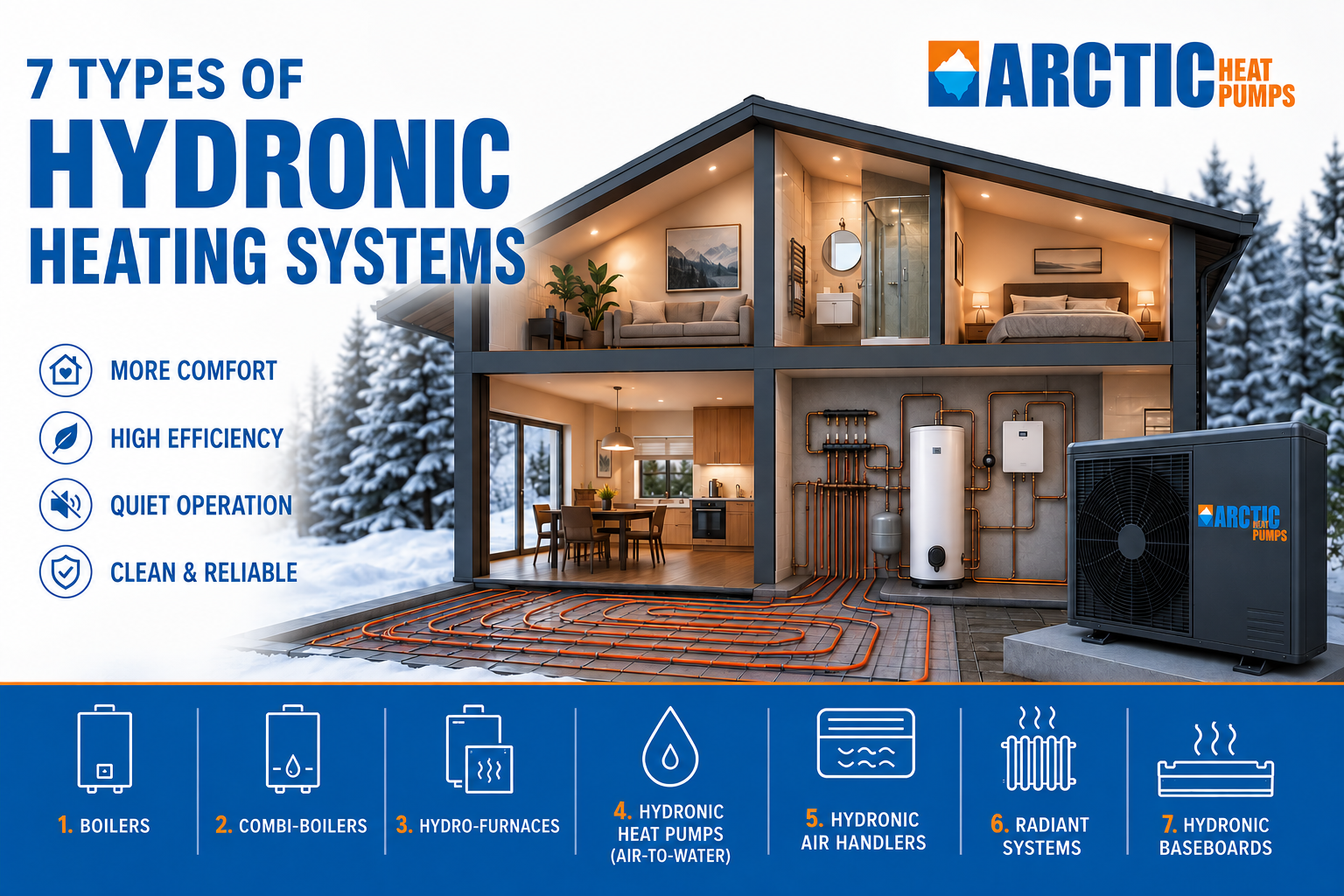
Hydronic heating uses water, not air, to carry warmth through your home, and it’s one of the most efficient, comfortable, and quiet ways to heat a building. But “hydronic” isn’t a single product; it’s a family of systems, each pairing a way to heat water with a way to deliver that heat into your rooms.
Understanding the different types of hydronic heating systems is the key to choosing the right setup for your home, climate, and budget. In this article, I will explain what a hydronic heating system is, its types, show how they work and why they’re so efficient, and point you to a free design service that will help you build one according to your needs.
What Is a Hydronic Heating System?
A hydronic heating system is any system that uses heated water (or a water-and-antifreeze mix) as the medium to transfer heat throughout a building. A heat source warms the water, a circulator pump moves it through a closed loop of piping, and heat emitters release that warmth into your living space, then the cooled water returns to be reheated, cycling continuously.
Because water carries far more heat per unit volume than air, hydronic systems move energy efficiently and deliver steady, even comfort without the drafts and dust of forced-air heating. The same water-based approach can also distribute cooling (chilled water) in many modern systems.
Every hydronic system shares a few core components:
- A heat source: A boiler, heat pump, or water heater that warms the water.
- A circulator pump: It moves water through the loop (zones may use multiple pumps or zone valves).
- Piping: Usually flexible PEX or other tubing carrying water to and from the emitters.
- A manifold and thermostat: Direct flow and control temperature, often room by room.
- Heat emitters: Radiant floor tubing, radiators, baseboards, or air handlers that release the heat.
- An expansion tank and air elimination: Manage pressure and keep the loop air-free.
Some types of hydronic heating systems are heat sources, and others are distribution methods. The best systems deliberately pair an efficient source with a well-matched emitter, and the rest of this guide is organized to make that pairing clear.
7 Types of Hydronic Heating Systems You Need to Know
Here are the seven Hydronic heating systems homeowners encounter most. The first four are primarily heat sources; the last three are delivery methods that connect to one of those sources.
Boilers
The boiler is the classic heart of a hydronic system. A boiler hydronic heating system burns fuel, natural gas, propane, or oil, to heat water, which is then circulated through radiators, baseboards, radiant floor loops, or other emitters. Modern condensing boilers are remarkably efficient, reaching up to about 95% AFUE by capturing heat from their own exhaust gases that older units sent up the flue.
Boilers are durable, quiet, and well-suited to cold climates where they need to produce consistent heat regardless of outdoor temperature. They can also indirectly heat domestic hot water and even melt snow on driveways. Their main drawback is reliance on fossil fuels and their fluctuating price.
Combi-Boilers
A combi (combination) boiler does everything a standard boiler does and supplies on-demand domestic hot water for showers, faucets, and appliances, all from one compact, wall-hung unit. Instead of storing hot water in a separate tank, it heats water instantly as you need it.
Combi-boilers are popular in smaller homes and retrofits where space is tight, since they consolidate space heating and hot water into a single appliance. The trade-off is that very high simultaneous demand (several hot taps plus heating at once) can strain output, so they’re best matched to household size.
Hydro-Furnaces
A hydro-furnace is a hybrid that delivers hydronic warmth through forced-air ductwork. Fuel is burned in a sealed combustion heat exchanger, isolated from the airstream, to heat water, which then flows through a water-to-air coil inside the furnace cabinet. A blower passes household air across that coil and distributes the warmed air through ducts.
Because water (not a flame) heats the air, a hydro-furnace tends to be gentler on indoor humidity than a conventional furnace, reducing the need for add-on humidifiers. Many modern hydro-furnaces are also dual-fuel compatible, pairing with a heat pump so the system can run on electricity when efficient and switch to combustion in deep cold. They’re a natural fit for homes that already have ductwork.
Hydronic Heat Pumps (Air-to-Water)
A hydronic heat pump system, also called an air-to-water heat pump, is the most efficient and versatile modern heat source. Rather than burning fuel, it extracts heat from the outdoor air using a refrigerant, compresses that heat to a higher temperature, and transfers it to the water loop through a heat exchanger. Because it moves heat rather than creating it, a hydronic heat pump can deliver several units of heat for every unit of electricity it uses.
The standout advantages are that it runs on clean electricity, it can reverse to provide chilled water for cooling in summer, and a single unit can feed radiant floors, fan coils, low-temperature radiators, domestic hot water, and even a pool. Cold-climate models using enhanced vapor injection (EVI) inverter compressors keep working efficiently far below freezing. Arctic air-to-water units operate down to −35 °C (−31 °F), which makes a hydronic heat pump a true year-round heating and cooling solution, often at roughly half the installed cost of geothermal.
Hydronic Air Handlers
A hydronic air handler is a delivery method that turns hot water into warm forced air. It works with a boiler, heat pump, or water heater. Heated water circulates through a water-to-air coil inside the air handler, and a fan blows household air across the coil, sending warmed air through ductwork to each room. Run chilled water through the same coil, and it provides air conditioning.
Hydronic air handlers are ideal when you want the even, efficient heat of a water-based source but prefer (or already have) ducted distribution, and the same ducts can handle both heating and cooling. Units engineered for low water temperatures pair especially well with heat pumps. They’re frequently combined with radiant floors in a single home radiant on the main level, air handlers for upper floors, or zones that also need cooling.
Hydronic Radiant Floor Heating
Hydronic radiant floor heating circulates warm water through PEX tubing embedded in or beneath the floor, gently warming the room from the ground up. It’s widely considered the most comfortable and efficient way to distribute hydronic heat. It warms objects and people directly rather than blowing hot air, eliminates duct losses, and lets you feel comfortable at a lower thermostat setting.
It runs at low water temperatures (often 85–120 °F), which is exactly the range where heat pumps and condensing boilers operate most efficiently, making radiant floors and air-to-water heat pumps a near-perfect match. “Wet” installs embed tubing in a concrete slab (great thermal mass); “dry” installs run tubing in panels above or below the subfloor for faster response. The main consideration is installation cost and complexity, so it’s easiest to include in new builds or major renovations.
Hydronic Baseboards and Radiators
The most traditional emitters, hydronic baseboards and radiators, circulate hot water through finned baseboard units or panel/column radiators placed around the room, usually along exterior walls or under windows. Heat radiates and convects into space, and because the same water recirculates continuously, a hydronic baseboard is far more efficient than an electric baseboard.
Modern panel radiators and thermostatic radiator valves allow precise, room-by-room control, heating only the spaces you’re using. Radiators typically run hotter (around 120–180 °F) than radiant floors, so they pair naturally with boilers, though low-temperature radiator designs now exist specifically to work with heat pumps. (Solar thermal collectors can also feed any of these systems as a supplemental, renewable heat source.)
How Do Hydronic Heating Systems Work?
Every hydronic system runs the same basic cycle, regardless of type. First, the heat source raises the water temperature by combustion (boiler, hydro-furnace), by moving heat from the air (heat pump), or by another water heater.
Next, a circulator pump pushes the heated water through a closed loop of insulated piping. As the water reaches the emitters, radiant tubing, radiators, baseboards, or an air-handler coil, it releases its heat into the room through radiation, convection, or forced air. The now-cooler water returns through the loop to the heat source to be reheated, and the cycle repeats.
Control is what makes it efficient. A thermostat (often one per zone) tells the system when to circulate water, and zone valves or multiple pumps direct heat only where it’s needed, so you’re not warming empty rooms.
A manifold distributes flow among multiple loops, an expansion tank absorbs pressure changes as water heats and cools, and air-elimination devices keep the loop free of air bubbles that would cause noise and corrosion. Proper balancing, setting the right flow to each emitter, ensures every room heats evenly.
The efficiency payoff comes from two facts. Water transfers heat far better than air, and the lower the water temperature an emitter needs, the more efficient the heat source can be. That’s why pairing a low-temperature emitter (like a radiant floor) with a modern source (like a heat pump or condensing boiler) produces the best results.
Benefits of Hydronic Heating Systems
7 benefits you will get from using high-quality Hydronic heating systems.
- Superior, even comfort. Hydronic heat warms rooms steadily from surfaces rather than blasting hot air, eliminating the hot-and-cold swings and cold spots common with forced air. Radiant floors in particular deliver gentle, uniform warmth right where you feel it.
- High energy efficiency. Water is a far more effective heat-transfer medium than air, and water-based systems avoid the duct losses that plague forced-air heating. Paired with a condensing boiler or heat pump, a well-designed hydronic system is among the most efficient ways to heat a home, and lower water temperatures mean lower running costs.
- Quiet operation. With no furnace roaring and blowing air through ducts, hydronic systems run almost silently, just the soft, unobtrusive movement of water.
- Cleaner indoor air. Because the heat travels through sealed pipes instead of being blown around the house, hydronic heating doesn’t circulate dust, pollen, and allergens the way forced-air systems do. This makes it a favorite for people with allergies, asthma, or respiratory sensitivities. It also doesn’t dry out the air.
- Precise zoning. Hydronic systems make it easy to control temperature room by room or zone by zone, so you heat occupied spaces and save energy elsewhere.
- Flexibility and longevity. A single hydronic loop can combine radiant floors, radiators, air handlers, and domestic hot water, fed by your choice of heat source, and with cooling capability in many modern designs. Components like boilers and PEX tubing are durable and long-lived. The system can also grow and adapt as your needs change.
- A clear path to electrification. Because hydronic distribution works beautifully at low water temperatures, it’s the ideal partner for an air-to-water heat pump, letting you heat (and cool) your whole home efficiently on electricity, with an optional backup for the coldest days.
Get a Free Hydronic Heating Design Service with Arctic Heat Pumps
Designing a hydronic system correctly is what separates a comfortable, efficient home from cold spots and wasted money, and it’s where many DIY and contractor projects struggle. Arctic Heat Pumps removes that hurdle with a free hydronic heating design service for both new construction and retrofits.
Our team handles the entire design process, including:
- Heat Load Calculation: Determining the exact BTUs your home needs on the coldest day, so the system is sized right (no expensive oversizing, no underperforming undersizing).
- Radiant Loop CAD Layout: State-of-the-art software optimizes tubing layouts for concrete, subfloor, or panels to eliminate cold spots.
- Pump Sizing: Simulation software calculates the correctly sized circulator pump to ensure performance while minimizing operating cost.
- Complete Integrated Package: Everything from the air-to-water heat pump to PEX piping, manifolds, valves, and the electrical wiring table, supplied as one coordinated kit.
- Free Control Logic: Pre-built control programming delivered on an SD card for the Resol MX controller, so the system can be set up to perform correctly the first time, with no programming required.
- Free Remote Monitoring: Free access to the vbus.net platform to view and compare your system’s performance from any phone, tablet, or computer.
If you’re planning a hydronic project and want it designed right, without added engineering fees, Arctic’s free hydronic heating design service is a genuine head start. Pair it with their cold-climate air-to-water heat pumps, and you have a complete, efficient, all-electric heating and cooling solution.
Finishing With
A hydronic heating system is really a partnership between a heat source and a delivery method, joined by water. Boilers, combi-boilers, hydro-furnaces, and hydronic heat pumps make the hot water; air handlers, radiant floors, and radiators deliver it, and the most efficient, comfortable homes deliberately match the two.
Whatever combination fits your home, hydronic heating rewards you with even warmth, quiet operation, cleaner air, and excellent efficiency. If you’re ready to plan a system, start with a proper design. Contact Arctic Heat Pumps to build an efficient, all-electric hydronic system customized to your home and climate.
Frequently Asked Questions
What are the main types of hydronic heating systems?
The most common are boilers, combi-boilers, hydro-furnaces, and hydronic (air-to-water) heat pumps as heat sources, and hydronic air handlers, radiant floor heating, and baseboards/radiators as distribution methods. The best systems pair an efficient source with a well-matched emitter.
What is a hydronic heat pump?
A hydronic heat pump (air-to-water heat pump) extracts heat from outdoor air and transfers it to a water loop instead of burning fuel. It’s highly efficient, runs on electricity, can also provide cooling with chilled water, and can feed radiant floors, fan coils, radiators, and domestic hot water from one unit.
Is hydronic radiant floor heating efficient?
Yes, it’s one of the most efficient distribution methods because it warms people and objects directly, has no duct losses, and runs at low water temperatures where heat pumps and condensing boilers are most efficient. It also delivers exceptionally even, comfortable heat.
Can a hydronic system also cool my home?
Many can. Hydronic heat pumps reverse to produce chilled water, which can run through air handlers or compatible radiant systems to provide efficient cooling, giving you heating and air conditioning from one water-based system.
Are hydronic heating systems good for allergies?
Generally, yes. Because heat travels through sealed pipes rather than being blown through the home, radiant and radiator-based hydronic systems don’t circulate dust and allergens the way forced-air heating does, and they don’t dry the air.
Which heat source is best for a hydronic system?
It depends on fuel prices and climate, but for efficiency and flexibility, an air-to-water heat pump is often the best choice, especially paired with low-temperature emitters like radiant floors. In very cold regions, a cold-climate heat pump with backup, or a dual-fuel hydro-furnace, provides reliability.