Comprehensive Guide on How Does a Pool Heat Pump Work

How Does a Pool Heat Pump Work

A pool heat pump is the most energy-efficient way to heat a swimming pool, but unlike a gas or electric heater, it doesn’t actually make heat. It moves it. Using the same proven refrigeration technology found in your refrigerator or air conditioner, a pool heat pump captures warmth that already exists in the outside air and transfers it into your pool water, delivering several units of heat for every single unit of electricity it consumes.

That simple difference is why heat pump owners routinely cut their pool-heating costs by 50% or more compared to traditional heaters. In this article, I will explain exactly how does a pool heat pump work, walk you through the full process from installation to maintenance, and show you how to choose the right heat pump.

What Is a Pool Heat Pump?

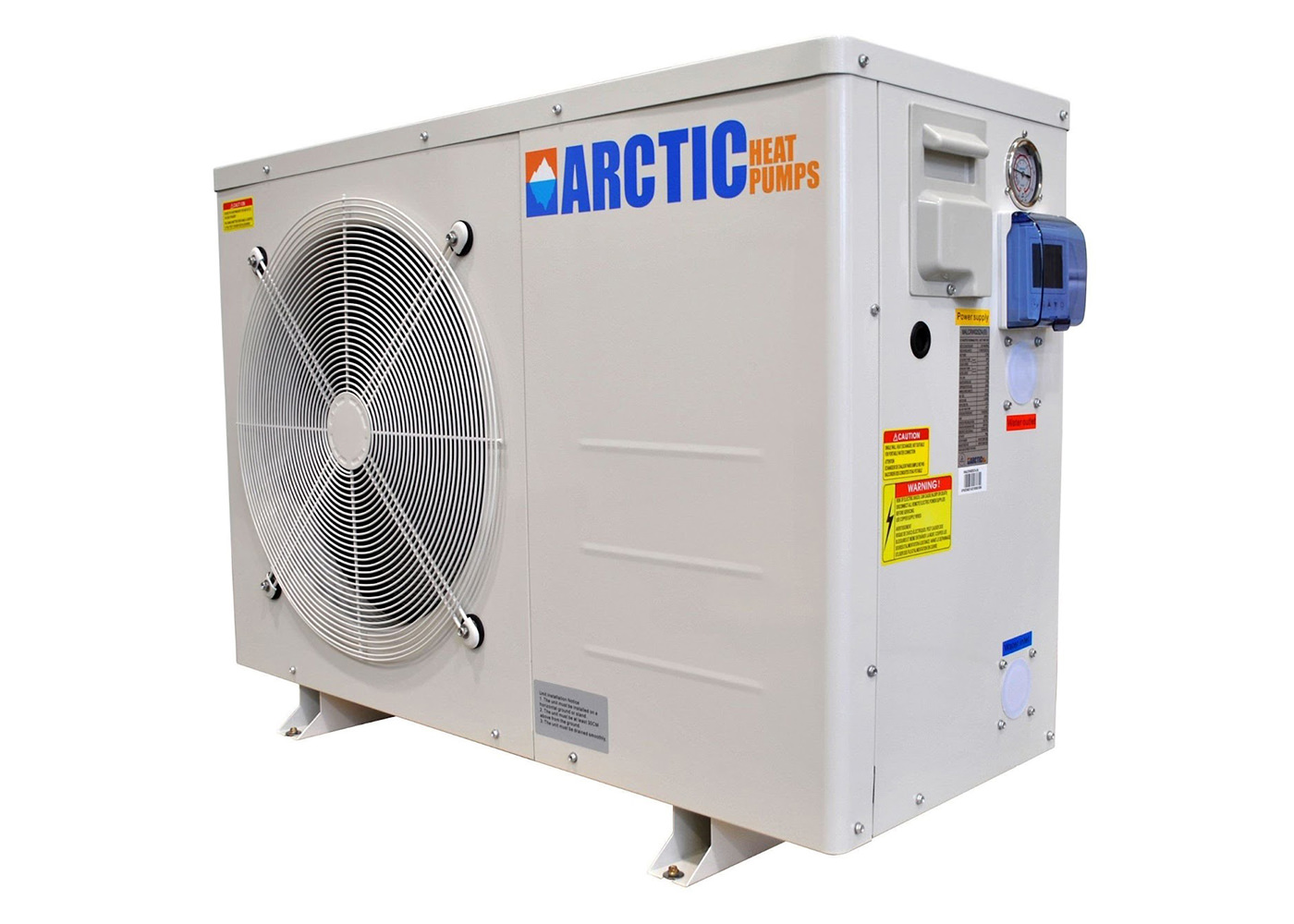
A pool heat pump is an electrically powered device that heats (and, in many modern units, cools) swimming pool and spa water by transferring heat from the surrounding air into the water. It does not burn fuel and does not use electric resistance elements as its primary heat source. Instead, electricity simply powers a fan, a compressor, and a circulation system that relocates free heat from the air.

If you already own an air conditioner, a dehumidifier, or a refrigerator, you already own a heat pump. They all rely on the same sealed refrigerant-compression cycle to move heat from one place to another. A pool heat pump is purpose-built to do this for recreational water: in-ground pools, above-ground pools, spas, hot tubs, and swim spas.

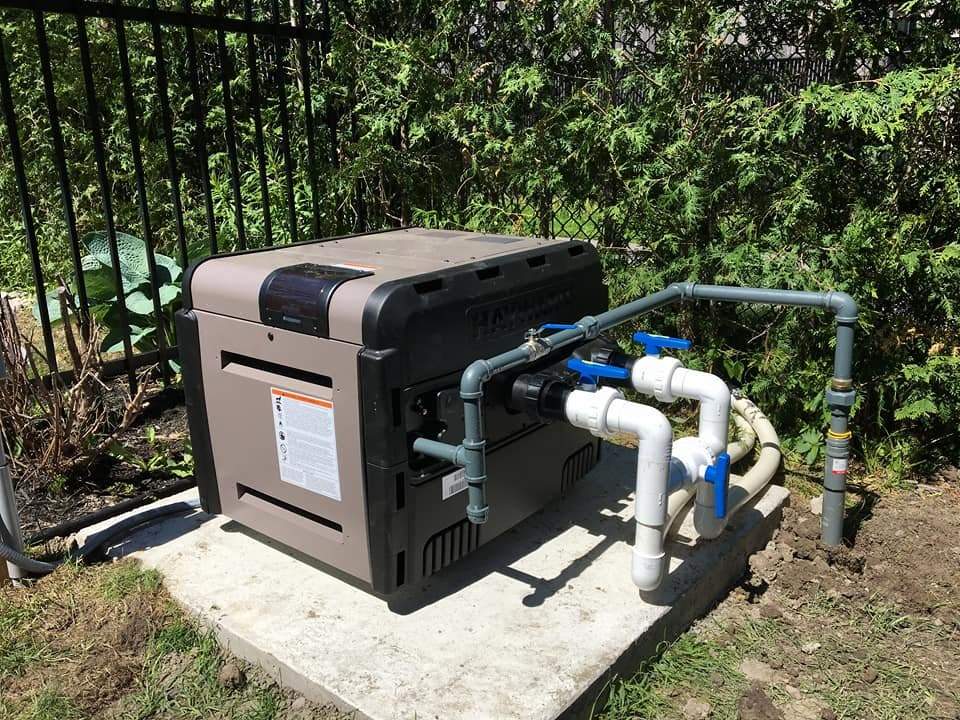
This is fundamentally different from a gas heater, which produces heat by combustion, or an electric resistance heater, which converts electricity directly into heat at roughly a one-to-one ratio. Because a heat pump moves heat rather than generating it, it can deliver three to six units of heat energy for every unit of electrical energy it draws, an efficiency no combustion or resistance heater can approach.

Benefits of Using a Heat Pump for Pool Heating

Before we know how heat pumps work, let’s see why you should consider using heat pumps for your pool heating.

Useful All Year Round

Because a quality cold-climate heat pump keeps working even when the air is near or below freezing, it dramatically extends your usable swimming season, opening earlier in spring and staying warm later into fall. 

In milder climates, that can mean year-round swimming. A unit with intelligent defrost technology will automatically manage frost on the coil in cold weather so heating stays consistent.

Cools Your Pool

Many modern heat pumps are reversible. By running the refrigeration cycle in the opposite direction, the unit pulls heat out of the pool water and releases it to the air, chilling an over-warm pool during a heat wave.

This is a genuine comfort and water-quality advantage: pool water that gets too hot encourages algae growth and throws off chemical balance, costing you more in treatment. Inverter pool heat pumps with dual-zone capability can even heat a hot tub while cooling the pool at the same time.

Saves Energy

It is one of the biggest benefits because a heat pump moves heat rather than burning fuel; it can cut heating costs by 50–80% compared with gas or propane heaters.

The U.S. Department of Energy notes that running an average heat pump year-round can save hundreds of dollars annually versus conventional heating, and inverter-driven models push savings even higher by ramping output up and down to match demand instead of cycling fully on and off.

Long Lifespan and Durability

Because it transfers heat instead of generating it through combustion, a heat pump runs under far less internal stress than a gas heater.

Heat pumps commonly last 10–20 years, compared with roughly 5–10 years for a typical gas heater. Models built with a titanium heat exchanger resist corrosion from chlorine and salt, making them ideal for saltwater pools and extending service life further.

Environmentally Friendly

A heat pump produces no on-site combustion and no carbon monoxide. Paired with a clean electricity supply or rooftop solar, it can heat your pool with a very low carbon footprint. Newer units also use R32 refrigerant, which has a lower global-warming potential than older refrigerants.

Quietly Operates

Inverter compressors and brushless DC fan motors allow premium units to run noticeably quieter than older single-stage pumps, an underrated benefit when the equipment sits near a patio or a neighbor’s property line.

Works With Every Pool Type

Heat pumps are made for in-ground and above-ground pools alike. For an above-ground pool, a compact heat pump is usually the simplest and most cost-effective option; it connects to the same circulation line as an in-ground system. Whatever the pool, correct sizing (covered below) matters more than the pool’s construction type.

How Does a Pool Heat Pump Work?

At its core, a pool heat pump runs a continuous four-stage refrigeration cycle. The “magic” is that even cool-feeling outdoor air contains usable heat energy, and the refrigerant inside the unit boils at such a low temperature that it can absorb that heat readily. Here is the full process, stage by stage.

Understanding The Four Key Components

Every pool heat pump relies on four main parts working in a closed loop:

  • Evaporator Coil: A finned coil on the outside of the unit where refrigerant absorbs heat from the air.
  • Compressor: The heart of the system; it compresses the refrigerant gas, dramatically raising its temperature and pressure.
  • Condenser/Heat Exchanger: Where the hot refrigerant gives up its heat to the pool water flowing through.
  • Expansion Valve: A metering device that drops the refrigerant’s pressure, cooling it sharply so the cycle can begin again.

A fan and the refrigerant (modern units use environmentally friendly R32) complete the system, while your existing pool pump pushes water through the heat exchanger.

The Heating Cycle, Step by Step

If you understand its four key components, this is how does a pool heat pump work.

  • Air Intake. A fan draws outside air, warmed by the sun, even on cool days, across the evaporator coil.
  • Heat Absorption. Cold liquid refrigerant inside the evaporator absorbs heat from that air and evaporates into a low-temperature gas.
  • Compression. The gas passes into the compressor, which squeezes it to high pressure. Compression concentrates the heat, and the refrigerant’s temperature climbs sharply, often above 200 °F (93 °C).
  • Heat Transfer to Water. The very hot gas flows into the heat exchanger (condenser). Meanwhile, your pool pump circulates pool water, already filtered, through the other side of the exchanger. Heat passes from the refrigerant into the water, typically raising it 3–5 °F (about 2–3 °C) on each pass before the warmer water returns to the pool.
  • Condensation and Reset. Having surrendered its heat, the refrigerant condenses back into a liquid, flows through the expansion valve where its pressure and temperature drop, and returns to the evaporator to repeat the cycle.

Because the water is warmed only a few degrees per pass and recirculated continuously, a heat pump heats gradually, usually raising the whole pool by about 1–3 °F per hour depending on pool size and unit output. That steady, low-effort approach is exactly what makes it so efficient at maintaining temperature over a long season.

Installation and Maintenance Process

The pool heat pump installation and maintenance process is quite easy. Just follow the method, and you can use a top-quality pool heat pump for a long time.

How a Pool Heat Pump Is Installed

Adding a heat pump to an existing pool is more straightforward than most owners expect. The unit is plumbed into the circulation system after the pool filter (and, where a chlorinator or salt cell is used, before that device, so corrosive treated water doesn’t sit in the exchanger). The typical installation involves:

  • A Level Base 

Pour a small concrete pad or set a manufactured base so the unit sits level with adequate airflow clearance on all sides, usually a couple of feet of open space around the coil and unobstructed air above.

  • Plumbing Connection 

Connect the unit to the return line after the filter using rigid PVC, and install a bypass valve assembly. The bypass lets you fine-tune water flow through the heat pump and isolate it for service without shutting down the pool.

  • Electrical Supply

A heat pump needs a dedicated circuit, commonly a 50–60-amp breaker, wired and grounded by a licensed electrician to meet local code.

  • Startup 

Fill and prime the system, purge air from the lines, set your target temperature on the controller, and let the unit begin its gradual heating cycle.

If you’re replacing an existing gas or propane heater, installation is even simpler because the plumbing and pad are often already in place.

Maintenance Process

One of the quiet advantages of a heat pump is how little upkeep it needs. A short, consistent maintenance routine keeps it running at peak COP for years:

  • Maintain water flow. Low flow is the most common cause of heat pump problems, and it’s almost always a dirty filter. Keep your pool filter clean and check skimmer and pump baskets so the unit gets the circulation it needs.
  • Keep the coil clear. The evaporator coil can collect leaves, grass clippings, and dust pulled in with the air. Periodically power down the unit and gently clear debris; hose the coil if it looks dirty.
  • Check connections. Inspect plumbing fittings and electrical connections for leaks or wear. Note that water around the base is often harmless condensation rather than a leak.
  • Watch the controller. Modern units display fault codes and performance data; a WiFi controller lets you monitor temperature and catch issues from your phone.
  • Book an annual check. A yearly professional inspection catches small faults early and protects the unit’s lifespan.

Maintenance in Winter

If you close your pool for winter, drain the water from the heat pump using its drain plug to prevent freeze damage inside the heat exchanger, and fit a winter cover to protect the casing from snow and debris. Units with built-in anti-freeze protection add another layer of safety in cold storage.

How to Select a High-Quality Heat Pump Pool Heater

Choosing the best heat pump for your swimming pool comes down to matching the unit’s size, efficiency, and features to your pool and climate.

Size

An undersized unit will struggle to reach temperature; an oversized one costs more than necessary. Size is driven by your pool’s surface area and the temperature rise you need (your target temperature minus the average air temperature in the coldest month you’ll swim). Wind exposure, humidity, and cool nights all increase the load; windy, dry, low-humidity sites need more capacity.

The U.S. Department of Energy’s quick formula for an outdoor pool is:

Pool surface area (sq ft) × temperature rise (°F) × 12 = required BTU/hr output

As a fast reference by pool volume:

Pool VolumeSuggested Minimum Heat Output
Up to 10,000 gallons60,000 BTU
Up to 15,000 gallons90,000 BTU
Up to 20,000 gallons (average pool)120,000 BTU
25,000 gallons or more140,000 BTU+

These figures assume a roughly 1–1.25 °F rise per hour. A pool cover is the single best companion to any heat pump; it cuts overnight heat loss dramatically, letting a smaller unit keep up and slashing running costs. Because the variables add up, it’s worth running your numbers through a dedicated pool sizing tool rather than guessing.

Efficiency

Compare units on COP; higher is better, and prioritize inverter-driven models. A DC inverter compressor varies its speed to match the exact heating demand, instead of switching fully on and off like a single- or two-stage unit.

It delivers higher real-world efficiency (often around 50% better than fixed-speed pumps), steadier water temperature, and much quieter operation. Brushless DC fan motors add further efficiency and noise reduction.

Cold-Climate Capability

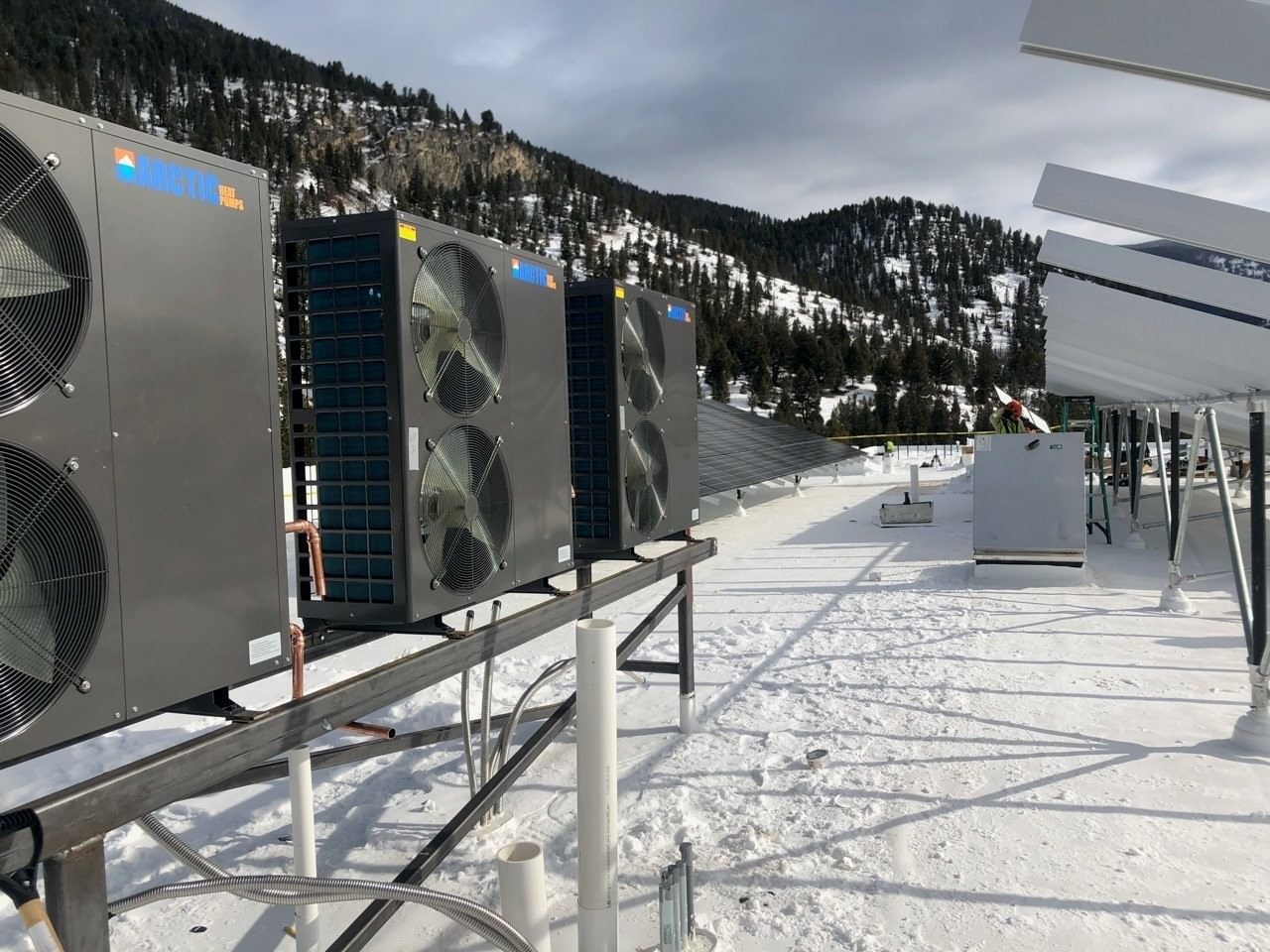
If you live anywhere with cool shoulder seasons, the single most important spec is the unit’s low-ambient operating range. Seasonal pumps that quit at 50 °F give you a short season. A cold-climate-rated unit that operates well below freezing, Arctic’s run to –20 °C (–4 °F) — is what actually extends your swimming months, with an automatic backup option for the coldest spells.

Check Features

When comparing the best heat pump swimming pool options, look for:

  • DC inverter compressor for efficiency and quiet running
  • Titanium (ideally spiral) heat exchanger for corrosion resistance and saltwater compatibility
  • Cold-climate rating with intelligent defrost
  • Reversible heat/chill, and dual-zone control if you run a pool and spa
  • Environmentally friendly R32 refrigerant
  • A smart WiFi controller for remote monitoring
  • A strong warranty

Costs

A pool heat pump typically costs more to buy than a gas heater but far less to run, so the lifetime cost usually favors the heat pump, often paying back the difference within a few seasons.

Budget for three things: the unit itself, installation (electrical plus plumbing), and ongoing electricity. Because running costs are where heat pumps win, the efficiency of the unit you choose directly determines your long-term savings. Check for local rebates and incentives, which are increasingly available for efficient electric heating.

To Conclude

Did you get your answer to ” How Does a Pool Heat Pump Work? A pool heat pump works by capturing free heat from the air and concentrating it into your pool water through a simple, durable refrigeration cycle, delivering several units of heat for every unit of electricity.

The payoff is a longer swimming season, dramatically lower running costs, optional summer cooling, and a unit that can last two decades. To get all of that, choose a properly sized, high-COP inverter unit, and if you swim in a cold climate, insist on a cold-climate-rated model.

If you are ready to find the right fit for your pool, use Arctic’s pool heat pump sizing tool for a custom recommendation, or explore the full range of Arctic Heat Pumps, DC inverter units that heat to 104 °F, cool on demand, and run efficiently down to –20 °C.

Frequently Asked Questions

It uses a fan to pull in outside air, extracts the heat from that air using a refrigerant, compresses that heat to a high temperature, and transfers it into your pool water through a heat exchanger, then repeats. It moves existing heat rather than creating it, which is why it’s so efficient.

Standard units lose efficiency below about 45–50 °F and may shut off. Cold-climate inverter models are specifically engineered to keep heating in freezing conditions, down to –20 °C (–4 °F) on the best units, making them suitable for northern climates and winter hot-tub use.

Heat pumps heat gradually, typically raising water temperature about 1–3 °F per hour depending on pool size and unit output. Using a pool cover to hold heat overnight significantly shortens the time to reach and maintain your target temperature.

Yes, reversible models run the cycle backward to chill an over-warm pool, which also helps prevent algae growth and chemical imbalance during heat waves. Dual-zone units can heat a spa and cool a pool simultaneously.

Absolutely. Compact heat pumps are an excellent, cost-effective match for above-ground pools and connect to the same circulation line as in-ground systems. Sizing it correctly for your water volume is what matters most.

Yes, provided it has a titanium heat exchanger. Titanium resists corrosion from salt and chlorine, making it the right choice for saltwater pools and spas.

Size depends on your pool’s surface area, the temperature rise you want, and local conditions like wind and humidity. Use the DOE formula (area × temperature rise × 12 = BTU/hr) or a dedicated sizing calculator, and round up for windy or exposed sites.

Significantly. With a COP of 5–6, a heat pump delivers several dollars of heat per dollar of electricity, while gas heaters deliver less heat than the fuel they burn. Most owners cut heating costs by 50–80%.

Heat Pump vs Tankless Water Heater: Real Cost & Savings Guide

Heat Pump vs Tankless Water Heater

When it comes time to replace an aging water heater, homeowners are faced with a dizzying array of options. The days of simply buying a standard 50-gallon electric resistance tank are over. Today, the conversation almost always boils down to a high-stakes heavyweight match: the heat pump vs tankless water heater.

Both technologies promise massive upgrades over traditional models, but they achieve their results through completely different scientific principles. One provides endless hot water on demand, while the other uses advanced refrigeration technology to heat water for pennies on the dollar. But as utility rates climb and homeowners look to future-proof their homes, the ultimate question remains: which system actually keeps more money in your wallet?

In this comprehensive guide, we are going to break down the engineering, the true installation costs, the hidden electrical panel upgrades, and the real-world efficiency of both systems to give you a definitive answer.

Quick Answer: The Bottom Line

If you are looking for the short answer, here it is: Heat pump water heaters save more money long-term due to their exponentially higher energy efficiency, while tankless systems offer instant, endless hot water but come with higher operating costs.

Because a heat pump moves existing heat rather than generating new heat, it operates at an astonishing 300% to 400% efficiency. Over a standard 10-to-15-year lifespan, the massive reduction in your monthly utility bill will mathematically outpace the savings of a tankless unit, making the heat pump the undisputed champion of long-term financial return.

How Does a Tankless Water Heater Work?

To understand the financial implications, you first have to understand the mechanics. A tankless water heater (often called an on-demand water heater) completely eliminates the traditional storage tank. Instead of keeping 50 gallons of water piping hot 24 hours a day, it only springs into action the exact second you turn on a hot water faucet.

When you open the tap, a flow sensor detects the movement of water. This triggers the heating element, either massive electric coils or a high-powered gas burner. Cold water flows into the unit, passes through a highly efficient heat exchanger, and exits the unit as hot water, traveling directly to your shower or sink.

The Benefits of On-Demand Heating

  • Zero Standby Heat Loss: Because there is no tank, you aren’t paying to keep water hot while you are sleeping or at work.
  • Endless Supply: As long as you have electricity or gas, you will never run out of hot water. You can fill a massive soaking tub and run the dishwasher simultaneously (if the unit is sized correctly).
  • Space Savings: These units are roughly the size of a suitcase and mount directly to the wall, freeing up valuable mechanical room space.

The Flow Rate Limitation

However, tankless systems are bound by the laws of physics and thermodynamics. Their performance is heavily dictated by flow rate (Gallons Per Minute or GPM) and the groundwater temperature in your specific climate. If you live in a northern climate where winter groundwater temperatures drop to 40°F (4°C), the tankless unit has to work incredibly hard to raise that water to 120°F (49°C) instantly. This drastically reduces the volume of hot water it can output per minute.

While efficient in short bursts, tankless systems consume more energy over time compared to heat pump systems. The sheer amount of instantaneous energy required to flash-heat freezing water is staggering, which directly impacts your utility bill.

How Does a Heat Pump Water Heater Work?

A heat pump water heater (often referred to as a hybrid water heater) operates on an entirely different plane of physics. Instead of creating heat through raw electrical resistance or burning fossil fuels, a heat pump acts like a refrigerator running in reverse.

The unit features a compressor, an evaporator coil, and a closed loop of eco-friendly refrigerant. A fan pulls in the ambient air surrounding the unit. The refrigerant absorbs the thermal energy from this air (even if the air feels relatively cool to you, it still contains extractable heat energy). The compressor then pressurizes the refrigerant, drastically raising its temperature. This super-heated gas is then pumped through a condenser coil that wraps around the water tank, transferring the heat directly into your water.

The Magic of Thermal Transfer

Because it is simply relocating heat from the air into the water, a heat pump can produce three to four units of heat for every one unit of electricity it consumes. Unlike tankless systems, heat pumps don’t generate heat, they move it. Making them far more energy-efficient.

Modern heat pump technology has evolved dramatically. While older models struggled in cooler basements, today’s advanced systems that utilize split-system architecture or cold-climate engineering can effectively extract heat and provide reliable domestic hot water even in highly demanding environments. For homeowners looking to decarbonize without sacrificing comfort, the heat pump is the pinnacle of modern HVAC engineering.

Are Tankless Water Heaters Good?

The short answer is yes; tankless water heaters are brilliant pieces of engineering. But being “good” does not mean being “good for everyone.”

Where Tankless Shines

Tankless heaters are exceptionally good for specific use cases. If you have a massive soaking tub that requires 80 gallons to fill, a traditional tank will run out halfway through. A tankless unit will fill it effortlessly. They are also phenomenal for very small homes, condos, or tight crawl spaces where a 60-inch tall tank simply cannot physically fit.

The Real-World Limitations

But the reality of living with a tankless heater comes with caveats that salespeople rarely mention:

  • The “Cold Water Sandwich”: If you turn the shower off to lather up and turn it back on, you will get a blast of hot water, followed by a shock of cold water (the water that passed through before the burner ignited), followed by hot water again.
  • Minimum Flow Rates: If you turn a faucet on to a slow trickle to shave or wash your hands, the flow sensor may not detect enough movement to ignite the burner, leaving you with cold water.
  • High Installation Costs: Retrofitting a house for tankless is rarely cheap. Gas units often require wider gas lines and specialized stainless steel venting. Electric units are notorious for requiring massive electrical upgrades, often needing three or four dedicated 40-amp breakers.

While tankless systems work well for certain use cases, they may not be the most cost-effective long-term solution.

Looking for an energy-efficient solution? Explore cold-climate heat pump systems designed for maximum long-term savings, providing reliable hot water and home heating even in the harshest winter conditions.

Are Tankless Water Heaters Worth It?

Determining worth requires looking at both the immediate future and the distant horizon.

Short-term → Yes. If you frequently host large families and back-to-back showers leave the last person shivering, the immediate lifestyle upgrade of infinite hot water makes the high purchase price feel entirely worth it.

Long-term → It depends entirely on your energy rates and climate. If you install a gas tankless unit in a region with cheap natural gas, the math might balance out over a decade. However, if you attempt to install a whole-home electric tankless heater, the massive amp draw (sometimes up to 120 amps just for the heater) will not only require thousands of dollars in electrical panel upgrades but will also hit your electric bill hard every time it kicks on.

For long-term savings, heat pump water heaters are often the better investment. When you factor in the total lifecycle cost like purchase, installation, and a decade of utility bills, the tankless system almost always costs more to own.

Cost Comparison: The Real Math Behind the Machines

To truly answer the question of which saves more money, we have to look at the three phases of ownership: Upfront Costs, Installation Complexity, and Yearly Operational Costs.

Cost Factor Heat Pump Water Heater Tankless (Gas/Electric)
Upfront Unit Cost $1,400 to $2,800 $600 to $2,000
Installation & Labor $500 to $1,200 (Standard plumbing) $1,000 to $3,500 (Venting/Panel upgrades)
Estimated Yearly Energy Cost $110 to $160 $250 to $450+
10-Year Operational Cost ~$1,500 ~$3,500+
Tax Credits & Rebates Very High (Up to $2,000 via IRA in US) Moderate to Low

While the heat pump unit itself has a higher retail sticker price, the installation is generally straightforward because it uses standard 240v electrical connections (and newer 120v plug-in models are now hitting the market). Tankless systems often have hidden retrofit costs. When you calculate the incredibly low yearly operating cost of the heat pump and factor in massive government tax credits designed to promote electrification, the heat pump decisively wins the 10-year cost battle.

Energy Efficiency Comparison

In the world of water heating, efficiency is measured by the Uniform Energy Factor (UEF). The higher the UEF number, the more efficient the system.

  • Standard Electric Tank: Operates at roughly 0.90 UEF. For every dollar of electricity you put in, you get 90 cents of heat, and 10 cents is lost to inefficiencies.
  • Tankless Water Heaters: Highly efficient compared to old tanks, generally operating between 0.85 and 0.99 UEF. If you have a condensing gas tankless, it extracts almost all the heat from the combustion gases, putting it right at 99% efficiency.
  • Heat Pump Water Heaters: Because of the Coefficient of Performance (COP) of thermal extraction, heat pumps boast UEF ratings between 3.0 and 4.0. This means they operate at 300% to 400% efficiency. For every dollar of electricity you put in, the heat pump harvests three to four dollars’ worth of ambient heat from the air.

According to the laws of science, even the best tankless system cannot be more than 100% efficient. It cannot produce more energy than it consumes. A heat pump circumvents this rule by moving existing energy, making it the undisputed king of efficiency.

Which Saves More Money?

If we strip away all the marketing buzzwords and look purely at the economics, the answer is categorical: Heat pump water heaters save more money over time due to lower energy consumption and operating costs.

Let’s paint a real-world scenario. A family of four using a traditional electric water heater might spend $600 a year heating water. Switching to an electric tankless might drop that bill to $450 by eliminating standby heat loss. But switching to a heat pump water heater will plunge that exact same bill down to roughly $150 a year.

That is $300 in pure cash savings every single year compared to the tankless unit. Over a 12-year lifespan, you have kept $3,600 in your bank account, completely paying for the cost of the heat pump unit multiple times over.

You can also explore real-world savings examples of heat pump systems here.

Pros & Cons: Head-to-Head

Heat Pump Water Heater

Pros:

  • Massive Utility Savings: The lowest operating cost of any system on the market.
  • Eco-Friendly: Drastically reduces your carbon footprint and grid strain.
  • Dehumidification: As a byproduct of pulling heat from the air, it dehumidifies the space it’s in (great for damp basements).
  • High Rebates: Qualifies for maximum federal, state, and provincial tax incentives.

Cons:

  • Slower Recovery: Once the tank is empty, it takes longer to reheat than a standard electric element (though most have hybrid modes to compensate).
  • Space Requirements: Requires adequate ambient air volume to draw heat from (usually a 1,000 cubic foot room or louvered doors).

Tankless Water Heater

Pros:

  • Instant & Endless Water: You can take a 3-hour shower if you want to.
  • Massive Space Savings: Mounts on the wall, freeing up floor space.
  • Long Lifespan: High-quality units can last 20+ years if descaled and maintained properly.

Cons:

  • Higher Long-Term Cost: The energy consumed during heating limits your financial ROI.
  • Complex Retrofits: Often requires expensive upsizing of gas lines, venting, or main electrical panels.
  • Annual Maintenance: Must be flushed with vinegar or descaling solution yearly to prevent hard water buildup in the heat exchanger.

Which One Should You Choose?

The right choice isn’t just about the machine; it is about your home’s infrastructure, your climate, and your ultimate goals.

  • Instant need and large family demands → Tankless. If you have four teenagers who all shower in the morning while the washing machine is running, the endless supply of a tankless unit will prevent morning warfare over hot water.
  • Save money and maximize ROI → Heat Pump. If you are playing the long game and want to insulate yourself against rising utility rates, there is no better investment for your mechanical room.
  • Cold climate resilience → Heat Pump. (BIG PUSH) It is a myth that heat pump technology fails in the cold. Premium, cold-climate optimized heat pumps, specifically split-system hydronic setups are engineered to pull thermal energy from sub-zero air with remarkable efficiency. If you live in a northern climate, investing in a robust, cold-weather heat pump system protects your wallet year-round without the punishing flow-rate drops that tankless units suffer in winter.

Final Verdict

While both systems represent a massive leap forward from the archaic, energy-wasting tanks of the past, the math tells a clear story. Tankless water heaters provide unparalleled lifestyle luxury through endless hot water, but that luxury comes at a premium in both installation and operational costs.

If your goal is to save money, heat pump water heaters are the better long-term choice. Their ability to operate at 300%+ efficiency makes them the smartest financial move, the most eco-friendly option, and the ultimate upgrade for the modern, energy-conscious home.

Frequently Asked Questions (FAQs)

A tankless water heater eliminates the storage tank and uses high-powered gas burners or electric coils to instantly heat water as it flows through a heat exchanger. It only operates when a hot water faucet is opened, providing an endless supply of hot water without standby heat loss.

Yes, they are excellent for specific situations. They save space, provide endless hot water, and eliminate standby energy waste. However, they can suffer from reduced flow rates in cold climates and often require expensive electrical or gas line upgrades during retrofits.

In the short term, the luxury of endless hot water makes them worth it for large, busy households. However, in the long term, they consume more energy than heat pump systems, meaning they yield a lower financial return on investment over a 10-to-15-year period.

A heat pump water heater is significantly cheaper long term. Because it extracts heat from the air rather than generating it from scratch, it operates at 300% to 400% efficiency, cutting water heating utility bills by up to 70% compared to standard or tankless models.

Pool Heat Pump Not Heating? 8 Problems You Can Fix Yourself (Before Calling a Technician)

Pool Heat Pump Not Heating? 8 Problems You Can Fix Yourself

Before you spend $250 on an emergency service call, take 15 minutes. Eight out of ten broken heat pumps are not actually broken. They are just fighting a problem you can fix yourself. Service calls can cost anywhere from $200 to $400, and technicians are often booked 3 to 5 days out. You need your pool warm now, and the fear that it is a major, expensive problem is likely keeping you from enjoying your morning.

This guide walks you through the 8 most common heat pump problems in order of likelihood. Most take under 10 minutes to check. We will tell you exactly when you do need a professional versus when you just need a screwdriver and some common sense.

We are Arctic Heat Pumps. We have installed over 2,400 pool heat pump systems. These are the actual issues our service techs find on 80% of “not heating” calls. Half the time, homeowners could have fixed them before we even arrived.

How to Know If Your Heat Pump Is Actually Broken

Most of the calls that we receive are related to the heat pump not working. As a matter of fact, my heat pump is not functioning as fast as I had imagined it would. We should establish a base before we explore fixes for what normal operation should look like.

Under good conditions, a healthy pool heat pump should increase the water temperature by 1°F to 1.5 °F per hour. It may require 24 to 72 hours to warm the water in your pool by 20°F, assuming that you have just opened your pool. When the unit is expelling cold air through the top, then that is a good sign. It is an indication that the unit is extracting the heat from the air and transferring it to your water successfully. The condensation of water under the unit should also be observed (in some cases reaching 9 gallons an hour). This is normally confused with a leak, yet it is only a symptom of a working machine.

Signs It Is Not Broken, Just Slow

  • The outside temperature is between 50 & 60°F. Heating will be very slow in these conditions.
  • The pool temperature has risen even 2 or 3 degrees in the last 24 hours.
  • You are trying to heat the pool for the first time this season.

Signs Something Is Actually Wrong

  • The unit runs for 24+ hours with zero temperature change.
  • The display shows specific error codes.
  • The compressor will not start.
  • The fan runs, but the compressor remains silent.
  • The pool temperature is actually dropping while the unit runs.

Grab a thermometer and run into your pool, and if there is any temperature that has been gained in the last 24 hours, then the unit is operative. It may not be as quick as you want.

Problem #1: Not Enough Water Flow (30% of All Issues)

Heat pumps that are used in pools, are quite sensitive to flow of water. Their usual requirement is 30 to 50 gallons per minute through them. When the amount of water flowing is inadequate, the safety switch is closed by shutting all down so that the unit does not overheat. You may have an FLO on display, or the unit may do nothing at all.

How to Fix It (5 Minute Check)

  1. Check Your Pool Water Level: The water is supposed to be centrally located on the skimmer opening. It is too small and thus, the lines are blocked with air. Add water, and repeat after 10 minutes.
  2. Check Your Filter Pressure: A clean filter usually shows 8 to 12 PSI. A dirty filter can jump to 18 to 25 PSI. If your pressure is high, backwash or clean your filter. This alone fixes 40% of flow issues.
  3. Clear the Baskets: Switch off the pump and pour out the skimmer and pump basket. In this case debris may decrease the flow by 40%.
  4. Check the Valves: This sounds obvious, but we find partially closed valves all the time. The pipe is supposed to be aligned with the handle of the valve. Ensure that all the valves between the pool and the heat pump are fully open.
  5. Verify the Bypass Valve: There is a possibility of a bypass valve in the installation. When it is open, water cannot pass through your heat pump and can goes around it. When you are heating the pool, the bypass valve should be closed.

When the FLO error continues to occur after such actions, an upgrade of the pump may be required, or a professional may be needed to adjust the flow switch.

Problem #2: It Is Too Cold Outside (25% of Issues)

Here is what salespeople often downplay: pool heat pumps work by extracting heat from the air. When the air is cold, there is less heat to extract. It is physics, not a defect.

Temperature Performance Guide

  • 70 to 90°F Outside: Perfect conditions. The unit operates at peak efficiency.
  • 55 to 70°F Outside: Functional but patience is required. Heating will be slower.
  • 45 to 55°F Outside: The unit will struggle significantly. It might only heat the pool by 0.2°F per hour.
  • Below 45°F: The unit may not heat at all and will likely go into “Defrost Mode” to melt ice off the coils.

Having an LP or Low Pressure code usually indicates that the air is too cold to have any refrigerant pressurized correctly. When it was 58°F at 2 PM, but was 38°F overnight, the unit must have been in defrost all night. To run the unit, you can only do it on the sunniest day of the day, or at night, it will need a solar cover to keep the heat you have acquired.

Problem #3: Thermostat Set Wrong (15% of Issues)

We are called out, we come and we see the thermostat at 78°F and already the pool water is at 79°F. The homeowner is bewildered and the bill has not changed to $195 yet. Contrary to the home thermostat, pool heat pumps tend to display the video of the current water temperature as its primary display. The unit becomes hot only when the target temperature is more than the current temperature.

Common Mistakes

  • Set Too Low: When the pool temperature is 76°F with the thermostat at 75°F, then it will not come on. Test it with a temperature of 82°F or above.
  • Wrong Mode: Make sure that the unit is in heat mode, not cool.
  • Sensor Issues: When your display says the water is 72°F, but a floating thermometer indicates that it is 82°F, your sensor could either be dirty or broken.

To check this, put the unit off, turn the thermostat to 85°F , put the mode to HEAT, then turn it on. Wait 5 minutes for the delay of the compressor, and observe whether it starts.

Problem #4: Blocked Airflow (10% of Issues)

Your heat pump needs a massive amount of air to work. It pulls air in by means of its sides and expels cold air through the top. When even the airflow is blocked by half, then your efficiency is halved.

Common Airflow Killers

Check for leaves piled around the unit, overgrown bushes within two feet, or pool toys stored against the machine. The internal evaporator coil should also be checked. When it is plugged with grass cuts or dandelion seeds, it will have a fuzzy or solid appearance.

How to Clean the Coil

Switch off the power at the breaker. Spray inside out with a garden hose that has a nozzle. This provides an outward push instead of an inward push of debris. A pressure washer should never be used, as it will bend the delicate fins.

Problem #5: Electrical Issues (8% of Issues)

With a fully dark display, you probably have a power problem. Check your circuit breaker. It is commonly a 40 to 60 amp double-pole disconnect. In case it is turned on, you have to turn it completely off and then on.

The 5-5-5 Rule: When you use a breaker that you experience 3 trips in 5 minutes, then do not continue resetting it. You have failed short or a failed part. Continued resetting can start a fire.

In case of the smell of something burning or melted wires, call an expert right away. A replacement costs over 2000 dollars to replace a burnt-out compressor due to negligence in terms of electrical conditions.

Problem #6: Refrigerant Leaks (5% of Issues)

Refrigerant is the magic juice that moves heat from the air to your water. Without it, your heat pump is just an expensive fan.

Signs of a Leak

Checking to see whether there is an oily residue below or on the heat pump. If you see a puddle, touch it. The chlorine water in the pools has a smell and the refrigerant is oily and sweet. When the unit is operating continuously and the changes in temperature are not very large or you can hear a hissing sound, then there is most likely a leak. This is not a DIY fix. It requires EPA certification and special tools to repair and recharge.

Problem #7: Dirty Pool or Chemical Imbalance (5% of Issues)

The elevated calcium level may lead to scaling on the inside of a heat exchanger. This scale insulates and prevents the heat from your water from getting to your unit, and this makes the unit 30 percent to 50 percent less efficient. Equally, low PH (less than 7.2) may corrode the metal parts, resulting in micro-leaks. Maintain the balance of your water (pH 7.4-7.6) in order to have your heater last 10 to 12 years.

Problem #8: Component Failure

Sometimes, parts just wear out. The most common (and the cheapest) professional repair is a failed capacitor. In the event that the unit is clicking but the compressor is not starting, then the capacitor is probably the suspect. When the compressor of the heat pump is more than 10 years old and fails, then it is generally more appropriate to change the entire unit instead of paying $1,500 to repair it.

The 15 Minute Troubleshooting Checklist

Before calling for service, check these in order:

  • Step 1: Water Flow: Is the water level correct? Is the filter pressure under 15 PSI? Are the baskets clean?
  • Step 2: Thermostat: Is it in HEAT mode? Is the target temp set 5 degrees above the current temp?
  • Step 3: Electrical: Is the breaker ON? Does the display have power?
  • Step 4: Airflow: Is the unit clear of debris and bushes?
  • Step 5: Environment: Is the outside temperature above 50°F?
  • Step 6: Reset: Turn it off for 5 minutes, turn it back on, and wait for the compressor delay.

Conclusion

The trend is quite obvious. 80 percent of the heat pump issues in pools are maintenance or operator-related. Actual equipment failures are only 20%. Take 15 minutes and fill in this checklist prior to service. You will either do it yourself or provide the tech with useful information that will save you money, as it will accelerate their diagnosis.

Provided that your heat pump is less than 3 years old, and nothing on this list worked, then call in to have it fixed under warranty. When the vehicle is 10 years or above and requires a significant component, it may be necessary to go out to purchase a new and more efficient model.

Frequently Asked Questions (FAQs)

Under ideal conditions (70°F to 90°F outside), a healthy pool heat pump will increase the water temperature by 1°F to 1.5°F per hour. If you are heating the pool for the first time in the season, it can take 24 to 72 hours to raise the temperature by 20°F.

In most cases, water under the unit is just normal condensation, not a leak. A working heat pump can produce up to 9 gallons of condensation per hour. However, if the liquid feels oily and smells sweet, it might be a refrigerant leak, which requires a professional technician to fix.

An “FLO” error means there is not enough water flowing through the unit (usually 30 to 50 Gallons Per Minute is required). You can fix this yourself by checking if the pool water level is high enough, cleaning out the skimmer and pump baskets, backwashing a dirty filter, and ensuring all bypass valves are fully open.

Pool heat pumps extract heat from the outside air. If the temperature drops between 45°F and 55°F, the unit will struggle and heat very slowly (about 0.2°F per hour). If it drops below 45°F, it likely won’t heat at all and will enter “Defrost Mode” to prevent the coils from freezing.

If the fan is running or you hear a clicking sound but the compressor remains silent, it is usually a sign of a failed capacitor. This is a very common and relatively cheap repair, but you will need to call a professional to replace it.

You should call a professional immediately if you experience the “5-5-5 Rule” (your circuit breaker trips 3 times in 5 minutes), if you smell burning or melting wires, if you suspect an oily refrigerant leak, or if the unit runs for over 24 hours with zero temperature change despite doing basic troubleshooting.

How Often to Run a Pool Heater in Cold Climates (Expert Guide)

how often to run pool heater in cold climates

Imagine stepping outside on a crisp October morning, coffee in hand, glancing at your backyard pool. The water looks inviting but you hesitate. Is it worth firing up the heater? And if you do, how long should it run? Will this month’s energy bill make you regret it?

For pool owners in cold climates from Minnesota and Montana to Ontario and Scotland, this exact dilemma plays out every fall and spring. Running a pool heater in cold weather is genuinely different from heating a pool in Florida. Heat loss is faster, energy costs climb quickly, and the wrong approach can easily double your utility bill.

The good news: with the right strategy, you can enjoy a warm, swimmable pool even in chilly weather without hemorrhaging money. This guide breaks down exactly how often to run your pool heater, what factors drive that decision, and how to cut costs without sacrificing comfort.

Understanding Pool Heating in Cold Weather

Before deciding how often to run your heater, it helps to understand why cold-climate pool heating is so demanding. Your heater is essentially fighting against physics and in cold weather, physics fights hard.

How Temperature Differential Drives Heat Loss

The greater the difference between your pool water temperature and the surrounding air, the faster heat escapes. On a 40°F (4°C) night, a pool heated to 82°F (28°C) loses heat roughly 2 to 3 times faster than the same pool on a 65°F (18°C) evening. This means your heater has to work proportionally harder just to maintain temperature.

Wind, Evaporation, and Night Cooling

Three forces accelerate heat loss in cold climates and all three are worse than most owners realize:

  • Evaporation accounts for 70 to 80% of total pool heat loss. As water molecules escape from the surface, they carry enormous amounts of thermal energy with them.
  • Wind dramatically accelerates evaporation. A 10 mph breeze over an uncovered pool can increase heat loss by 300% or more.
  • Radiative cooling at night means your pool radiates stored heat directly into a cold, clear sky. An uncovered pool can drop 5°F to 8°F overnight in northern climates.

Want to go deeper? See our guide to pool and spa heat pump technology for the thermodynamic principles behind efficient cold-weather heating.

Daily vs As-Needed Pool Heating — What’s Better?

This is the central question most cold-climate pool owners wrestle with. Should you keep the heater running consistently, or switch it on only before you plan to swim?

The honest answer: it depends on your usage pattern and your heater type. But here’s the framework to think through it clearly.

Running the Heater Daily (Continuous Maintenance)

This approach keeps your pool at a target temperature around the clock. The heater cycles on and off as needed to hold that setpoint.

Works best for: Households that swim 4 to 7 days a week, or anyone using a heat pump (which heats slowly but efficiently).

On-Demand Heating (Before Swimming Only)

You turn the heater on 12 to 48 hours before you plan to swim, let it heat up, then turn it off afterward. The pool cools between uses.

Works best for: Occasional swimmers (1 to 2 days a week), or anyone with a gas heater that can rapidly reheat water.

Comparison Table: Daily vs As-Needed Heating

Factor

Daily (Continuous)

As-Needed (On-Demand)

Energy Use

Lower per day. Smaller temperature swings to recover

Higher per session. Large reheat load each time

Monthly Cost

Higher total (runs more days)

Lower total (if swimming ≤3x/week)

Comfort

Pool always ready

Requires advance planning

Best Heater Type

Heat pump

Gas heater

Pool Cover Required?

Strongly recommended

Essential between uses

Works Below Freezing?

Yes, with cold-climate heat pump

Yes (gas); limited (standard heat pump)

💡 Pro Tip: If you swim 4+ times per week, continuous maintenance heating almost always costs less overall because you avoid repeated large reheat cycles. If you swim once or twice a week, on-demand heating with a gas heater typically wins on cost.

Factors That Determine How Often You Should Run Your Pool Heater

No two pools are identical. Here are the key variables that directly influence your optimal heating schedule.

Pool Size and Volume

A 20,000-gallon pool holds roughly twice the thermal mass of a 10,000-gallon pool. Larger pools lose more total BTUs per degree of temperature drop but also retain heat longer once warm.

  • Pools under 15,000 gallons cool and reheat relatively quickly.
  • Pools over 30,000 gallons may take 24 to 48 hours to reheat from cold, making continuous maintenance more practical.

Heater Type and Output

Your heater type fundamentally shapes how often and how long it needs to run. A 400,000 BTU gas heater can raise a 20,000-gallon pool by 10°F in about 4 to 5 hours. A 60,000 BTU heat pump might take 24–36 hours to accomplish the same task in cold weather but at a fraction of the operating cost per BTU.

See the inverter pool heat pump technology overview to understand how modern variable-speed systems adapt output to changing conditions.

Climate Severity

The colder and windier your climate, the more your heater will cycle. A pool owner in Vancouver (mild, oceanic) can maintain temperature with far less run-time than someone in Minneapolis or Calgary. Consider your:

  • Average overnight low temperatures during your swim season
  • Typical wind exposure at the pool location
  • Number of overcast vs sunny days (solar gain reduces heating need)

How Often You Actually Swim

Be honest with yourself. If the pool gets used twice a week in spring and fall, continuous heating is likely wasteful. If your household swims daily, the calculus flips entirely. Track your actual usage for two weeks before committing to a heating schedule.

Pool Cover Usage

This single variable can cut your heating costs by 50 to 70%. A quality solar cover or thermal blanket dramatically reduces evaporation and radiative cooling. If you’re not using a cover, you’re essentially heating the air above your pool as much as the water itself.

Ideal Pool Temperature in Cold Climates

Knowing your target temperature is essential both for comfort and for calculating how hard your heater needs to work.

Recommended Range: 78°F–82°F (25°C–28°C) — The sweet spot for recreational swimming in cold climates. Most adults find 78°F comfortable for active swimming; families with children or seniors typically prefer 82°F.

Balancing Comfort and Energy Cost

Every 1°F (0.6°C) increase in target pool temperature increases heating energy consumption by approximately 10–30%, depending on ambient conditions:

  • Setting your pool to 84°F instead of 78°F doesn’t just feel 8% warmer. It can cost 60to 80% more to maintain in cold weather.
  • Dropping your setpoint from 82°F to 78°F during periods of non-use saves meaningful money.
  • For lap swimming or fitness use, 78°F is plenty. For soaking or family recreation, 80 to 82°F is the sweet spot.

Cost Breakdown of Running a Pool Heater in Cold Weather

Let’s talk numbers. Pool heating costs vary enormously by heater type, pool size, and local energy prices but these estimates give you a realistic framework.

Estimated Daily & Monthly Costs (20,000 gal pool)

Heater Type

Daily Cost

Monthly Cost

Best For

Gas Heater (Continuous)

$15–$40

$400–$900

Rapid heat-up, occasional use

Cold-Climate Heat Pump

$3–$8

$90–$250

Daily use, seasonal climates

Solar (Supplemental)

~$0

$0–$20

Sunny climates only; supplemental

*Estimates based on natural gas at $1.20/therm and electricity at $0.14/kWh. Actual costs vary by region and energy prices.*

Gas vs Heat Pump: The Long-Term Math

Gas heaters cost less upfront ($500 to $2,500) but significantly more to run. A cold-climate heat pump costs $3,000 to $6,000+ installed but operates at 3–5× the efficiency of gas. For cold-climate pool owners who swim seasonally (3 to 5 months), a heat pump typically recoups its premium within 3 to 5 seasons through energy savings.

Explore the full range of pool and spa heat pumps or use the free heat pump sizing tool to find the right capacity for your pool.

Expert Tips to Reduce Pool Heating Costs in Cold Climates

You don’t have to choose between a warm pool and a manageable energy bill. These evidence-backed strategies can cut your pool heating costs by 40 to 70%.

1. Use a Solar Cover Every Single Night

A solar blanket or thermal cover eliminates up to 97% of evaporative heat loss and adds passive solar gain during daylight hours. For a pool in a cold climate running 4 months per year, a quality cover can save $300 to $800 annually.

2. Run Your Heater During Off-Peak Electricity Hours

If you’re using a heat pump, scheduling it to run primarily during off-peak hours (often overnight or mid-morning, depending on your utility) can reduce electricity costs by 20 to 40% on time-of-use rate plans.

3. Install a Windbreak

A fence, hedge, or windbreak panel around your pool can reduce wind-driven evaporation dramatically. Even reducing average wind speed from 15 mph to 5 mph can cut heating energy by 30 to 50% in exposed locations.

4. Use a Smart or Programmable Thermostat

Set your pool controller to schedule temperature setbacks during non-use periods. Dropping the setpoint by 6 to 8°F overnight, especially when combined with a cover. It creates substantial savings without sacrificing comfort when you swim.

5. Maintain Your Heater Annually

A heat pump or gas heater running at less than peak efficiency costs extra money every hour it operates. Annual servicing ensures clean coils, proper refrigerant charge, and efficient combustion. This can recover 10 to 20% of efficiency degradation.

6. Right-Size Your Heater

An undersized heater runs constantly and still can’t maintain temperature in cold weather. Use a proper heat load calculation for your pool, climate, and usage pattern.

💡 Pro Tip: In climates that regularly see overnight temperatures below 40°F (4°C), a standard heat pump will lose efficiency rapidly and some models shut down entirely. A purpose-built cold-climate heat pump with EVI (Enhanced Vapor Injection) technology continues operating efficiently well below freezing. This matters enormously for northern pool owners who want to extend their swim season.

Best Pool Heater Types for Cold Climates

Not all pool heaters are created equal when temperatures drop. Here’s an honest assessment of your options.

Heater Type

Cold-Climate Rating

Notes

Cold-Climate Heat Pump (EVI)

⭐⭐⭐⭐⭐ Best Overall

COP 3 to 6. Operates down to -15°C (5°F). Highest upfront cost, lowest running cost. Ideal for frequent swimmers.

Gas Heater

⭐⭐⭐⭐ Great On-Demand

Heats fast, works in any temperature, low upfront cost. High operating cost for daily cold-weather use.

Solar Heating

⭐⭐ Limited in Cold

Free to run; largely ineffective in cloudy/cold conditions. Best as supplemental heating only.

For cold-climate pool owners specifically, the EVI DC inverter technology used in Arctic’s cold-climate heat pumps maintains strong output even in sub-zero conditions where conventional heat pumps fail.

Conclusion: Finding Your Ideal Pool Heating Rhythm

The best heating schedule for your cold-climate pool is the product of your usage habits, heater type, pool size, and tolerance for planning ahead. The evidence consistently points toward a few core principles:

  • Use a pool cover every time the pool isn’t in use. Nothing else comes close in terms of cost-per-dollar-saved.
  • Match your heating strategy to your usage frequency. Daily swimmers should maintain temperature with a heat pump. Occasional swimmers should heat on demand with gas.
  • Invest in the right heater for your climate. In genuinely cold regions, a standard heat pump will underperform. A cold-climate EVI inverter model is worth the premium.
  • Set it and optimize it. Use programmable controls, schedule setbacks, and review your energy use seasonally.

Cold-climate pool ownership doesn’t have to mean sky-high heating bills. With the right equipment and habits, a comfortable, swimmable pool well into autumn or even through winter. It is entirely achievable at a cost that won’t make you wince.

Use the Free Heat Pump Sizing Tool →

Frequently Asked Questions

It depends on your heater type and pool size, but as a general rule: a heat pump may need to run 6 to 12 hours daily in cold weather to maintain target temperature. While a gas heater might only need 2 to 4 hours of active heating to compensate for overnight losses, especially when used with a quality pool cover. The goal is to run your heater just enough to offset heat loss, not continuously at full power.

Yes, maintaining a consistent temperature typically costs less than repeatedly reheating from cold. For gas heaters, on-demand heating (if swimming ≤2x per week) usually saves money. The rule of thumb: swim 4+ times per week = keep the heat pump running. Swim 1 to 2 times per week = heat on demand with gas.

The lowest-cost combination is: (1) a cold-climate heat pump with EVI technology, (2) a quality solar cover to eliminate evaporative loss, (3) a programmable controller to schedule temperature setbacks during non-use, and (4) a windbreak if your pool is exposed. Together, these can reduce heating costs by 60–75% compared to a gas heater without a cover.

Yes, but not with just any heater. Standard heat pumps stop functioning below 40–50°F (4–10°C). Gas heaters work in any temperature but become expensive in extreme cold. Purpose-built cold-climate heat pumps with EVI technology continue operating efficiently down to -15°C (5°F), making sub-freezing pool heating genuinely practical for northern climates.

Monthly costs range widely: a gas heater running continuously can cost $400 to $900/month. A cold-climate heat pump running continuously with a cover typically costs $90 to $250/month. With on-demand gas heating (3 days/week) and a cover, expect $150 to $350/month. Location, pool size, target temperature, and cover usage all shift these numbers significantly.

How to Choose the Right Heat Pump Contractor (Checklist & Tips)

How to Choose the Right Heat Pump Contractor

You have decided to install or upgrade a heat pump. Smart move, but now comes the part that can make or break the whole investment. Finding the right heat pump contractor.

The truth is, not every HVAC company is qualified to install or service a modern heat pump, especially a cold climate or DC inverter model. A poor installation can cut your system’s efficiency in half, void your warranty, and leave you with expensive repairs down the road.

This guide will walk you through exactly how to choose the right heat pump contractor. What certifications to look for, what questions to ask, and which red flags should make you walk away.

Quick Answer:

The right heat pump contractor is licensed, insured, and experienced specifically with heat pump systems, not just general HVAC. They should be able to perform a proper heat load calculation, explain your installation options clearly, and back their work with a written warranty.


Why Choosing the Wrong Contractor Is a Costly Mistake

A heat pump is not a plug-and-play appliance. The installation involves refrigerant handling, electrical work, ductwork or hydronic piping, control systems, and in many cases, integration with solar or domestic hot water systems.

When a contractor without proper heat pump training does the job, here is what can go wrong:

  • Incorrect system sizing: Leads to short cycling, poor efficiency, and premature compressor wear
  • Improper refrigerant charge: It reduces heating/cooling capacity and increases energy bills
  • Wrong placement of the outdoor unit: It causes noise issues, reduced airflow, and frost problems
  • Poor electrical wiring: It creates safety hazards and trips breakers
  • Voided manufacturer warranty: The most warranties require certified installation


For cold climate homeowners in Canada and northern US states like Maine or Vermont, these mistakes are even more costly. Your heat pump needs to operate reliably at -20°C or below that requires a contractor who genuinely understands cold weather heat pump performance.

7 Must-Ask Questions Before Hiring a Heat Pump Contractor

Use this checklist every time you are evaluating a contractor. Their answers will tell you quickly whether they are the right fit.

1. Are You Licensed and Insured in My Province or State?

This is non-negotiable. A licensed contractor has passed required trade exams and carries liability insurance. If something goes wrong during installation like a refrigerant leak, electrical fault, or property damage. You need to know you are protected.

In Canada, look for a Red Seal certification or provincial HVAC licence. In the US, look for EPA 608 certification (required for refrigerant handling) plus a state-level contractor licence.

2. Do You Have Experience With Cold Climate or Inverter Heat Pumps Specifically?

Cold climate heat pumps, especially those using EVI (Enhanced Vapor Injection) and DC inverter compressor technology. It is fundamentally different from standard air conditioners or even older heat pump models.

A contractor who has only installed mini-splits or standard split systems may not know how to properly commission an air-to-water heat pump or a hydronic heat pump system. Ask directly: How many cold climate heat pump installations have you completed in the last 12 months?

3. Will You Perform a Heat Load Calculation?

A proper installation always starts with a heat load calculation (also called a Manual J in the US or CSA F280 in Canada). This determines exactly how much heating and cooling capacity your home needs.

Any contractor who skips this step and just guesses the system size based on square footage is cutting corners. Oversized and undersized units both cause serious problems.

Pro Tip:

Arctic Heat Pumps offers a free heat load design service to help homeowners and contractors size systems correctly. Ask your contractor if they use a similar calculation process before signing anything.


4. Are You Familiar With My Specific Brand or System?

Different heat pump brands have different commissioning procedures, control systems, and fault diagnostics. A contractor experienced with Arctic, Mitsubishi, or Daikin units will set up your system correctly and know how to read its error codes if something comes up later.

If you are already considering an Arctic heat pump, ask if they have installed Arctic units before or if they are willing to review the technical documentation before the job.

5. What Does the Installation Include?

A complete heat pump installation is more than just mounting the unit. Make sure you get a clear scope of work in writing, including:

  • Electrical panel upgrade if required
  • Refrigerant line set and insulation
  • Condensate drainage setup
  • Thermostat or controller wiring and programming
  • Integration with existing hydronic, radiant floor, or duct system if applicable
  • Commissioning and test run before handover


6. What Warranty Do You Provide on Labour?

Most heat pump manufacturers offer 5 to 12 year warranties on parts. But the labour warranty depends entirely on your contractor. Ask for at least 1 to 2 years of labour coverage. If a contractor offers no labour warranty, that is a significant red flag.

7. Can You Help Me Access Rebates or Incentive Programs?

In Canada and many US states, government rebates are available for heat pump installations. A knowledgeable contractor should be able to guide you through programs like the Canada Greener Homes Grant, BC Hydro rebates, or state-level utility incentives.

Arctic Heat Pumps provides detailed information on air-to-water rebate programs and regional incentives. Make sure your contractor knows what is available in your area.

Red Flags to Watch Out For

Not every contractor who calls themselves an HVAC professional is right for a heat pump installation. Here are warning signs that should make you pause:

Red Flag

Why It Matters

Skips the heat load calculation

Guesswork sizing causes inefficiency and early failure

Cannot explain inverter technology

Likely has no real heat pump experience

No written quote or scope of work

Verbal agreements lead to disputes and surprise costs

Pressures you to decide same day

Trustworthy contractors give you time to compare

Unusually low price with no explanation

May cut corners on materials or skip key steps

No labour warranty offered

They may not stand behind their work

Cannot name past heat pump projects

Inexperience with heat pumps specifically

Not familiar with available rebates

Likely not up to date on the industry


What Certifications Should a Heat Pump Contractor Have?

Certifications are one of the fastest ways to verify a contractor’s expertise. Here is what to look for in Canada and the US:

In Canada

  • Red Seal Refrigeration and Air Conditioning Mechanic — the gold standard for HVAC work
  • HRAI (Heating, Refrigeration and Air Conditioning Institute of Canada) certification
  • TECA (Technology, Environment and Certification Authority) certification
  • Manufacturer-specific training from brands like Arctic, Mitsubishi, or Bosch


In the United States

  • EPA Section 608 certification required to handle refrigerants legally
  • NATE (North American Technician Excellence) heat pump specialty
  • State contractor licence varies by state, always required
  • ACCA (Air Conditioning Contractors of America) membership


Important:

For cold climate and hydronic heat pump systems, manufacturer-specific training is just as important as general certifications. A technician trained directly by Arctic or a similar manufacturer will understand your system at a deeper level than someone who only has general HVAC credentials.


How to Compare Multiple Heat Pump Contractor Quotes

You should always get at least two to three quotes before making a decision. But a quote is more than just a number, here is how to compare them properly:

  1. Make sure each quote covers the same scope of work
  2. Check whether the quote includes equipment, labour, permits, and disposal of old equipment
  3. Ask each contractor what brand and model they are proposing and why
  4. Compare the proposed system’s HSPF2 (Heating Seasonal Performance Factor) rating for efficiency
  5. Check each contractor’s reviews specifically for heat pump installations, not just HVAC in general
  6. Ask whether the quoted system qualifies for available rebates


The cheapest quote is rarely the best value. A properly installed high-efficiency system will save you far more in energy costs over 15 years than you would save by going with the lowest bidder.

Cold Climate Installations: Why Your Contractor’s Experience Matters Even More

If you live in Canada, Maine, Vermont, Minnesota, or any region that sees temperatures below -15°C in winter, your contractor’s experience with cold climate systems is critical.

Here is why standard HVAC experience is not enough:

Cold Climate Heat Pumps Use Different Technology

Modern cold climate heat pumps use EVI (Enhanced Vapor Injection) compressors and DC inverter drives that maintain high efficiency down to -30°C. These systems have different refrigerant pressures, control logic, and defrost cycles than standard units.

A contractor who is not familiar with EVI technology may misinterpret normal operating behaviour as a fault or worse, adjust settings that actually reduce performance.

Hydronic Integration Is a Specialty

Many cold climate homeowners use hydronic heat pump systems. Where the heat pump heats water that circulates through radiant floor heating, fan coils, or air handlers. This type of installation requires knowledge of hydronic piping, buffer tanks, zone controllers, and mixing valves. Such features that are separate from standard forced-air HVAC.

Outdoor Unit Placement Is Critical in Cold Climates

Snow accumulation, prevailing wind direction, and clearance from the ground all affect how well your heat pump performs in winter. An experienced cold climate installer knows exactly where to position the unit for maximum performance and minimum maintenance.

Your Complete Contractor Hiring Checklist

Print this out or save it before you start calling contractors:

Checklist Item

Licensed and insured in your province or state

EPA 608 certified (US) or Red Seal / TECA certified (Canada)

Specific heat pump installation experience — not just HVAC

Experience with cold climate or EVI inverter systems

Will perform a heat load calculation before sizing the system

Familiar with your chosen brand (e.g. Arctic Heat Pumps)

Provides written quote with full scope of work

Offers at least 1-year labour warranty

Can assist with rebate applications

Has verifiable reviews from heat pump customers

Does not pressure you into a same-day decision

Explains technical details clearly and answers your questions


Related Resources from Arctic Heat Pumps


Conclusion

Choosing the right heat pump contractor is just as important as choosing the right heat pump. A skilled, certified installer ensures your system performs as designed, your warranty stays valid, and your home stays warm even when the temperature drops well below zero.

Take your time, ask the right questions, use the checklist above, and do not let price alone drive the decision. The best contractor is the one who shows up prepared, communicates clearly, and backs their work in writing.

If you are considering an Arctic heat pump and want guidance on finding a qualified installer in your area, reach out to the Arctic team directly. They can connect you with trained contractors and help you plan your installation the right way.


Planning a Heat Pump Installation?

Don’t leave your investment to chance. Work with a contractor who knows cold climate heat pumps inside and out.

Explore Arctic’s free heat load design service and find the right system for your home.

Visit arcticheatpumps.com/contact-us.html to get started today.

Frequently Asked Questions (FAQ)

An HVAC contractor handles heating, ventilation, and air conditioning broadly like furnaces, boilers, ductwork, and central air. A heat pump contractor has additional, specialized training in heat pump refrigerant systems, inverter technology, and cold climate performance. For a heat pump installation, you want the latter. Ideally someone with both general HVAC credentials and heat pump-specific experience.

Get at least two, ideally three quotes. This gives you a realistic sense of market pricing and lets you compare how each contractor approaches the scope of work. A significant price gap between quotes is often a sign that one contractor is leaving something out. Ask for a detailed breakdown before deciding.

Technically yes, but practically no. Cold climate heat pumps, especially EVI DC inverter models, have different commissioning requirements, refrigerant handling procedures, and control settings than standard HVAC equipment. A contractor without specific cold climate heat pump training may install the unit but not optimize it for peak performance in your climate.

Arctic Heat Pumps works with a manufacturers representative network of trained contractors across Canada and the US. You can contact Arctic directly to get a referral to a contractor familiar with their product line in your area.

Incorrect installation can void your manufacturer warranty, reduce system efficiency, cause early component failure, and in serious cases create safety hazards. This is why choosing a certified, experienced contractor from the start is so important. Always get a written scope of work and keep a copy of all documentation.

Not automatically. Price is one factor, but it should not be the deciding one. A low quote might mean the contractor is cutting corners on equipment quality, skipping the heat load calculation, or not including permits and inspections. Always ask what is included in the price and compare quotes on an equal basis.

A standard air-source heat pump installation usually takes one to two days. A more complex installation involving hydronic piping, radiant floor integration, or a whole-home system can take three to five days or more. Ask your contractor for a realistic timeline before work begins.

Arctic Heat Pumps Wins 2025 FedEx Small Business Award

Fed Ex Business Award

Arctic Heat Pumps has been officially named a Winner of the 2025 FedEx #BackingSmall Small Business Award. Selected from thousands of applicants across Canada, this prestigious honor recognizes Arctic’s innovation in cold-climate hydronic heating technology and its commitment to sustainability. This milestone validates our mission to provide energy-efficient heating solutions for the harshest North American winters.

Cold-Climate Heat Pump

1.A Milestone Achievement for Sustainable Innovation

We are incredibly proud to announce that Arctic Heat Pumps has been recognized as a 2025 FedEx #BackingSmall Small Business Award Winner!

This esteemed award honors Canadian companies that lead in innovation, growth, and community impact. For us, winning this award is not just a trophy, it is a defining moment in our journey toward making green energy accessible in cold climates.

The FedEx #BackingSmall Contest awards entrepreneurial spirit and rewards companies making a visible difference. In 2025, with a $150,000 prize pool, Arctic Heat Pumps was honored for its dedicated work advancing air-to-water heat pump technology for extreme climates.

Learn more about the program : FedEx.com

2.Why This Recognition Matters

For our customers, partners, and the green building community, this award serves as a powerful validation of our technology.

Award Highlights & Impact

Feature
What This Means for You
Industry Validation
FedEx’s vetting confirms the reliability and real-world impact of our heating systems.
Empowered Innovation
The grant allows us to accelerate R&D for even more efficient cold-weather performance.
Market Confidence
Homeowners and contractors can trust they are choosing an award-winning, recognized brand.
Sustainability Goal
Recognizes our contribution to reducing carbon footprints across North America.

3.Our Journey: From Concept to Award-Winner

Arctic Heat Pumps began with a simple yet ambitious goal: to redefine heating and cooling for cold climates.

While many heat pumps fail when temperatures drop, our team of engineers dedicated years to developing Hydronic Air-to-Water Systems that remain efficient even in freezing conditions. From custom engineering to turnkey installation support, our growth has been driven by a refusal to compromise on performance.

This award confirms that our vision of combining sustainability with reliability is the future of HVAC.

4.What Winning Means for the Future

Winning the 2025 FedEx #BackingSmall Award is not a finish line for us; it is a launchpad. We plan to reinvest these resources directly into what matters most:

  • Growth Acceleration: Expanding our production capabilities to meet the growing demand in Canada, the US, and Europe.
  • Advanced R&D: Developing next-generation features that make our heat pumps even easier to install and integrate with solar/geothermal setups.
  • Customer Support: Strengthening our support network to assist homeowners and installers seamlessly.
  • Community Leadership: Inspiring other Canadian small businesses to pursue sustainable innovations.

5.A Heartfelt Thank You

This achievement belongs to the entire Arctic Heat Pumps family.

  • To our dedicated staff who engineer and support our systems.
  • To our loyal customers who trusted us to keep their homes warm.
  • To FedEx, for believing in the power of small businesses to change the world.

We are proud to be part of a community that values resilience and sustainability. As we celebrate this milestone, we look ahead to a future powered by renewable energy.

Frequently Asked Questions (FAQs)

The FedEx #BackingSmall Award is a prestigious program that recognizes and rewards Canadian small businesses demonstrating exceptional innovation, community impact, and growth potential.

 Arctic Heat Pumps was selected for its leadership in the Green Energy sector, specifically for developing high-efficiency cold-climate heat pumps that reduce reliance on fossil fuels in extreme winter conditions.

The resources and recognition from this award will be used to accelerate Product R&D, improve customer support services, and expand availability across North America, ensuring better products and service for our users.

Yes. While we are a proud Canadian company, our award-winning hydronic heating and cooling systems are shipped and installed across the United States and parts of Europe.

You can explore our full range of products, including our Cold Climate Heat Pumps and Pool Heaters, directly on our website at www.arcticheatpumps.com.

Maintain Perfect Pool Temperature Year-Round with Arctic Heat Pumps

Arctic’s Pool Heat Pumps

Imagine extending your swimming season, enjoying a refreshing dip on a sweltering summer day, and even taking a soothing soak in the winter. With an Arctic Heat Pump, this dream becomes a reality. Unlike traditional pool heaters that solely focus on increasing water temperature, Arctic Heat Pumps boast a unique dual functionality: heating and cooling. This innovative pool heat pump technology allows you to maintain the perfect pool temperature all year round, making it a worthwhile investment for any pool owner.

Beat the Heat and Stay Cool:

Living in a hot climate? An Arctic Heat Pump acts as a chiller, providing a cool escape during scorching summer months. By extracting heat from your pool water and transferring it to the surrounding air, it effectively lowers the temperature, creating a refreshing haven for you and your family. This feature is particularly beneficial in regions where scorching temperatures can make enjoying your pool an unpleasant experience.

The Dangers of an Overheated Pool:

It’s important to remember that excessively high pool temperatures can be detrimental. When pool water reaches above 86°F (30°C), it can:

  • Promote algae growth: This unsightly green film not only makes your pool unappealing but can also clog filters and irritate swimmers’ skin.
  • Increase chemical consumption: To maintain proper sanitation at higher temperatures, more chlorine or other sanitizers are needed, leading to increased costs and potential chemical imbalances.
  • Damage pool equipment: Excessive heat can wear down pool liners, filters, and other components, leading to costly repairs or replacements.

Enjoy Warmth When You Need It:

Of course, when the temperature dips, the Arctic Heat Pump seamlessly transitions into heating mode. Its efficient operation extracts heat from the surrounding air and transfers it to your pool water, ensuring comfortable swimming even in cooler months. This extends your pool season significantly, allowing you to enjoy it for a longer period.

Additional Benefits of Arctic Heat Pumps:

  • Energy Efficiency: Compared to traditional electric heaters, Arctic Heat Pumps offer superior energy efficiency, resulting in significant cost savings on your energy bills.
  • Quiet Operation: Unlike gas-powered heaters, Arctic Heat Pumps operate quietly, creating a peaceful poolside environment.
  • Environmentally Friendly: By utilizing renewable energy sources like air, Arctic Heat Pumps contribute to a greener environment.

Conclusion:

An Arctic Heat Pump is an investment that pays off in the long run. With its ability to both heat and cool your pool, it ensures year-round comfort, reduces pool maintenance costs, and contributes to a more sustainable lifestyle. So, take the plunge and experience the difference an Arctic Heat Pump can make in your pool ownership experience.

The Ultimate Guide to Energy-Efficient Pool Heating in 2026

Energy-Efficient Pool Heating Banner

What is the best pool heating solution in 2026?

The most energy-efficient way to heat a pool in 2026 is an Air-to-Water Heat Pump. Unlike gas or electric resistance heaters that burn fuel or consume massive amounts of electricity, heat pumps transfer free heat from the air to your pool water. With a Coefficient of Performance (COP) of up to 6.0, Arctic Heat Pumps can deliver $6 worth of heat for every $1 of electricity, reducing operating costs by up to 75%.

energy efficiency

1. Introduction: Swim Year-Round Without Breaking the Bank

With the winter months fast approaching, swimming usually stops for homeowners who rely on the sun or expensive gas heaters. But in 2026, that’s no longer the case.

Modern Pool Heat Pumps have revolutionized the industry, allowing you to maintain a warm, comfortable pool even when the temperature drops without any high utility bills.

If you are considering an upgrade this year, this guide covers everything you need to know about energy-efficient pool heating, how it lowers your carbon footprint, and which models are leading the market in 2026.

Comparing Heat Pumps to Gas and Electric Heaters

Why Choose a Pool Heat Pump?

  • Energy Efficiency: Uses up to 80% less energy than standard electric heaters.
  • All-Season Use: Capabilities to heat your pool, extending your swim season into spring and autumn.
  • Eco-Friendly: Zero emissions on-site, unlike propane or natural gas heaters.

2. How Heat Pumps Work: The Science of Savings (COP)

The technology inside a pool heat pump is similar to your refrigerator or air conditioner—but in reverse.

  1. Capture: A fan pulls in ambient air across an evaporator coil.
  2. Absorb: The refrigerant inside the coil absorbs the heat from the air and turns into a gas.
  3. Compress: The compressor squeezes this gas, intensifying the heat.
  4. Transfer: This super-heated gas passes through a heat exchanger, transferring its heat to your pool water.

Understanding COP (Coefficient of Performance)

Efficiency is measured by COP.

  • COP of 1.0: For every 1kW of electricity used, you get 1kW of heat (Standard Electric Heater).
  • COP of 6.0: For every 1kW of electricity used, you get 6kW of heat (Arctic Heat Pump).
    Bottom Line: A higher COP means lower monthly bills. In 2026, Arctic models are achieving industry-leading COP ratings.

3. Comparison: Heat Pumps vs. Gas vs. Electric

Is a heat pump right for you? Compare the technologies below:

Feature
Arctic Heat Pump
Gas Heater (Propane/Nat)
Electric Resistance
Energy Source
Electricity + Air
Fossil Fuel
Electricity
Efficiency (COP)
High (4.0 – 6.0)
Low (0.80 – 0.95)
Very Low (1.0)
Operating Cost
Lowest ($50-$100/mo)
High ($300-$500/mo)
Highest ($600+/mo)
Speed
Steady & Consistent
Fast Heating
Fast Heating
Lifespan
15-20 Years
5-10 Years
10-15 Years

4. Top Energy-Efficient Pool Heat Pump Models of 2026

To help you choose, here are the top-rated models from Arctic Heat Pumps for 2026. All models utilize Energy Star-grade technology and advanced Titanium Heat Exchangers.

   1.Arctic Titanium Heat Pump 060ZA/B (Best for Temperate Climates)

  • Capacity: 95,500 BTU / 28 KW
  • Best For: Standard pools, hot tubs, and spas.
  • Key Feature: Its smart control system allows you to switch between heating and cooling effortlessly. It is the workhorse for families in moderate climates.

    2. Arctic Titanium Heat Pump 015ZA/B (Best for Hot/Summer Use)

  • Capacity: 23,000 BTU / 6.7 KW
  • Best For: Smaller pools or swim spas in hotter regions.
  • Key Feature: This unit is a master of cooling. It can achieve output temperatures as low as -4°F (-20°C), making it perfect for cooling down a pool in the scorching summer heat.
  • Efficiency: COP range of 3.6 – 13.0 (Incredibly efficient).

    3. Arctic Heat Pump 035ZA/B (Cold Climate Specialist)

  • Capacity: 29,000 BTU
  • Best For: Frigid climates and extended seasons.
  • Key Feature: Optimized for colder locations where other pumps freeze up. When sized correctly for your pool, this unit can save you more than 70% on energy costs compared to traditional heating methods.

5. Maintenance Tips to Maximize Efficiency

Even the best machine needs care. Follow these simple tips to keep your COP high and bills low:

  • Check Refrigerant Levels: Ensure your system is charged correctly. Low refrigerant reduces heat absorption capability.
  • Clean the Filters & Coils: A dirty air filter or clogged evaporator coil restricts airflow, forcing the fan to work harder and use more electricity.
  • Inspect Electrical Connections: Check controls and wires annually for signs of wear or corrosion to prevent efficiency drops.
  • Use a Pool Cover: A heat pump adds heat, but a cover keeps it there. Using a solar cover can reduce heat loss by 50%, doubling your system’s effectiveness.

Conclusion

Energy-efficient pool heat pumps are making life more enjoyable for people who want to swim beyond the summer months. While the initial investment in 2026 might be higher than a gas heater, the ROI (Return on Investment) is quick and often pays for itself in savings within 2-3 years.

With advanced models like the Arctic Titanium Series, there’s never been a better time to stop using fossil fuels and invest in a sustainable, cost-effective swimming experience.

👉 Shop 2026 Pool Heat Pumps


Frequently Asked Questions (FAQs)

Standard heat pumps work well down to 40°F (4°C). However, Arctic’s Cold Climate Heat Pumps are designed to operate efficiently in much lower temperatures, making them suitable for extending the season into late autumn and early winter.

Most homeowners save 60% to 80% on their operating costs compared to propane or natural gas heaters. For an average pool, this can mean saving $1,500 to $2,000 per year.

With proper maintenance, a high-quality pool heat pump like an Arctic model can last 15 to 20 years, which is nearly double the lifespan of a typical gas heater (5-10 years).

Choosing the Perfect Pool Heat Pump in 2026: The Ultimate Guide

Pool Heat Pump

How do I choose the right pool heat pump?

To select the perfect pool heat pump, you must calculate your Pool Volume (Gallons), determine your local Climate Zone, and identify your desired Temperature Rise. A unit that is too small will run continuously without reaching the desired heat, increasing electricity bills. For accurate sizing, always match the heat pump’s BTU output to your pool’s surface area and heat loss factors.

1. Why the Right Heat Pump Matters

Deciding to install a pool heat pump is a smart investment, but picking the first unit you see on sale is a mistake. The wrong size or model can lead to high energy bills and a cold pool.

Here is why sizing matters in 2026:

  • Efficiency: An undersized pump works overtime, killing the COP (Coefficient of Performance). The right size runs in short, efficient cycles.
  • Cost-Savings: Arctic Heat Pumps are designed to save up to 75% on energy costs compared to gas heaters but only if sized correctly.
  • All-Year Performance: If you want to swim in November or December, you need a unit specifically designed for low ambient temperatures, not a standard summer pump.

2. The Big 3 Factors: Pool Size, Climate, and Heat Loss

Before clicking “Buy,” you need to evaluate these three critical variables:

A. Pool Volume & Surface Area

A larger pool requires more BTUs (British Thermal Units) to raise the temperature by 1°F.

  • The Risk: If you choose an undersized pump, it may maintain temperature on a warm day but will fail completely when a cold breeze hits or the sun goes down.
  • The Solution: Calculate your total water volume and surface area. (See our sizing formula below).

B. Local Climate

Heat pumps extract heat from the air.

  • Warm Climates (Florida/California): Standard heat pumps work efficiently.
  • Cold Climates (Canada/Northern US): You need a Cold Climate Heat Pump (like Arctic’s Titanium Series) that can operate down to -4°F (-20°C). Standard pumps often shut down when the air drops below 50°F

C. Heat Loss & Insulation

  • Evaporation: 75% of pool heat loss happens at the surface.
  • Pro Tip: Always use a Pool Cover. A cover creates a barrier that retains heat, allowing you to potentially use a smaller, more affordable heat pump while maintaining the same temperature.

3. Quick Selection Guide: Which Arctic Model Do You Need?

We have simplified the choice based on your specific needs. Here are the top Arctic Heat Pump models for 2026:

Best For…
Recommended Model
Capacity
Key Feature
Hot Tubs & Swim Spas
Arctic 015ZA/B
23,000 BTU
Works down to -4°F (-20°C). Perfect for winter spa use.
Small Pools / Lap Pools
Arctic 035ZA/B
29,000 BTU
The “Versatile Performer.” Heats and cools smaller bodies of water efficiently.
Large Pools / Commercial
Arctic 060ZA/B
95,500 BTU
The “Heavy Lifter.” Ideal for large family pools requiring rapid heating.
Arctic Heat Pumps

4. How to Size Your Heat Pump (The Formula)

While we recommend using our Official Sizing Tool for precision, here is a quick way to estimate your needs manually:

  1. Calculate Surface Area: Length × Width = Surface Area (sq. ft.).
  2. Calculate Pool Volume: Surface Area × Average Depth × 7.5 = Volume (Gallons).
  3. Estimate kW Required: A general rule of thumb for maintaining temperature is:
    Pool Volume (Gallons) ÷ 2,500 ≈ Required kW Output

Example: A 25,000-gallon pool ÷ 2,500 = ~10 kW Heat Pump required (minimum).

5. Installation Tips for Maximum Efficiency

Even the best heat pump will fail if installed poorly. Follow these 2026 guidelines:

  • Airflow is King: Heat pumps need to breathe. Ensure there is at least 12 inches of clearance from walls and no obstructions in front of the fan discharge.
  • Plumbing: Install the heater after the filter but before any chlorinators or chemical feeders to prevent corrosion.
  • Location: Place the unit as close to the pool pump/filter as possible to minimize heat loss through pipes.

6. The Cost-Benefit Analysis (ROI)

Is the upfront cost worth it?

  • Average Cost: $2,000 – $5,000 (installed).
  • Annual Savings: compared to gas/electric resistance heaters, you save $1,000 to $2,000 per year.
  • Payback Period: Most Arctic homeowners see a full Return on Investment (ROI) in less than 2 years.

After the payback period, the savings go straight to your pocket for the remaining 15-20 year lifespan of the unit.

Accurate Sizing and Professional Installation

Conclusion

Choosing the perfect pool heat pump requires balancing your location, pool size, and budget. Stop guessing work and start calculating. By selecting a high-efficiency Arctic Heat Pump tailored to your specific climate, you ensure comfortable swimming year-round while keeping your energy bills rock bottom.

👉 Use Our Heat Pump Sizing Tool Now

Frequently Asked Questions (FAQs)

Yes. In warmer climates, the air provides more “free heat,” so the pump doesn’t have to work as hard. However, if you plan to extend your swim season into winter, you should still size the unit based on the coldest month you intend to swim.

Highly recommended. Without a cover, you lose heat rapidly through evaporation, forcing the pump to run longer. A cover can reduce your heat pump’s running time by up to 50%, doubling your savings.

A “pool heater” typically refers to a gas or electric resistance unit that creates heat (expensive). A “heat pump” moves heat from the air to the water (efficient). Arctic Heat Pumps are up to 600% more efficient than electric heaters.

Arctic’s Heat Pumps for 2026: Features, Reviews, and Benefits

Arctic’s Pool Heat Pumps

Are you shopping for a pool heat pump but can’t get the right one? In this guide, we’ll review Arctic’s pool heat pumps of 2024, highlighting efficiency, cost, and features.

Overview of Pool Heat Pumps and Their Benefits

Pool heat pumps are devices designed to heat pools by gathering heat around them and moving it to the pool. This simple process allows you to maintain a constant water temperature regardless of the weather.

These devices are beneficial for the following reasons:

  • Energy Savings: Compared to other pool heating alternatives, heat pumps offer the best energy savings of the lot. You can save over $2000 in one year in energy savings using a heat pump at 85 degrees throughout the year.
  • No Pollution: Unlike gas heaters, heat pumps do not pollute the environment with natural gas or propane byproducts.
  • Quiet: Heat pumps are designed to operate quietly. This feature ensures you won’t be bothered by annoying noises as you relax in the pool.

Criteria for Selecting the Best Heat Pump

For you to claim you have the best heat pump, it must meet the following criteria:

  • Inverter Technology: With inverter technology, your heat pump’s energy conversion can be automatically adjusted to match the temperature change. As a result, heat pumps with this technology can save up to 50% on energy versus non inverter heat pumps.
  • Energy Efficiency: Energy efficiency means the device uses less energy to heat your pool. Energy-efficient pool heat pumps usually have a high coefficient of performance (COP). So, ensure you go for a model with a high COP.
  • Low Noise: Certain heat pump models like the Arctic Pool Heat Pumps operate silently thanks to their DC inverter fans and super-silent DC inverter compressors.

Arctic Heat Pump Models

In-Depth Review of Arctic Heat Pump Models

Browsing through different heat pump models can be confusing. To save you from all the confusion, here’s a side by side review of the top 5 pool heat pumps.

Arctic Titanium Heat Pump 015ZA/B

The Arctic heat pump 015ZA/B is perfect for swimming pools, spas, and hot tubs. You can enjoy a maximum of 6.7KW or 23,000 heat energy from this device. The heat pump can work in temperatures as low as -4°F or -20°C, making it one of the best heat pump for cold climates. The 015ZA/B costs $2,245.94.

Arctic Titanium Heat Pump 025ZA/B

This DC inverter heat pump can heat and chill your pool, making it perfect for any climate and season. It is designed to produce about 37,500 BTU or 11KW of heat energy. It can save you up to 80% on energy costs compared to regular pool heating options. It costs $2,732.55.

Arctic Titanium Heat Pump 040ZA/B

The 040ZA/B is similar to the 025ZA/B model above but can produce up to 60,000 BTU or 17.5KW of heat energy. It can reach temperatures as high as 104°F while working in 20°F conditions. Since it can also cool your pool, it has three working modes: Auto, heating, and cooling. This heat pump is sold for $4,372.76.

Artic Titanium Heat Pump 060ZA/B

The Arctic High Temperature Heat Pump 060ZA/B is one of the best heat pumps you’ll ever find. It can also heat and cool your pool. While it is a good chiller, it’s a fantastic heater as it can produce 95,500 BTU or 28KW of heat energy. Its easy-to-operate LCD controller lets you to set the water temperature and other features. To enjoy all these features, you’ll spend $5,051.26 to get one.

Arctic Hydronic High Temperature Heat Pump 030ZA/BEH2

If you need a pool heat pump to work in colder that -30 C (-22F) then the Arctic High Temperature Heat pump with its inverter technology and two-stage compression cycle will do the job.  This device can heat up to temperatures as high as 185°F or 85°C.  A heat exchanger is needed to indirectly heat a pool using this heat pump.  However, It can also be used in very low-temperature regions, as low as -22°F or -30°C. So, if you live in a cold climate, this might just be the heat pump you need for indoor pools or hot tubs.

Arctic Inverter Pool Heat Pump

Features That Set These Heat Pumps Apart (e.g., noise levels, digital controls, durability)

Why are the Arctic Heat Pumps the best? Here are some of the features that make these heat pumps stand out:

  • Noise Levels: The Arctic Inverter Pool Heat Pump series has low noise levels. The loudest of the lot at 54 dB(A) is comparable to a refrigerator’s hum.
  • Digital Controls: These heat pumps are designed with an LCD controller that is easy to operate. With this controller, you can control the pump’s operation. You can even use your phone to control the device via the Wi-Fi remote control option.
  • Durability: These heat pumps are designed to last at least 15-20 years, so you won’t have to replace them soon.  Unlike gas heaters that burn out frequently.

Final Recommendations Based on Needs and Budget

The decision on buying a pool heat pump should be based on your needs. You must consider where you live, the pool size, and your budget. For instance, if you live in a cold region, get a heat pump with larger DC Inverter Compressor capable of operating well during colder nights. If you have a big pool, you must get a big heat pump to function efficiently.

Conclusion

The best pool heat pumps provide numerous benefits compared to other heating methods. Most top models use inverter technology, are energy-efficient, and operate at low noise. The article above highlights some of the best heat pumps available from Arctic Heat Pumps.