What is An Air to Water Heat Pump​ and How It Works?

What is An Air to Water Heat Pump​

An air to water heat pump is one of the most efficient and versatile ways to heat a home ever brought to market. This single electric appliance can replace your furnace, your boiler, your air conditioner, and even your water heater. Instead of burning fuel, it harvests free heat from the outdoor air and delivers it to your home through water, producing three to five units of heat for every unit of electricity it uses.

If you’re weighing a switch from a gas or oil boiler, planning a new build, or simply trying to understand this fast-growing technology, I’ve got you covered. In this article, I’ll explain what is an air to water heat pump, how it works step by step, the components inside it, its real benefits, and exactly when it’s the right choice for your home.

What Is an Air to Water Heat Pump?

An air to water heat pump is a renewable heating and cooling system that extracts thermal energy from the outside air and transfers it into water. That heated water is then circulated through a hydronic (water-based) distribution system, radiant floors, radiators, hydronic fan coils, or air handlers, to warm your home, and it can also supply domestic hot water for showers, taps, and appliances. In summer, most units reverse to produce chilled water for cooling.

As the name suggests, an air-to-air heat pump (a typical ductless mini-split) moves heat from the air outside directly into the air inside your rooms. An air-to-water heat pump moves that same harvested heat into water, which is a far more effective medium for carrying and storing energy, and which opens the door to whole-home heating, radiant comfort, domestic hot water, and pool heating from one system. This makes an air to water heat pump a true all-in-one replacement for the separate boiler, AC, and water heater most homes rely on.

Because it moves heat rather than generating it by combustion, an air to water heat pump is dramatically more efficient than any fuel-burning system. A gas or oil boiler tops out at around 90% efficiency, and an electric resistance heater at 100%, while an air to water heat pump routinely operates at 300 – 500% efficiency, a low-carbon, low-cost alternative that’s rapidly replacing fossil-fuel heating worldwide.

Benefits of Using the Best Air to Water Heat Pump

8 advantages of air-to-water heat pumps explained. It will help you understand the importance of air-to-water heat pumps and decide whether you should use one.

Exceptional Energy Efficiency

Efficiency is measured by the Coefficient of Performance (COP), the ratio of heat delivered to electricity consumed. Air to water heat pumps typically achieve a COP of 3 to 5, meaning they produce three to five units of heat for every unit of electricity.

Put simply, a heat pump can deliver three to four times more heat than an electric resistance heater using the same power, because most of the energy comes free from the outdoor air. For homeowners, that translates directly into lower monthly bills, especially when replacing propane, oil, or electric-resistance heating.

All-in-One Solution

One air to water heat pump can handle space heating, air conditioning, and domestic hot water, three appliances collapsed into one. That streamlines your mechanical room, frees up living space, and simplifies maintenance.

The same unit that warms your radiant floors in January can chill them (or feed fan coils) in July and keep your hot water tank charged year-round. Premium systems can even heat a pool or hot tub from the same equipment.

Quiet Operation

With no roaring burner and no furnace blasting air through ducts, an air to water heat pump runs quietly. Modern units with variable-speed (inverter) compressors and brushless DC fans are engineered specifically for low noise, humming softly in the background rather than cycling loudly on and off. Combined with the draft-free warmth of hydronic distribution, the result is a notably peaceful home.

Eco-Friendly Performance

An air to water heat pump produces zero on-site combustion and zero direct carbon emissions, no burning of gas, oil, or propane, and no carbon monoxide risk. Because it runs on electricity, its footprint shrinks further as the grid gets cleaner, and it can be paired with rooftop solar to approach carbon-free heating. 

Newer units also use lower-GWP refrigerants like R32 or R290, reducing environmental impact even further. For anyone electrifying their home to cut emissions, it’s one of the highest-impact upgrades available.

Lower Operating Costs and Long Lifespan

Beyond raw efficiency, heat pumps have low operating and maintenance costs; there’s no combustion to service, no flue to clean, and no fuel deliveries. A well-maintained air to water heat pump typically lasts 15 – 20 years, and because it replaces multiple appliances, you’re maintaining one system instead of three.

Reliable Performance in Cold Climates

The old belief that heat pumps can’t handle winter is outdated. Standard cold climate air to water heat pumps extract usable heat from air as cold as -20 to -25 °C, and cold-climate models go further still. 

Units using Enhanced Vapor Injection (EVI) inverter compressors, such as Arctic’s air to water heat pumps, keep heating efficiently down to -35 °C (-31 °F), with an automatic backup heater covering only the very coldest days. That makes them viable primary heating even in northern climates where winters are severe.

Simple, Safe Installation

Many air to water heat pumps use a monobloc design, meaning the entire refrigerant circuit is sealed inside the single outdoor unit; only water pipes run into the house. There are no refrigerant lines to route indoors, no on-site charging or vacuuming, and no risk of refrigerant leaks inside your living space. Installation is simpler, safer, and often cheaper, typically needing just an electrical connection and water piping.

Versatility and Future-Proofing

Because it works with virtually any hydronic emitter, an air to water heat pump fits radiant floors, low-temperature radiators, fan coils, and ducted air handlers alike, and one system can combine several. It works in new builds and retrofits, integrates with solar and backup heat sources, and positions your home for an all-electric, fossil-fuel-free future.

An Air to Water Heat Pump’s Components Include

Understanding air to water heat pump parts helps you understand how the system delivers such high efficiency. It’s built around a sealed refrigeration circuit plus a water side:

  • Evaporator Coil: A finned coil in the outdoor unit where cold liquid refrigerant absorbs heat from the passing air and boils into a gas.
  • Fan: Draws large volumes of outdoor air across the evaporator so the refrigerant has heat to absorb, even in freezing conditions.
  • Compressor: The heart of the system; it compresses the refrigerant gas, sharply raising its temperature and pressure. Variable-speed inverter compressors (and EVI compressors in cold-climate units) modulate output to match demand for maximum efficiency.
  • Refrigerant: The working fluid (commonly R32, R290, or R410A) that boils at very low temperatures, allowing it to absorb heat from cold air.
  • Condenser/Heat Exchanger: Where the hot refrigerant transfers its heat to the water loop, a high-efficiency plate or coil exchanger does the actual air-to-water energy transfer.
  • Expansion Valve: Meters the refrigerant and drops its pressure, cooling it sharply so it’s ready to absorb heat again.
  • Circulator Pump: Moves the heated water from the heat pump through your home’s distribution system and back.
  • Buffer Tank: A well-insulated tank that stores heated (or chilled) water, smooths system operation, prevents short-cycling, and often houses the automatic backup heating element.
  • Controls: A digital controller manages temperatures, switches between heating, cooling, and hot water, runs the defrost cycle, and (in advanced systems) enables remote monitoring from a phone or computer.

In a monobloc unit, the evaporator, compressor, condenser, expansion valve, fan, and refrigerant all live in the sealed outdoor cabinet; the buffer tank, pump, and emitters live indoors, connected only by water pipes.

How an Air to Water Heat Pump Works

An air to water heat pump runs a continuous four-stage refrigeration cycle, the same physics as a refrigerator, but working in reverse to pump heat into your home rather than out of a food compartment. Here’s each stage.

Absorb the Heat

A fan draws outdoor air across the evaporator coil. Even air that feels frigid to us contains abundant thermal energy, and the refrigerant inside the evaporator boils at such a low temperature that it readily absorbs that heat. 

As it does, the cold liquid refrigerant evaporates into a low-temperature, low-pressure gas. This is the stage where free energy from the environment enters the system, and it’s why the electricity you pay for yields several times more heat.

Compression

The refrigerant gas flows into the compressor, which squeezes it to high pressure. Compression concentrates the diffuse heat that the refrigerant collected, driving its temperature up dramatically, hot enough to heat water for your home. 

The compressor is the only major energy-consuming component, and in modern inverter units, it varies its speed to deliver exactly the heat needed, no more, keeping efficiency high. Cold-climate EVI compressors inject additional refrigerant vapor mid-compression to maintain strong output when outdoor air is very cold.

Water Heating

The hot, high-pressure refrigerant gas passes into the condenser (heat exchanger), where it meets the water loop. Heat transfers from the refrigerant into the water, warming it for circulation through your radiant floors, radiators, fan coils, or hot water tank. 

As it surrenders its heat, the refrigerant condenses back into a liquid. It then flows through the expansion valve, where its pressure and temperature drop sharply, returning it to a cold liquid ready to absorb heat again, and the cycle repeats.

Air to water heat pumps are most efficient when producing lower water temperatures (ideally around 30-50 °C / 86-122 °F), which is why they pair so well with low-temperature emitters like radiant floors. They can produce hotter water when needed, but efficiency declines as target temperature rises, so good system design keeps flow temperatures modest.

Cooling Mode

In summer, a reversing valve flips the cycle. The heat pump now extracts heat from the water circulating inside your home and releases it to the outdoor air, chilling the water instead of heating it. Chilled water runs through fan coils, hydronic air handlers, or compatible radiant systems to provide efficient air conditioning. One unit, one set of pipes, heating in winter, cooling in summer, and hot water all year.

A quick note on winter operation: periodically, the outdoor coil accumulates frost, so the unit briefly runs a defrost cycle to clear it. This is normal, lasts only a few minutes, and modern intelligent-defrost controls minimize any impact on comfort.

When to Choose an Air to Water Heat Pump for Your Home

An air to water heat pump is ideal if

  • You have or plan a hydronic distribution system. Homes with radiant floor heating, hydronic radiators, or fan coils are perfect candidates because the heat pump plugs straight into water-based distribution. If you’re building new or renovating, designing around radiant floors and an air to water heat pump yields the most efficient, comfortable result.
  • You’re replacing an aging boiler. An air to water heat pump is a natural boiler replacement; it uses the same water-based approach but adds cooling and slashes running costs. Some older, high-temperature radiators may need to be upsized or supplemented with low-temperature emitters to run efficiently at heat-pump flow temperatures.
  • You want to electrify and cut emissions. If reducing your carbon footprint and getting off fossil fuels matter to you, this is one of the highest-impact home upgrades available, especially paired with solar.
  • You want one system for everything. If you’d rather maintain a single all-in-one system for heating, cooling, and hot water instead of a separate furnace, AC, and water heater, an air to water heat pump consolidates all three.
  • You live in a cold climate, with the right unit. Don’t rule it out for northern winters. Choose a cold-climate-rated model with EVI inverter technology and a low-ambient operating spec (the lower the better) plus an integrated backup, and it can serve as your primary heat source through deep cold.

Finishing With

Are you clear about “What is An Air to Water Heat Pump?” An air to water heat pump captures free heat from the outdoor air and delivers it to your home through water, providing heating, cooling, and hot water from a single, highly efficient electric system. With a COP of 3-5, no on-site emissions, quiet operation, and a lifespan of 15-20 years, it’s one of the smartest ways to heat and cool a modern home and the leading path to getting off fossil fuels without sacrificing comfort.

The key to getting all of that is choosing a cold-climate-capable unit and designing the system correctly for your home. Check out Arctic’s cold-climate air to water heat pumps,  EVI monobloc units that heat, cool, and make hot water down to -35 °C at about half the cost of geothermal, and take advantage of Arctic’s free hydronic heating design service to size and lay out a system built for your home and climate.

Frequently Asked Questions

Very. With a COP of 3-5, it delivers 300–500% efficiency, three to five units of heat per unit of electricity, compared with 90% or less for a fuel boiler. This can substantially reduce heating costs, particularly when replacing oil, propane, or electric-resistance heat.

Yes. Standard units work down to around -20 to -25 °C, and cold-climate models with EVI compressors operate efficiently to about -35 °C (-31 °F), with automatic backup for colder extremes. They’re used as primary heating even in severe northern winters.

Most can. A reversing valve lets the unit produce chilled water in summer, which circulates through fan coils, hydronic air handlers, or compatible radiant systems to provide air conditioning, giving you heating, cooling, and hot water from one system.

An air to air heat pump moves heat into indoor air (like a ductless mini-split). An air to water heat pump moves heat into water, which then feeds radiant floors, radiators, fan coils, and a hot water tank, making it a whole-home heating, cooling, and hot water solution.

Costs vary widely by home size, distribution type, and region, and a whole-home hydronic system costs more than a single appliance swap. It’s typically higher upfront than a basic boiler but far cheaper to run, and often about half the cost of geothermal. Check current local rebates, as available incentives change over time.

With proper maintenance, typically 15-20 years. Longevity depends on installation quality, usage, and regular servicing; an annual check, cleaning the coils, and clearing airflow around the outdoor unit go a long way.

Not always. Radiant floors and modern low-temperature emitters are ideal. Older high-temperature radiators may need to be upsized or paired with low-temp emitters to run efficiently at the lower flow temperatures a heat pump prefers. A design service can tell you what your existing system needs.

Comprehensive Guide on How Does a Pool Heat Pump Work

How Does a Pool Heat Pump Work

A pool heat pump is the most energy-efficient way to heat a swimming pool, but unlike a gas or electric heater, it doesn’t actually make heat. It moves it. Using the same proven refrigeration technology found in your refrigerator or air conditioner, a pool heat pump captures warmth that already exists in the outside air and transfers it into your pool water, delivering several units of heat for every single unit of electricity it consumes.

That simple difference is why heat pump owners routinely cut their pool-heating costs by 50% or more compared to traditional heaters. In this article, I will explain exactly how does a pool heat pump work, walk you through the full process from installation to maintenance, and show you how to choose the right heat pump.

What Is a Pool Heat Pump?

A pool heat pump is an electrically powered device that heats (and, in many modern units, cools) swimming pool and spa water by transferring heat from the surrounding air into the water. It does not burn fuel and does not use electric resistance elements as its primary heat source. Instead, electricity simply powers a fan, a compressor, and a circulation system that relocates free heat from the air.

If you already own an air conditioner, a dehumidifier, or a refrigerator, you already own a heat pump. They all rely on the same sealed refrigerant-compression cycle to move heat from one place to another. A pool heat pump is purpose-built to do this for recreational water: in-ground pools, above-ground pools, spas, hot tubs, and swim spas.

This is fundamentally different from a gas heater, which produces heat by combustion, or an electric resistance heater, which converts electricity directly into heat at roughly a one-to-one ratio. Because a heat pump moves heat rather than generating it, it can deliver three to six units of heat energy for every unit of electrical energy it draws, an efficiency no combustion or resistance heater can approach.

Benefits of Using a Heat Pump for Pool Heating

Before we know how heat pumps work, let’s see why you should consider using heat pumps for your pool heating.

Useful All Year Round

Because a quality cold-climate heat pump keeps working even when the air is near or below freezing, it dramatically extends your usable swimming season, opening earlier in spring and staying warm later into fall. 

In milder climates, that can mean year-round swimming. A unit with intelligent defrost technology will automatically manage frost on the coil in cold weather so heating stays consistent.

Cools Your Pool

Many modern heat pumps are reversible. By running the refrigeration cycle in the opposite direction, the unit pulls heat out of the pool water and releases it to the air, chilling an over-warm pool during a heat wave.

This is a genuine comfort and water-quality advantage: pool water that gets too hot encourages algae growth and throws off chemical balance, costing you more in treatment. Inverter pool heat pumps with dual-zone capability can even heat a hot tub while cooling the pool at the same time.

Saves Energy

It is one of the biggest benefits because a heat pump moves heat rather than burning fuel; it can cut heating costs by 50–80% compared with gas or propane heaters.

The U.S. Department of Energy notes that running an average heat pump year-round can save hundreds of dollars annually versus conventional heating, and inverter-driven models push savings even higher by ramping output up and down to match demand instead of cycling fully on and off.

Long Lifespan and Durability

Because it transfers heat instead of generating it through combustion, a heat pump runs under far less internal stress than a gas heater.

Heat pumps commonly last 10–20 years, compared with roughly 5–10 years for a typical gas heater. Models built with a titanium heat exchanger resist corrosion from chlorine and salt, making them ideal for saltwater pools and extending service life further.

Environmentally Friendly

A heat pump produces no on-site combustion and no carbon monoxide. Paired with a clean electricity supply or rooftop solar, it can heat your pool with a very low carbon footprint. Newer units also use R32 refrigerant, which has a lower global-warming potential than older refrigerants.

Quietly Operates

Inverter compressors and brushless DC fan motors allow premium units to run noticeably quieter than older single-stage pumps, an underrated benefit when the equipment sits near a patio or a neighbor’s property line.

Works With Every Pool Type

Heat pumps are made for in-ground and above-ground pools alike. For an above-ground pool, a compact heat pump is usually the simplest and most cost-effective option; it connects to the same circulation line as an in-ground system. Whatever the pool, correct sizing (covered below) matters more than the pool’s construction type.

How Does a Pool Heat Pump Work?

At its core, a pool heat pump runs a continuous four-stage refrigeration cycle. The “magic” is that even cool-feeling outdoor air contains usable heat energy, and the refrigerant inside the unit boils at such a low temperature that it can absorb that heat readily. Here is the full process, stage by stage.

Understanding The Four Key Components

Every pool heat pump relies on four main parts working in a closed loop:

  • Evaporator Coil: A finned coil on the outside of the unit where refrigerant absorbs heat from the air.
  • Compressor: The heart of the system; it compresses the refrigerant gas, dramatically raising its temperature and pressure.
  • Condenser/Heat Exchanger: Where the hot refrigerant gives up its heat to the pool water flowing through.
  • Expansion Valve: A metering device that drops the refrigerant’s pressure, cooling it sharply so the cycle can begin again.

A fan and the refrigerant (modern units use environmentally friendly R32) complete the system, while your existing pool pump pushes water through the heat exchanger.

The Heating Cycle, Step by Step

If you understand its four key components, this is how does a pool heat pump work.

  • Air Intake. A fan draws outside air, warmed by the sun, even on cool days, across the evaporator coil.
  • Heat Absorption. Cold liquid refrigerant inside the evaporator absorbs heat from that air and evaporates into a low-temperature gas.
  • Compression. The gas passes into the compressor, which squeezes it to high pressure. Compression concentrates the heat, and the refrigerant’s temperature climbs sharply, often above 200 °F (93 °C).
  • Heat Transfer to Water. The very hot gas flows into the heat exchanger (condenser). Meanwhile, your pool pump circulates pool water, already filtered, through the other side of the exchanger. Heat passes from the refrigerant into the water, typically raising it 3–5 °F (about 2–3 °C) on each pass before the warmer water returns to the pool.
  • Condensation and Reset. Having surrendered its heat, the refrigerant condenses back into a liquid, flows through the expansion valve where its pressure and temperature drop, and returns to the evaporator to repeat the cycle.

Because the water is warmed only a few degrees per pass and recirculated continuously, a heat pump heats gradually, usually raising the whole pool by about 1–3 °F per hour depending on pool size and unit output. That steady, low-effort approach is exactly what makes it so efficient at maintaining temperature over a long season.

Installation and Maintenance Process

The pool heat pump installation and maintenance process is quite easy. Just follow the method, and you can use a top-quality pool heat pump for a long time.

How a Pool Heat Pump Is Installed

Adding a heat pump to an existing pool is more straightforward than most owners expect. The unit is plumbed into the circulation system after the pool filter (and, where a chlorinator or salt cell is used, before that device, so corrosive treated water doesn’t sit in the exchanger). The typical installation involves:

  • A Level Base 

Pour a small concrete pad or set a manufactured base so the unit sits level with adequate airflow clearance on all sides, usually a couple of feet of open space around the coil and unobstructed air above.

  • Plumbing Connection 

Connect the unit to the return line after the filter using rigid PVC, and install a bypass valve assembly. The bypass lets you fine-tune water flow through the heat pump and isolate it for service without shutting down the pool.

  • Electrical Supply

A heat pump needs a dedicated circuit, commonly a 50–60-amp breaker, wired and grounded by a licensed electrician to meet local code.

  • Startup 

Fill and prime the system, purge air from the lines, set your target temperature on the controller, and let the unit begin its gradual heating cycle.

If you’re replacing an existing gas or propane heater, installation is even simpler because the plumbing and pad are often already in place.

Maintenance Process

One of the quiet advantages of a heat pump is how little upkeep it needs. A short, consistent maintenance routine keeps it running at peak COP for years:

  • Maintain water flow. Low flow is the most common cause of heat pump problems, and it’s almost always a dirty filter. Keep your pool filter clean and check skimmer and pump baskets so the unit gets the circulation it needs.
  • Keep the coil clear. The evaporator coil can collect leaves, grass clippings, and dust pulled in with the air. Periodically power down the unit and gently clear debris; hose the coil if it looks dirty.
  • Check connections. Inspect plumbing fittings and electrical connections for leaks or wear. Note that water around the base is often harmless condensation rather than a leak.
  • Watch the controller. Modern units display fault codes and performance data; a WiFi controller lets you monitor temperature and catch issues from your phone.
  • Book an annual check. A yearly professional inspection catches small faults early and protects the unit’s lifespan.

Maintenance in Winter

If you close your pool for winter, drain the water from the heat pump using its drain plug to prevent freeze damage inside the heat exchanger, and fit a winter cover to protect the casing from snow and debris. Units with built-in anti-freeze protection add another layer of safety in cold storage.

How to Select a High-Quality Heat Pump Pool Heater

Choosing the best heat pump for your swimming pool comes down to matching the unit’s size, efficiency, and features to your pool and climate.

Size

An undersized unit will struggle to reach temperature; an oversized one costs more than necessary. Size is driven by your pool’s surface area and the temperature rise you need (your target temperature minus the average air temperature in the coldest month you’ll swim). Wind exposure, humidity, and cool nights all increase the load; windy, dry, low-humidity sites need more capacity.

The U.S. Department of Energy’s quick formula for an outdoor pool is:

Pool surface area (sq ft) × temperature rise (°F) × 12 = required BTU/hr output

As a fast reference by pool volume:

Pool VolumeSuggested Minimum Heat Output
Up to 10,000 gallons60,000 BTU
Up to 15,000 gallons90,000 BTU
Up to 20,000 gallons (average pool)120,000 BTU
25,000 gallons or more140,000 BTU+

These figures assume a roughly 1–1.25 °F rise per hour. A pool cover is the single best companion to any heat pump; it cuts overnight heat loss dramatically, letting a smaller unit keep up and slashing running costs. Because the variables add up, it’s worth running your numbers through a dedicated pool sizing tool rather than guessing.

Efficiency

Compare units on COP; higher is better, and prioritize inverter-driven models. A DC inverter compressor varies its speed to match the exact heating demand, instead of switching fully on and off like a single- or two-stage unit.

It delivers higher real-world efficiency (often around 50% better than fixed-speed pumps), steadier water temperature, and much quieter operation. Brushless DC fan motors add further efficiency and noise reduction.

Cold-Climate Capability

If you live anywhere with cool shoulder seasons, the single most important spec is the unit’s low-ambient operating range. Seasonal pumps that quit at 50 °F give you a short season. A cold-climate-rated unit that operates well below freezing, Arctic’s run to –20 °C (–4 °F) — is what actually extends your swimming months, with an automatic backup option for the coldest spells.

Check Features

When comparing the best heat pump swimming pool options, look for:

  • DC inverter compressor for efficiency and quiet running
  • Titanium (ideally spiral) heat exchanger for corrosion resistance and saltwater compatibility
  • Cold-climate rating with intelligent defrost
  • Reversible heat/chill, and dual-zone control if you run a pool and spa
  • Environmentally friendly R32 refrigerant
  • A smart WiFi controller for remote monitoring
  • A strong warranty

Costs

A pool heat pump typically costs more to buy than a gas heater but far less to run, so the lifetime cost usually favors the heat pump, often paying back the difference within a few seasons.

Budget for three things: the unit itself, installation (electrical plus plumbing), and ongoing electricity. Because running costs are where heat pumps win, the efficiency of the unit you choose directly determines your long-term savings. Check for local rebates and incentives, which are increasingly available for efficient electric heating.

To Conclude

Did you get your answer to ” How Does a Pool Heat Pump Work? A pool heat pump works by capturing free heat from the air and concentrating it into your pool water through a simple, durable refrigeration cycle, delivering several units of heat for every unit of electricity.

The payoff is a longer swimming season, dramatically lower running costs, optional summer cooling, and a unit that can last two decades. To get all of that, choose a properly sized, high-COP inverter unit, and if you swim in a cold climate, insist on a cold-climate-rated model.

If you are ready to find the right fit for your pool, use Arctic’s pool heat pump sizing tool for a custom recommendation, or explore the full range of Arctic Heat Pumps, DC inverter units that heat to 104 °F, cool on demand, and run efficiently down to –20 °C.

Frequently Asked Questions

It uses a fan to pull in outside air, extracts the heat from that air using a refrigerant, compresses that heat to a high temperature, and transfers it into your pool water through a heat exchanger, then repeats. It moves existing heat rather than creating it, which is why it’s so efficient.

Standard units lose efficiency below about 45–50 °F and may shut off. Cold-climate inverter models are specifically engineered to keep heating in freezing conditions, down to –20 °C (–4 °F) on the best units, making them suitable for northern climates and winter hot-tub use.

Heat pumps heat gradually, typically raising water temperature about 1–3 °F per hour depending on pool size and unit output. Using a pool cover to hold heat overnight significantly shortens the time to reach and maintain your target temperature.

Yes, reversible models run the cycle backward to chill an over-warm pool, which also helps prevent algae growth and chemical imbalance during heat waves. Dual-zone units can heat a spa and cool a pool simultaneously.

Absolutely. Compact heat pumps are an excellent, cost-effective match for above-ground pools and connect to the same circulation line as in-ground systems. Sizing it correctly for your water volume is what matters most.

Yes, provided it has a titanium heat exchanger. Titanium resists corrosion from salt and chlorine, making it the right choice for saltwater pools and spas.

Size depends on your pool’s surface area, the temperature rise you want, and local conditions like wind and humidity. Use the DOE formula (area × temperature rise × 12 = BTU/hr) or a dedicated sizing calculator, and round up for windy or exposed sites.

Significantly. With a COP of 5–6, a heat pump delivers several dollars of heat per dollar of electricity, while gas heaters deliver less heat than the fuel they burn. Most owners cut heating costs by 50–80%.

What Is the Ideal Temperature for Domestic Hot Water?

Ideal Temperature for Domestic Hot Water?

Set your hot water too low, and you risk bacteria taking hold in the tank. Set it too high, and you waste energy and put your household at risk of scalding. The “right” temperature for domestic hot water sits in a fairly narrow window that balances three competing demands: safety, hygiene, and efficiency.

For most homes, the answer comes down to a simple principle: store hot, deliver warm. In this article, I’ll explain what that means in practice, what is the ideal temperature for domestic hot water, and how to check and adjust your own system with confidence.

What Is Domestic Hot Water (DHW)?

Domestic hot water, often shortened to DHW, is the heated water you use for everyday household tasks: showering and bathing, washing hands and dishes, laundry, and general cleaning. It is different from the water used in a “wet” central heating system, which circulates through radiators or underfloor loops to warm your rooms and is never meant for drinking or washing.

DHW is produced in a few common ways. A storage water heater keeps a tank of water hot and ready around the clock. A tankless (or “instantaneous”) heater warms water on demand as it flows through the unit. Combi boilers, heat pumps, and solar thermal systems can all supply domestic hot water as well. Whatever the source, the temperature at which the water is stored and delivered determines whether your system is safe, comfortable, and cost-effective.

Why Hot Water Temperature Matters

Hot water temperature is important to maintain health and hygiene, household safety, energy costs, and improve system performance.

Health and Hygiene

Beyond Legionella, properly heated water supports general hygiene; it helps dishes, laundry, and hands come clean and limits the microbial load in your plumbing. A system that runs too cool can quietly become a breeding ground long before anyone notices a problem.

Household Safety

Scalds are among the most common household burn injuries, and they disproportionately affect young children and older adults, whose thinner skin burns faster and who may react more slowly to dangerously hot water. Tempering delivery temperatures is one of the simplest, most effective safety upgrades a home can make.

Energy Costs and Consumption

Water heating accounts for a meaningful share of a typical energy bill. Overheating wastes money every single day through standby losses and unnecessary reheating. Dialling in the correct temperature and insulating the system produces savings you’ll see month after month.

System Performance and Longevity

Running water hotter than necessary accelerates limescale buildup in hard-water areas, which coats heating elements, reduces efficiency, and shortens equipment life. Excessively high temperatures also stress tanks, valves, and seals. A correctly set system runs cooler where it can, lasts longer, and needs less maintenance.

What is the Ideal Temperature for Domestic Hot Water? Pro Tips

There is no single magic number because the ideal temperature differs depending on where in the system you measure it. The temperature inside the storage tank and the temperature flowing out of your tap should not be the same, and understanding that distinction is the key to getting it right.

Ideal Storage Temperature

Water held in a storage tank or cylinder should be kept at around 60°C (140°F).

This is the widely accepted benchmark because it is hot enough to suppress and kill harmful bacteria, particularly Legionella, which can multiply in stagnant warm water. Storing below this threshold for extended periods gives bacteria a comfortable environment to grow. Keeping the stored water at 60°C ensures the reservoir stays effectively sterilised.

If your tank lets you run a periodic high-temperature cycle, briefly raising stored water toward 65-70°C can serve as an extra disinfection measure, especially in systems with long pipe runs or infrequent use.

Ideal Delivery Temperature

Water that actually reaches your taps, showers, and basins should be cooler, generally no hotter than 50°C (122°F), and often lower at fixtures used by vulnerable people.

This is achieved not by lowering the tank temperature, but by blending the stored hot water with cold water before it reaches the outlet. A thermostatic mixing valve (TMV) does this automatically, tempering the 60°C stored water down to a safe delivery temperature. The result is the best of both worlds: a tank hot enough to stay hygienic, and water at the tap that won’t scald.

For showers and baths, a comfortable and safe delivery range is roughly 38-43°C (100-109°F), close to body temperature for showering, slightly warmer for a relaxing bath.

3 Elements Shapes The Best Temperature for Domestic Hot Water

The “store hot, deliver warm” approach exists precisely because of the three goals below. Here is how each one shapes the ideal heat pump domestic hot water setting.

Balancing Safety and Scald Prevention

Hot water causes burns faster than most people realise. The hotter the water, the less contact time the skin can tolerate before a serious scald occurs:

  • At 60°C (140°F), a serious burn can occur in about 1 second.
  • At 55°C (131°F), it takes roughly 30 seconds.
  • At 50°C (122°F), around 5 minutes.
  • At 49°C (120°F) or below, skin can tolerate contact far longer, making accidental scalding much less likely.

Because the stored water is held at 60°C for hygiene, scald protection has to come from tempering the delivery temperature down, which is exactly what a mixing valve provides.

Maintaining Energy Efficiency

Every degree you heat water above what you actually need costs energy. A storage tank loses heat continuously to its surroundings (standby loss), and the hotter the tank, the greater that loss. Heating water is typically one of the largest energy uses in a home, second only to space heating.

This is where a tension appears: pure energy logic favours a lower setting, but hygiene demands 60°C in storage. The resolution is to insulate the tank and pipes well, keep the tank at 60°C rather than higher, and use mixing valves so you are not over-heating water, which you will only cool down again.

Preventing Bacterial Growth

Legionella bacteria, responsible for Legionnaires’ disease, thrive in stagnant water between roughly 20°C and 45°C (68-113°F). Within this range, especially around 35–37°C, they multiply readily. Below about 20°C, they remain dormant, and above 50°C, they begin to die. At 60°C, Legionella is killed within a few minutes; at 70°C, almost instantly.

This biology is the single strongest reason not to set storage temperatures low for the sake of saving money. The 60°C storage benchmark is fundamentally a public-health figure.

How to Determine the Ideal Temperature

While 60°C storage and 50°C delivery are reliable domestic hot water temperatures, the best setting for your home depends on who lives there, your climate, and your equipment.

Your Climate Influences Temperature

Summer, winter, and spring are different. You need to use a different temperature based on the weather.

In Summer

In warmer months, incoming mains water is already milder, so your heater works less to reach the target. You can usually maintain the same 60°C storage temperature while enjoying lower running costs simply because the temperature gap is smaller. There is rarely a reason to drop storage below 60°C; hygiene requirements don’t take a summer holiday.

In Winter

Cold incoming water and colder ambient temperatures mean the system must do more work, and water cools faster as it travels through pipes in unheated spaces. Keep storage at 60°C and make sure pipe insulation is intact. If taps feel cooler than expected in winter, the fix is usually better insulation or a slightly higher delivery setting at the mixing valve, not a lower tank temperature.

In Spring

Spring is a transitional season with moderate main temperatures. The standard 60°C storage and 50°C delivery settings work well without adjustment. It’s a good time of year to test your water temperature and check that your mixing valves and insulation are performing before the demands of the next season.

Other Factors That Influence Temperature Settings

Other than climate, your household size, water heater type, and others determine the temperature.

  • Household size: Larger households draw more hot water more frequently, which keeps water moving and reduces stagnation, but also demands a system sized to keep up without dropping below safe temperatures.
  • Age of occupants: Homes with young children or elderly residents should prioritise lower delivery temperatures (often 43°C or below at the relevant fixtures) to prevent scalding.
  • Local climate: Colder regions face lower incoming water temperatures and greater heat loss, affecting how hard the system works and how well it must be insulated.
  • Water heater type: Tanks need the 60°C storage standard for hygiene; tankless units heat on demand and are managed differently.

How to Check and Adjust Your Water Heater Temperature

Follow these three ways to check and adjust your water heater temperature.

Checking the Current Temperature

The most accurate method is to run hot water from the tap nearest the heater for a minute or two, then hold a kitchen or candy thermometer in the stream (or fill a cup and measure it immediately).

Compare the reading to your target delivery temperature. Some modern units and smart thermostats display the setting directly, but a physical measurement at the tap tells you what’s really coming out.

Adjusting a Tank Water Heater

Tank heaters have a thermostat dial, often hidden behind an access panel near the bottom of the unit (electric models may have two, upper and lower). Turn off the power or set the gas control to “pilot” before opening any panel.

Adjust the dial toward your target storage temperature, then wait a few hours for the tank to stabilise and re-measure at the tap. Make small changes and recheck rather than making large jumps.

Adjusting a Tankless Water Heater

Tankless units let you set the output temperature directly, usually via a digital control panel or remote. Because there is no stored reservoir, the Legionella concern from stagnant tank water is reduced, but any connected storage tank or recirculation loop still needs to follow the 60°C rule. Set the output to your desired delivery temperature (commonly around 49–50°C for general use) and confirm with a thermometer.

Concluding With

The ideal domestic hot water temperature is a strategy. Store your water at 60°C (140°F) to keep it free of harmful bacteria, and deliver it at 50°C (122°F) or below to protect against scalds and trim your energy bill. Thermostatic mixing valves and good insulation let you satisfy all three goals at once, without compromise.

Take a few minutes to measure the water at your taps, check your settings against these benchmarks, and adjust where needed. It’s a small effort that pays off in a safer, healthier, and more efficient home every day of the year.

Frequently Asked Questions

It’s the recommended temperature for stored water, not for what comes out of the tap. At 60°C, water can scald in about a second, so it should always be tempered down before reaching fixtures. Stored at 60°C and delivered cooler, it’s exactly right.

A comfortable and safe shower sits around 38 – 43°C (100–109°F) near body temperature. This feels warm without approaching the threshold where skin damage becomes a risk

Yes, a hotter tank loses more heat to its surroundings and costs more to maintain. However, you should not lower storage below 60°C for the sake of savings, because that invites bacterial growth. Save money instead by insulating the tank and pipes and by tempering delivery rather than over-heating.

Yes. Tank heaters must keep stored water at 60°C for hygiene, then temper it down for delivery. Tankless units heat on demand with no standing reservoir, so you set the output temperature directly (often around 49 – 50°C). Any storage tank or recirculation loop attached to a tankless system still needs the 60°C standard.

Pool Heat Pump vs Gas Heater: Which Saves More in 2026

arcticheatpumps

You are standing at your pool equipment pad with a contractor quote in hand. You are staring at two numbers that do not seem to make sense. The gas heater costs $2500. The heat pump costs 4800 $. Your neighbor swears by their gas heater. However your coworker says their heat pump paid for itself in two years. Who is actually right?

The confusion between upfront cost and long term value is a major pain point. Making a $5000 decision feels risky when you hear conflicting advice. Your friends and the internet often provide different answers. By the end of this guide you will know exactly which heater fits your situation.

This is not about a generic best pick. This is about what makes sense for your climate and your budget.

How They Actually Work: The Simple Version

Before we dive into the costs we must remove the tech confusion. These two machines handle heat in completely different ways.

Pool Heat Pumps: The Heat Thieves

A pool heat pump does not generate heat. It extracts heat from the outside air. You can think of it as a reverse air conditioner. It uses electricity to move heat rather than create it. Think of it as stealing warmth from the air and dropping it into your pool. This process involves heat transfer through a specialized compressor technology. It relies on the ambient air temperature to function. The efficiency of this unit is measured by the COP or Coefficient of Performance.

Gas Heaters: The Fast Burners

Gas heaters burn natural gas or propane to produce warmth. They generate heat through direct combustion inside a combustion chamber. This heat is transferred to the water through a heat exchanger. They work exactly like the water heater in your home. They are the speed champions of the pool world but they are also fuel guzzlers.

The Key Difference:

  • Heat Pump: Takes 24 to 72 hours to heat a pool. It runs on pennies per hour.
  • Gas Heater: Heats a pool in 3 to 6 hours. It costs $4 to $9 per hour to run.

The Real Cost Breakdown: Not The Marketing BS

You need actual numbers to make an informed choice. Marketing materials often hide the true total cost of ownership.

Initial Investment

Equipment Type
Equipment Cost
Installation Cost
Total Upfront
Pool Heat Pump
$2,800 to $5,500
$800 to $1,500
$3,600 to $7,000
Gas Heater
$1,500 to $3,500
$500 to $2,000
$2,000 to $5,500

Operating Costs Reality Check

For Daily Swimmers aiming for an 80 degree target over a six month season:

  • Heat Pump: $100 to $150 per month. This totals $600 to $900 per season.
  • Gas Heater: $250 to $400 per month. This totals $1,500 to $2,400 per season.
  • Annual Savings with Heat Pump: $900 to $1,500 .

For Weekend Warriors heating only 8 to 12 days per month:

  • Heat Pump: $40 to $60 per month. It still takes 2 to 3 days to reach the target.
  • Gas Heater: $80 to $120 per month. It is ready in a few hours.

The Break-Even Timeline

If you are a daily swimmer the pool heat pump pays for itself in 2 to 3 years. This is a solid ROI calculation. If you only heat once a week for pool parties the math favors gas. The payback period is much longer if the unit sits idle most of the time.

Hidden Costs Nobody Mentions

Most contractors will not tell you that heat pumps need air above 50 degrees to work. Below 45 degrees they are essentially useless. Gas heaters work in any weather conditions. However a gas heater has a shorter life cycle cost. You can expect 5 to 10 years of life from gas. A heat pump usually lasts 10 to 15 years with basic care. Gas heaters also require annual service permits and cost 150 to 300 $ to maintain. Heat pumps need minimal maintenance but require a larger electrical circuit.

Speed vs Savings: What Actually Matters for YOUR Pool

Help yourself identify your use case by looking at these common profiles.

Use Case 1: The Daily Swimmer

You use your pool 4 to 7 days per week. You want a consistent temperature of 80 to 85 degrees.

  • Best Choice: Pool Heat Pump.
  • Why: You are heating constantly anyway. Slow heating does not matter because you maintain the temperature. Your electricity bill stays steady while your neighbor cringes at their gas bill.
  • Real Example: Sarah in Phoenix runs her heat pump from March through November. Her initial cost was $4,200. Her monthly cost is $95. She saved $1,400 in her first year.

Use Case 2: The Weekend Warrior

On Friday afternoon you decide to heat the pool for a Saturday party.

  • Best Choice: Gas Heater.
  • Why: You need heat now. A heat pump needs up to 3 days to prepare. A gas heater gets you swimming ready in 4 to 6 hours. You only heat 15 times per year so the $9 hourly cost is manageable.
  • Real Example: Mike in Austin heats his pool about 12 weekends per year. His gas heater cost $2,100. His total annual cost is $540. A heat pump would be cheaper to run but he would have to plan 2 days ahead every single time.

Use Case 3: The Year-Round Swimmer in Cold Climates

You live in the Midwest or Northeast and want to swim in December.

  • Best Choice: Gas Heater or a Hybrid System.
  • Why: When it is 35 degrees outside your heat pump becomes an expensive lawn ornament. Gas heaters function at any v temperature.

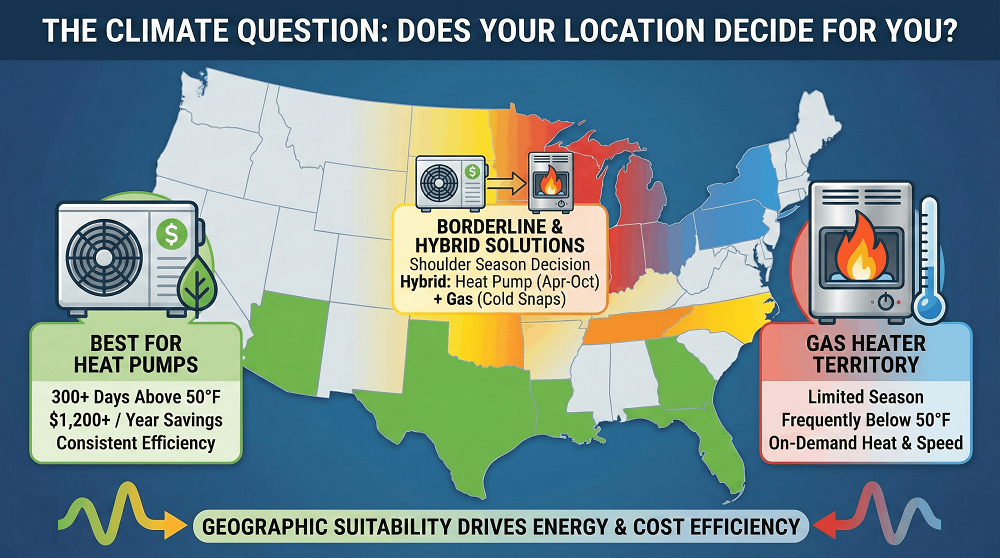
The Climate Question: Does Your Location Decide for You?

Pool heating climate comparison banner showing heat pump friendly states, gas heater regions, and hybrid solution with $1200 annual savings potential

Your geographic suitability is a major factor in energy consumption.

  • Best States for Heat Pumps: Florida, Texas, Arizona, Georgia, and Louisiana. These areas have 300 days above 50 degrees. You can expect savings of 1,200 $ per year over gas.
  • Borderline States: North Carolina, Tennessee, and Oklahoma. These states have about 250 good heating days. Your decision depends on how much you swim during the shoulder seasons.
  • Gas Heater Territory: Michigan, Minnesota, and Wisconsin. The season is limited and temperatures frequently drop below 50 degrees. Heat pumps struggle to maintain a consistent temperature here.

The Hybrid Solution: Some owners in borderline climates install both. Use the heat pump from April to October. Switch to gas for the cold snaps. This maximizes both savings and functionality.

7 Things Salespeople Won’t Tell You

  1. The 50 Degree Wall: Most salespeople gloss over efficiency drops. Below 50 degrees your heat pump loses its edge. At 40 degrees it might not heat the water at all.
  2. Installation Location Matters: Heat pumps have strict sizing requirements for airflow. You need 24 inches of side clearance and 48 inches on top. Obstructed airflow causes a 20 percent efficiency loss.
  3. Inverter Tech is Better: Inverter heat pumps cost 30 percent more upfront. However they use 25 percent less electricity and last longer.
  4. Your Pool Pump Matters: Heat pumps need specific minimum flow rates. If your pump is undersized the heater will not stay on.
  5. The Sizing Game: Contractors often try to oversell BTU output. For most residential pools 90K to 120K BTU is plenty.
  6. Gas Heaters Hate Salt Water: Salt pools corrode gas heat exchangers quickly. Expect a 40 percent shorter lifespan for a gas unit in a salt pool. Heat pumps use titanium which is salt resistant.
  7. The Payback Period is Relative: Sales pitches claim a 2 year payback. This is only true if you compare it to a very old and inefficient gas model.

Making Your Decision: The Simple 3-Question Test

How many days per month will I actually heat my pool?

  • 15 or more days: The heat pump is the financial winner.
  • Under 8 days: The gas heater is likely better for your lifestyle.

What is the lowest outdoor temperature when I want to swim?

  • Rarely below 55 degrees: Heat pumps are perfect.
  • Frequently below 45 degrees: You need a gas heater.

Can I wait 48 hours for my pool to heat up?

  • Yes, I plan ahead: Choose the heat pump.
  • No, I am spontaneous: Choose the gas heater.

Our Recommendation Based on 15 Years of Experience

tic Heat Pumps has installed thousands of systems. Here is our honest guidance for 2026.

Choose a Pool Heat Pump if you live south of Virginia and use your pool 3 times a week. It is the best choice for a 9 month swimming season. Choose a Gas Heater if you live in a cold state or heat only for specific events. It is the better choice for on demand needs or small spas.

For 70 percent of US pool owners a quality heat pump is the smarter long term investment. However gas heaters are not wrong. They are just right for different situations.

The debate is not about which tech is better. It is about which fits your life. Heat pumps win on operating expenses. Gas heaters win on speed. Before you sign a contract calculate your actual monthly usage. Check your local climate patterns.

Need help deciding? Our specialists can run a custom analysis for your pool. We install both systems so we have no bias. We only care about what actually works for you.

Get Your Free Pool Heating Assessment

Arctic Heat Pumps has installed over 2,400 systems. We do not sell you what we want. We recommend what you actually need to enjoy your pool.

A pool heat pump is significantly cheaper to operate, costing pennies per hour compared to $4-$9 per hour for a gas heater. For a daily swimmer, a heat pump can save $900 to $1,500 per season.

A gas heater is much faster, heating a pool in 3 to 6 hours. A heat pump is slower and can take 24 to 72 hours to heat a pool, making it better for maintaining a constant temperature.

Heat pumps rely on extracting heat from the outside air. Their efficiency drops significantly below 50°F (10°C), and they may not work at all when temperatures fall below 45°F. Gas heaters work in any weather condition.

A pool heat pump typically lasts longer, with a lifespan of 10 to 15 years with basic care. A gas heater generally lasts 5 to 10 years and may have a shorter life in salt water pools.

A gas heater is generally the better choice for a weekend warrior because it can heat the pool quickly on demand. A heat pump would require planning days in advance.

In northern climates like the Midwest or Northeast, a heat pump’s season will be limited by cold temperatures. A gas heater or a hybrid system that uses both is often a better solution for extending the swimming season in these areas.

Arctic Heat Pumps Wins 2025 FedEx Small Business Award

Fed Ex Business Award

Arctic Heat Pumps has been officially named a Winner of the 2025 FedEx #BackingSmall Small Business Award. Selected from thousands of applicants across Canada, this prestigious honor recognizes Arctic’s innovation in cold-climate hydronic heating technology and its commitment to sustainability. This milestone validates our mission to provide energy-efficient heating solutions for the harshest North American winters.

Cold-Climate Heat Pump

1.A Milestone Achievement for Sustainable Innovation

We are incredibly proud to announce that Arctic Heat Pumps has been recognized as a 2025 FedEx #BackingSmall Small Business Award Winner!

This esteemed award honors Canadian companies that lead in innovation, growth, and community impact. For us, winning this award is not just a trophy, it is a defining moment in our journey toward making green energy accessible in cold climates.

The FedEx #BackingSmall Contest awards entrepreneurial spirit and rewards companies making a visible difference. In 2025, with a $150,000 prize pool, Arctic Heat Pumps was honored for its dedicated work advancing air-to-water heat pump technology for extreme climates.

Learn more about the program : FedEx.com

2.Why This Recognition Matters

For our customers, partners, and the green building community, this award serves as a powerful validation of our technology.

Award Highlights & Impact

Feature
What This Means for You
Industry Validation
FedEx’s vetting confirms the reliability and real-world impact of our heating systems.
Empowered Innovation
The grant allows us to accelerate R&D for even more efficient cold-weather performance.
Market Confidence
Homeowners and contractors can trust they are choosing an award-winning, recognized brand.
Sustainability Goal
Recognizes our contribution to reducing carbon footprints across North America.

3.Our Journey: From Concept to Award-Winner

Arctic Heat Pumps began with a simple yet ambitious goal: to redefine heating and cooling for cold climates.

While many heat pumps fail when temperatures drop, our team of engineers dedicated years to developing Hydronic Air-to-Water Systems that remain efficient even in freezing conditions. From custom engineering to turnkey installation support, our growth has been driven by a refusal to compromise on performance.

This award confirms that our vision of combining sustainability with reliability is the future of HVAC.

4.What Winning Means for the Future

Winning the 2025 FedEx #BackingSmall Award is not a finish line for us; it is a launchpad. We plan to reinvest these resources directly into what matters most:

  • Growth Acceleration: Expanding our production capabilities to meet the growing demand in Canada, the US, and Europe.
  • Advanced R&D: Developing next-generation features that make our heat pumps even easier to install and integrate with solar/geothermal setups.
  • Customer Support: Strengthening our support network to assist homeowners and installers seamlessly.
  • Community Leadership: Inspiring other Canadian small businesses to pursue sustainable innovations.

5.A Heartfelt Thank You

This achievement belongs to the entire Arctic Heat Pumps family.

  • To our dedicated staff who engineer and support our systems.
  • To our loyal customers who trusted us to keep their homes warm.
  • To FedEx, for believing in the power of small businesses to change the world.

We are proud to be part of a community that values resilience and sustainability. As we celebrate this milestone, we look ahead to a future powered by renewable energy.

Frequently Asked Questions (FAQs)

The FedEx #BackingSmall Award is a prestigious program that recognizes and rewards Canadian small businesses demonstrating exceptional innovation, community impact, and growth potential.

 Arctic Heat Pumps was selected for its leadership in the Green Energy sector, specifically for developing high-efficiency cold-climate heat pumps that reduce reliance on fossil fuels in extreme winter conditions.

The resources and recognition from this award will be used to accelerate Product R&D, improve customer support services, and expand availability across North America, ensuring better products and service for our users.

Yes. While we are a proud Canadian company, our award-winning hydronic heating and cooling systems are shipped and installed across the United States and parts of Europe.

You can explore our full range of products, including our Cold Climate Heat Pumps and Pool Heaters, directly on our website at www.arcticheatpumps.com.

Heat Pump Water Heaters Explained: COP & UEF Guide

UEF & COP

What is the Arctic 4.14 UEF Advantage?


The Arctic Air Source Heat Pump Water Heater delivers a market-leading UEF (Uniform Energy Factor) of 4.14. This means it produces over four times the hot water for every unit of electricity consumed compared to a standard electric tank (which has a COP of 1.0). For a typical 5-person home, this translates to approximately $812 in annual savings and a payback period of under 2 years.

1. Decoding the Jargon: COP vs. UEF

When shopping for a high-efficiency water heater, you will face two main differences. Understanding them will help you calculate real-world savings. 

What is COP (Coefficient of Performance)?

COP measures instantaneous efficiency. It is the ratio of heat delivered to electricity consumed at a specific moment.

  • Standard Electric Tank: Has a COP of 1.0 (1 unit of electricity = 1 unit of heat).
  • Arctic Heat Pump: Has a COP of 4.0+ (1 unit of electricity = 4 units of heat).
  • Think of it like a car’s “Instant MPG” while driving on a flat highway.

What is UEF (Uniform Energy Factor)?

UEF is the U.S. DOE’s official real-world efficiency rating. Unlike COP, UEF accounts for warm-up cycles, standby losses, and daily use patterns.

  • Gas Tank: ~0.60 – 0.70 UEF
  • Electric Tank: ~0.90 – 0.95 UEF
  • Arctic Heat Pump Tank: 4.14 UEF (The Market Leader)
  • Think of it like a car’s “Combined City/Highway MPG”—a truer reflection of daily cost.
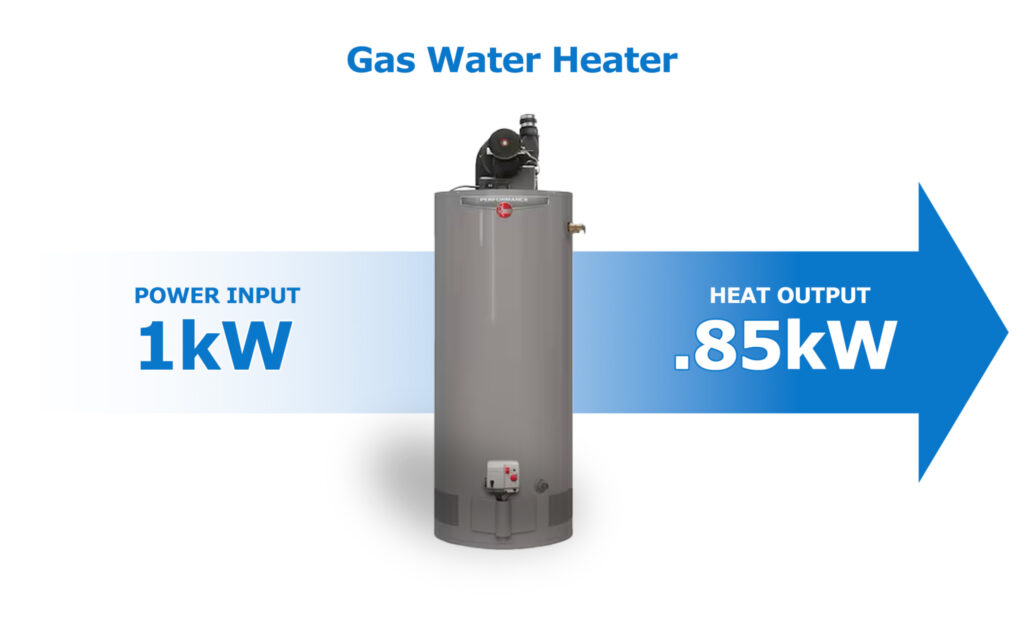
gas water heater
Traditional gas water heater: ~0.85 effective output per 1 kW input (roughly 85% efficient).

2. The Math: How 4.14 UEF Saves You $800+ Per Year

Let’s translate these numbers into dollars. We calculated the energy costs for a typical 5-person family using 100 gallons of hot water per day.

The Assumptions:

  • Usage: 100 gallons/day (20 gal/person).
  • Temp Rise: 60°F incoming water heated to 120°F.
  • Energy Required: ~18.26 million BTU/year (5,353 kWh/year for electric resistance).
  • Electricity Cost: $0.20/kWh.

Annual Cost Comparison Table

Water Heater Type
Efficiency Rating
Annual Electricity Use
Annual Operating Cost
Annual Savings
Standard Electric Tank
0.95 UEF (COP ≈ 1)
5,353 kWh
$1,070
Traditional Gas Tank
~0.65 UEF
N/A (Gas)
~$450 – $600*
Varies
Arctic Heat Pump
4.14 UEF
1,293 kWh
**$259**
$811 / Year

*> Gas prices vary, but heat pumps generally beat propane and natural gas on efficiency.

The Verdict: By switching to an Arctic Heat Pump Water Heater, you reduce your hot water bill by ~76%, saving almost $812 every single year.

electric water heater
Electric resistance water heater: 1 kW in → 1 kW out (COP ≈ 1.0)

3. ROI Analysis: When Do You Break Even?

High-efficiency systems cost more upfront, but the Payback Period is surprisingly short thanks to the massive monthly savings.

  • Estimated Upfront Premium: $1,500 – $2,500 (Cost difference vs. standard tank).
  • Annual Savings: $812.

The Payback Math:

  • Scenario A ($1,500 diff): $1,500 ÷ $812 = 1.8 Years
  • Scenario B ($2,500 diff): $2,500 ÷ $812 = 3.1 Years

After the payback period, the $800+ annual savings go straight to your pocket. This will also keep compounding over the 10-15 year life of the unit.

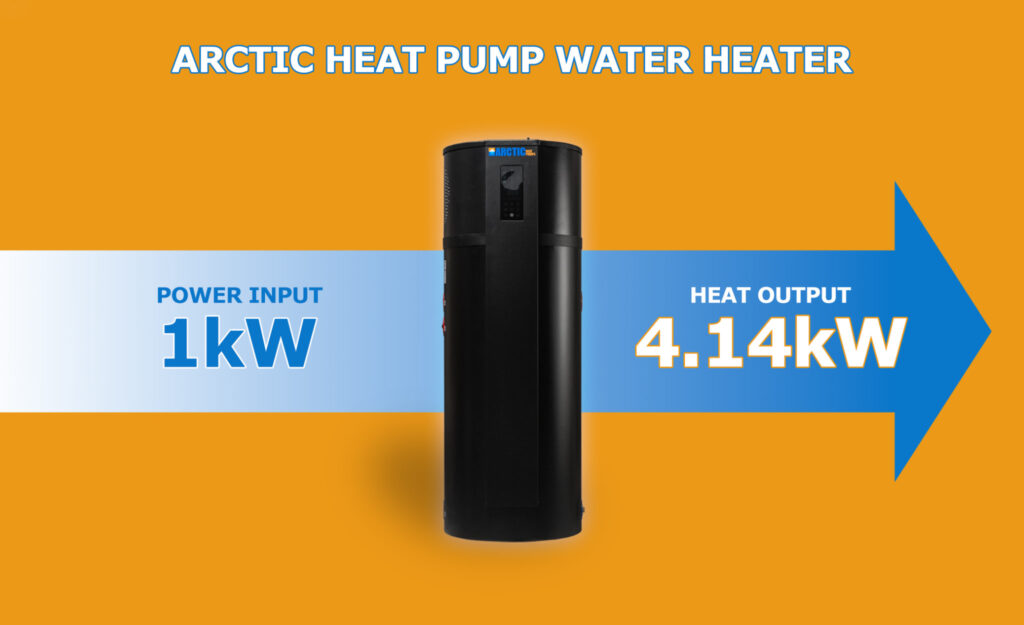
arctic heat pump water heater
Arctic Air Source Heat Pump Water Heater: 1 kW in → 4.14 kW out (UEF 4.14)

4. Beyond the Bill: Comfort & Climate Benefits

Saving money is great, but comfort is mandatory. The Arctic Heat Pump Hot Water Tank is designed for superior performance:

  1. Cold Climate Design: Unlike standard hybrids that struggle in extreme winters, Arctic systems are optimized for Northern homes, maintaining efficiency even when surrounding air is freezing.
  2. Free Dehumidification: As the heat pump pulls heat from the air, it naturally dehumidifies your basement or utility room, reducing mold risk and dampness.
  3. Smart Recovery: Advanced controls allow for rapid recovery modes (Hybrid Mode) if you have high guest loads, ensuring you never run out of hot water.

Eco-Friendly: Consuming 75% less electricity significantly lowers your home’s carbon footprint.

5. Frequently Asked Questions (FAQ)

COP (Coefficient of Performance) measures efficiency at a specific moment, while UEF (Uniform Energy Factor) is an official rating that accounts for real-world usage, including standby losses and cycling. UEF is the best number to use when comparing annual costs.

Yes. Arctic Heat Pumps are designed for cold climates. While they extract heat from the air (which slightly cools the room), they remain highly efficient down to low basement temperatures (typically 40°F/4°C).

A typical family of 4-5 people can save between $600 and $800 per year compared to a standard electric water heater, depending on local electricity rates.


Ready to Upgrade?

Stop paying for wasted energy. Switch to the Arctic 4.14 UEF Heat Pump Water Heater and start saving today. 👉 View Heat Pump Water Heaters

Choosing the Right Heat Pump Water Heater and Installing It

Domestic Heat Pump Water Heaters

How do I choose the right heat pump water heater? To select the best heat pump water heater, look for a UEF (Uniform Energy Factor) of 4.0 or higher. Sizing is critical: a general rule is 20 gallons per person, so a family of four needs an 80-gallon tank. Installation requires a 240V electrical circuit, a condensate drain, and roughly 700 cubic feet of air space (like a garage or basement) to operate efficiently.

1. Why Make the Switch in 2026?

Domestic Heat Pump Water Heaters (HPWHs) are the biggest energy savers in the modern home. While standard electric tanks are 100% efficient (using $1 of power to give $1 of heat), Arctic Heat Pump Water Heaters utilize Air-to-Water technology to achieve 400% efficiency.

This means for every $1 you spend on electricity, you get **$4 worth of hot water**.

If you are replacing an old tank or building a new home, understanding how to size and install these units is the key to locking in those savings.

Arctic Hot Water heat pumps

2. Choosing the Right Domestic Heat Pump Water Heater

Don’t just buy the first tank you see on sale. In 2026, pay attention to these three critical specs:

A. Sizing (The 20-Gallon Rule)

Heat pumps heat water slightly slower than traditional electric elements. Therefore, “Upsizing” is the smart move.

  • Standard Electric Tank: A family of 4 might use a 50 gallon tank.
  • Heat Pump Tank: That same family should opt for an 80 gallon unit.
  • Why? A larger tank stores more hot water, allowing the heat pump to run in its most efficient “Eco Mode” without needing to trigger the expensive backup electric element during morning showers.

B. Energy Efficiency (Look for UEF)

The magic number is UEF (Uniform Energy Factor).

  • Standard Tank: ~0.93 UEF
  • Arctic Heat Pump Tank: 4.14 UEF (The highest in North America).
  • Impact: A 4.14 UEF unit uses roughly 75% less electricity than a standard tank.

C. Climate Performance

Most generic heat pump tanks struggle when the garage or basement gets cold (<40°F). One of the most important advantages is that our units are designed for cold climates, maintaining efficiency even when surrounding air temperatures drop, ensuring you have hot water during winter storms.

3. Installation Requirements: Is Your Home Ready?

Before ordering, check these three boxes. If you miss one, the unit won’t work properly.

1. Air Space (The “Breathing Room”)

Heat pumps extract heat from the air. To do this, they need volume.

  • Requirement: ~700 cubic feet of unrestricted air space (e.g., a 10’ x 10’ room).
  • Ideal Locations: Unfinished basements, garages, or large utility rooms.
  • Tight Spot Solution: If installing in a small closet, you must install louvered doors or duct the intake/exhaust to a larger room or outdoors.

2. Condensate Drainage

Unlike old tanks, heat pumps dehumidify the air, producing water (condensate). You need a floor drain or a small condensate pump to move this water away.

3. Electrical (240V vs 120V)

  • Standard: Most high-efficiency units (including Arctic) require a 240-volt, 30-amp dedicated circuit.
  • Retrofit Challenge: If replacing a gas water heater, you may need an electrician to run a new power line, as gas units typically use a standard 120V outlet.

4. Step-by-Step Installation Guide

Note: We recommend hiring a professional, but knowing the steps protects you from bad installs.

  1. Positioning: Place the unit with access to the air filter and control panel. Ensure at least 6 to 12 inches of clearance from walls.
  2. Plumbing Connection: Connect Cold (Inlet) and Hot (Outlet).
  3. Pro Tip: Always install Dielectric Unions to prevent corrosion between copper pipes and the tank.
  4. Vacuum & T&P Valves:
  5. Install a Vacuum Relief Valve (prevents tank collapse during draining).
  6. Install the T&P (Temperature & Pressure) Relief Valve (mandatory safety feature).
  7. Expansion Tank: Most local codes in 2026 require a thermal expansion tank to handle pressure fluctuations.
  8. Condensate Line: Connect the drain line. Ensure it flows downhill or into a pump.
  9. Power Up: Turn on the water before the electricity to avoid burning out the heating element (Dry Fire). Then, flip the breaker.
Domestic Heat Pump Water Heater Installation

5. Common Challenges & Solutions

Challenge 1: “It makes my basement cold.”

  • The Reality: The unit blows out cool, dry air.
  • The Fix: In summer, this is free air conditioning! In winter, if it’s too cold, you can duct the exhaust air into another room or outside.

Challenge 2: Noise.

  • The Reality: Older models hummed loudly.
  • The Arctic Fix: Arctic models operate at ~49 dB (quieter than a library conversation), making them unobtrusive even in indoor utility rooms.

Conclusion: A Smart Investment for 2026

Choosing and installing a Domestic Heat Pump Water Heater requires a bit more planning than a standard tank, but the payoff is massive. With the Arctic 4.14 UEF model, you are future-proofing your home against rising energy costs.

Ready to start saving? 👉 View Arctic’s High-Efficiency Water Heaters

Frequently Asked Questions (FAQs)

Often both. A plumber handles the water connections and condensate drain, while an electrician ensures the 240V circuit is safe. Arctic units are “retrofit ready,” but professional installation ensures your warranty remains valid.

With proper maintenance (changing the anode rod and cleaning the air filter), an Arctic Heat Pump Water Heater can last 15-20 years, significantly longer than standard gas tanks (8-12 years).

Yes, but you will need to cap the gas line and have an electrician install a 240V outlet. While this adds an initial cost, the energy savings usually pay for this upgrade within 2-3 years.

Heat Pump Water Heater Costs, Rebates & Incentives Explained

Domestic Heat Pump Water Heater Installation

Are Heat Pump Water Heaters worth the investment?

Yes. While the upfront cost of a Domestic Heat Pump Water Heater ranges between $3,600 and $6,500 (including installation), federal incentives like the 30% Tax Credit and state rebates can reduce this by thousands. With operating costs up to 60% lower than standard electric tanks, most homeowners recover their investment in savings within a few years.

Costs of Domestic Heat Pump Water Heaters

1.Introduction: The Shift to Sustainable Water Heating

The shift towards sustainable energy is changing how we heat our homes and our water. Traditional gas and electric resistance heaters cannot keep up with modern domestic heat pump water heaters (HPWH).

Although these modern systems are the most energy-efficient option on the market, many homeowners hesitate due to the perceived high price tag.

The Reality: They are not as expensive as you think. When you consider lifetime savings and government incentives, a heat pump water heater often ends up cheaper than a standard tank in the long run. This guide breaks down the real numbers.

2. Breakdown: How Much Does It Really Cost?

The cost can be very different based on your current setup (Gas vs. Electric) and location. Here is a realistic look at where your money goes.

Upfront Costs ($3,600 – $6,500)

  • Replacing an Electric Tank: Generally cheaper ($3,600 – $4,800) because the wiring is likely already in place.
  • Replacing a Gas Tank: Generally more expensive ($4,300 – $6,500) because you often need an electrician to install a new 240V circuit and cap the old gas line.
Lifetime-Savings-on-Domestic-Heat-Pump-Water-Heaters

Cost Components Table

Expense Category
Estimated Cost
Notes
Unit Cost
$1,200 – $2,500
50-gallon tanks are cheaper; 80-gallon tanks cost more but offer more efficiency.
Installation Labor
$1,500 – $3,000+
Varies by plumber rates and complexity of the location (attic vs. garage).
Electrician
$300 – $800
Required if switching from gas to electric (new 240V outlet needed).
Supplies/Disposal
$100 – $300
Includes disposal of the old tank, new pipes, and expansion tanks.

3. Operating Costs: Monthly Savings

This is where the Heat Pump Water Heater shines.

Because these units move heat rather than creating it, they consume drastically less electricity.

  • Warm Climates: Expect higher savings as the unit extracts heat easily from the ambient air.
  • Cold Climates: Costs may be slightly higher in winter, but still significantly lower than resistance heating.
  • The Bottom Line: You can expect a 60% reduction in your water heating energy bill compared to a standard electric tank.

4. Lifetime Savings: The Long-Term Payoff

Don’t look at the sticker price; look at the 10 year picture.

By switching from a standard electric water heater to a heat pump model, the average household saves between $80 and $230 annually (depending on usage and rates).

  • 10-Year Savings: Over the typical 10 to 15 year lifespan of the unit, you can save roughly $2,300 in electricity costs alone.
  • ROI: When combined with rebates, the system often pays for itself entirely within 5 to 7 years.

5. Incentives: How to Get Paid to Upgrade

You don’t have to pay the full price. Governments are actively paying homeowners to switch to eco-friendly water heating.

A. Federal Tax Credit (Inflation Reduction Act)

  • Benefit: You can claim a 30% Tax Credit on the total project cost (equipment + installation).
  • Cap: Up to $2,000 per year.
  • Requirement: The unit must meet ENERGY STAR standards.

B. Electrification Rebates (For Low/Moderate Income)

  • Benefit: Upfront discounts covering 50% to 100% of the project cost.
  • Cap: Up to $1,750 specifically for heat pump water heaters.
  • Eligibility: Income-dependent (check your local guidelines).

C. State & Utility Rebates

Many states offer “Instant Rebates” at the point of sale:

  • California: Instant rebates of $500 to $900.
  • Massachusetts: Rebates ranging from $750 to $1,500.
  • Check with your local utility provider before buying!

Conclusion

While an initial investment of $3,600 to $6,500 may seem high, the calculation changes when you apply a 30% tax credit and factor in $2,000+ in lifetime energy savings. For most homeowners, upgrading to a domestic heat pump water heater is one of the smartest financial decisions you can make for your home.

👉 Browse Energy Star Heat Pump Water Heaters

Frequently Asked Questions (FAQs)

Most homeowners in the US qualify for the Inflation Reduction Act tax credit if they have sufficient tax liability. The unit must be Energy Star certified and installed in your primary residence.

It is slightly more expensive upfront (usually $500-$1,000 extra) because you need to hire an electrician to run a new 240V power line. However, eliminating your gas bill for water heating often makes up for this cost over time.

While it varies by usage, a typical heat pump water heater costs between $100 and $150 per year to operate, compared to $400+ for a standard electric tank.

A Complete Guide to Saving Money with Heat Pump Water Heaters

Heat Pump Water Heaters

How much money does a heat pump water heater save?

A Domestic Heat Pump Water Heater is roughly 300% more efficient than a standard electric tank. By reducing energy consumption by up to 70%, an average household can save approximately $700 annually on utility bills. Over a 15-20 year lifespan, this adds up to $10,000 – $14,000 in total savings, making it the most financially smart water heating upgrade available.

1.Introduction: The Mathematics of Efficiency

Heat pump water heaters are famous for their energy efficiency, but what does that actually mean for your money?

While the initial price tag might be higher than a standard tank, the Lifetime Value is unmatched. In this guide, we break down exactly how these devices work and calculate how switching to an Arctic Domestic Heat Pump Water Heater can save you thousands over its lifespan.

2. How It Works: The “Reverse Refrigerator”

To understand the savings, you must understand the science.

  • Standard Heaters (Resistance): These work like a giant toaster. They use massive amounts of electricity to create heat directly. (Efficiency: ~95%)
  • Heat Pump Heaters (Thermodynamics): These work like a refrigerator, but in reverse.

Instead of creating heat, they move it.

The unit pulls ambient heat from the surrounding air (garage/basement), compresses it to increase the temperature, and transfers it to the water tank. Because moving heat is easier than creating it, these units achieve 300% to 400% efficiency.

3. The Savings Breakdown: By the Numbers

Let’s look at the real-world financial impact of switching from a traditional electric water heater to a heat pump model.

A. Annual Bill Reduction

  • Standard Electric Tank: Costs ~$1,200/year to run.
  • Heat Pump Water Heater: Costs ~$500/year to run.
  • Annual Savings: ~$700 per year.

B. Lifetime Savings Calculator

Heat pumps are built to last. While standard tanks often fail after 8-12 years, high-quality heat pumps can last 15-20 years.

Lifespan Scenario
Annual Savings
Total Lifetime Savings
10 Years
$700 x 10
**$7,000**
15 Years
$700 x 15
**$10,500**
20 Years
$700 x 20
**$14,000**

The Verdict: Even if the unit costs $2,000 more upfront, you earn that back in just 3 years. The remaining 12-17 years are pure profit.

Cost-saving Benefits of Heat Pump Water Heaters

4. Incentives: The Cherry on Top

The savings start before you even turn it on. Governments are actively subsidizing these eco-friendly upgrades.

  • Federal Tax Credits (IRA): Under the Inflation Reduction Act (Section 25C), homeowners can claim a 30% tax credit on the project cost, capped at $2,000.
  • Local Utility Rebates: Many local power companies offer instant rebates ranging from $300 to $1,000 to reduce the strain on their grid.

By combining long-term bill reduction with upfront rebates, the “Effective Cost” of a heat pump water heater is often lower than a standard tank.

5. Eco-Friendly Advantages: Green for the Planet

Saving money is great, but saving the planet is a bonus.

  • Reduced Carbon Emissions: By reducing energy use by 70%, a single heat pump water heater prevents roughly 2,000 pounds of CO2 from entering the atmosphere every year.
  • Reduced Landfill Waste: Longer lifespans (15-20 years vs 10 years) mean fewer rusty water tanks ending up in landfills.
  • Fewer Moving Parts: Traditional gas heaters have complex burners and exhaust systems that wear out. Heat pumps are sealed systems that require minimal intervention.


Eco friendly Advantages of Heat Pump Water Heaters

6. Conclusion: The Best Choice for the Energy-Conscious

If you are an energy-conscious homeowner, the choice is clear.

  1. Lowest Operating Cost: Save ~$700/year.
  2. Zero Emissions: Reduce your carbon footprint.
  3. Government Supported: Get 30% back in taxes.

Don’t let the price tag fool you. A Domestic Heat Pump Water Heater isn’t an expense; it’s an investment with a guaranteed high return.

👉 Calculate Your Savings with Arctic

Frequently Asked Questions (FAQs)

They use advanced technology (compressors, evaporators, smart controls) compared to the simple heating elements in standard tanks. However, the energy savings usually pay back this difference in less than 3 years.

Yes. Modern units like the Arctic Heat Pump Water Heater are designed to extract heat even from cool air. However, they work most efficiently in spaces that stay above 40°F (4°C).

No. Maintenance is simple: clean the air filter regularly (just like an AC unit) and check the anode rod every few years. This simple care ensures the unit lasts its full 20-year potential.