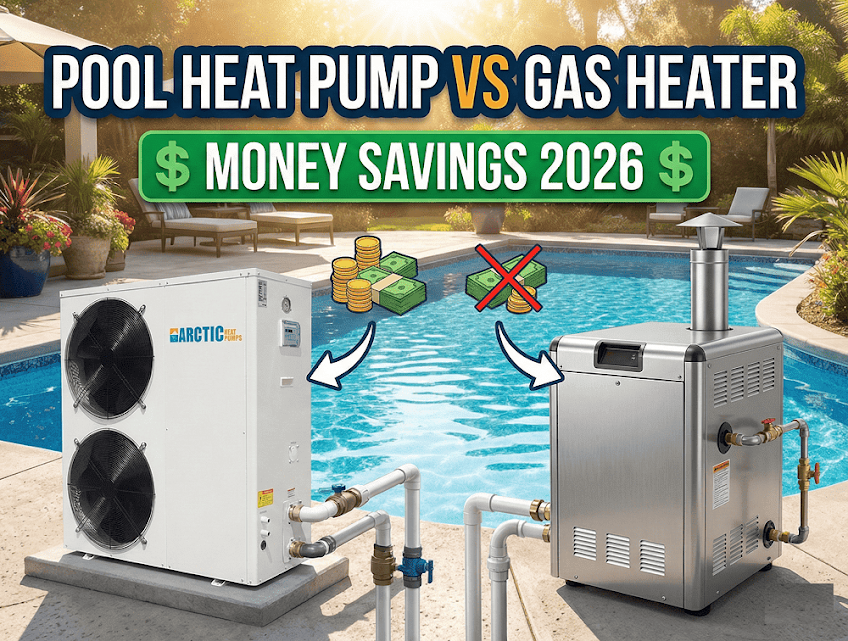
You are standing at your pool equipment pad with a contractor quote in hand. You are staring at two numbers that do not seem to make sense. The gas heater costs $2500. The heat pump costs 4800 $. Your neighbor swears by their gas heater. However your coworker says their heat pump paid for itself in two years. Who is actually right?
The confusion between upfront cost and long term value is a major pain point. Making a $5000 decision feels risky when you hear conflicting advice. Your friends and the internet often provide different answers. By the end of this guide you will know exactly which heater fits your situation.
This is not about a generic best pick. This is about what makes sense for your climate and your budget.
How They Actually Work: The Simple Version
Before we dive into the costs we must remove the tech confusion. These two machines handle heat in completely different ways.
Pool Heat Pumps: The Heat Thieves
A pool heat pump does not generate heat. It extracts heat from the outside air. You can think of it as a reverse air conditioner. It uses electricity to move heat rather than create it. Think of it as stealing warmth from the air and dropping it into your pool. This process involves heat transfer through a specialized compressor technology. It relies on the ambient air temperature to function. The efficiency of this unit is measured by the COP or Coefficient of Performance.
Gas Heaters: The Fast Burners
Gas heaters burn natural gas or propane to produce warmth. They generate heat through direct combustion inside a combustion chamber. This heat is transferred to the water through a heat exchanger. They work exactly like the water heater in your home. They are the speed champions of the pool world but they are also fuel guzzlers.
The Key Difference:
- Heat Pump: Takes 24 to 72 hours to heat a pool. It runs on pennies per hour.
- Gas Heater: Heats a pool in 3 to 6 hours. It costs $4 to $9 per hour to run.
The Real Cost Breakdown: Not The Marketing BS
You need actual numbers to make an informed choice. Marketing materials often hide the true total cost of ownership.
Initial Investment
Equipment Type | Equipment Cost | Installation Cost | Total Upfront |
|---|---|---|---|
Pool Heat Pump
| $2,800 to $5,500
| $800 to $1,500 | $3,600 to $7,000
|
Gas Heater | $1,500 to $3,500
| $500 to $2,000 | $2,000 to $5,500
|
Operating Costs Reality Check
For Daily Swimmers aiming for an 80 degree target over a six month season:
- Heat Pump: $100 to $150 per month. This totals $600 to $900 per season.
- Gas Heater: $250 to $400 per month. This totals $1,500 to $2,400 per season.
- Annual Savings with Heat Pump: $900 to $1,500 .
For Weekend Warriors heating only 8 to 12 days per month:
- Heat Pump: $40 to $60 per month. It still takes 2 to 3 days to reach the target.
- Gas Heater: $80 to $120 per month. It is ready in a few hours.
The Break-Even Timeline
If you are a daily swimmer the pool heat pump pays for itself in 2 to 3 years. This is a solid ROI calculation. If you only heat once a week for pool parties the math favors gas. The payback period is much longer if the unit sits idle most of the time.
Hidden Costs Nobody Mentions
Most contractors will not tell you that heat pumps need air above 50 degrees to work. Below 45 degrees they are essentially useless. Gas heaters work in any weather conditions. However a gas heater has a shorter life cycle cost. You can expect 5 to 10 years of life from gas. A heat pump usually lasts 10 to 15 years with basic care. Gas heaters also require annual service permits and cost 150 to 300 $ to maintain. Heat pumps need minimal maintenance but require a larger electrical circuit.
Speed vs Savings: What Actually Matters for YOUR Pool
Help yourself identify your use case by looking at these common profiles.
Use Case 1: The Daily Swimmer
You use your pool 4 to 7 days per week. You want a consistent temperature of 80 to 85 degrees.
- Best Choice: Pool Heat Pump.
- Why: You are heating constantly anyway. Slow heating does not matter because you maintain the temperature. Your electricity bill stays steady while your neighbor cringes at their gas bill.
- Real Example: Sarah in Phoenix runs her heat pump from March through November. Her initial cost was $4,200. Her monthly cost is $95. She saved $1,400 in her first year.
Use Case 2: The Weekend Warrior
On Friday afternoon you decide to heat the pool for a Saturday party.
- Best Choice: Gas Heater.
- Why: You need heat now. A heat pump needs up to 3 days to prepare. A gas heater gets you swimming ready in 4 to 6 hours. You only heat 15 times per year so the $9 hourly cost is manageable.
- Real Example: Mike in Austin heats his pool about 12 weekends per year. His gas heater cost $2,100. His total annual cost is $540. A heat pump would be cheaper to run but he would have to plan 2 days ahead every single time.
Use Case 3: The Year-Round Swimmer in Cold Climates
You live in the Midwest or Northeast and want to swim in December.
- Best Choice: Gas Heater or a Hybrid System.
- Why: When it is 35 degrees outside your heat pump becomes an expensive lawn ornament. Gas heaters function at any v temperature.
The Climate Question: Does Your Location Decide for You?
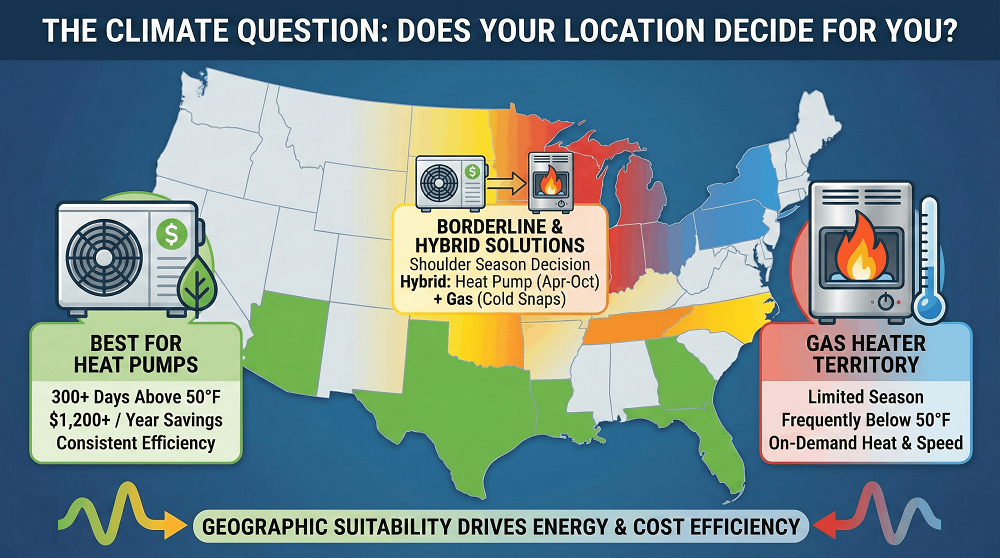
Your geographic suitability is a major factor in energy consumption.
- Best States for Heat Pumps: Florida, Texas, Arizona, Georgia, and Louisiana. These areas have 300 days above 50 degrees. You can expect savings of 1,200 $ per year over gas.
- Borderline States: North Carolina, Tennessee, and Oklahoma. These states have about 250 good heating days. Your decision depends on how much you swim during the shoulder seasons.
- Gas Heater Territory: Michigan, Minnesota, and Wisconsin. The season is limited and temperatures frequently drop below 50 degrees. Heat pumps struggle to maintain a consistent temperature here.
The Hybrid Solution: Some owners in borderline climates install both. Use the heat pump from April to October. Switch to gas for the cold snaps. This maximizes both savings and functionality.
7 Things Salespeople Won’t Tell You
- The 50 Degree Wall: Most salespeople gloss over efficiency drops. Below 50 degrees your heat pump loses its edge. At 40 degrees it might not heat the water at all.
- Installation Location Matters: Heat pumps have strict sizing requirements for airflow. You need 24 inches of side clearance and 48 inches on top. Obstructed airflow causes a 20 percent efficiency loss.
- Inverter Tech is Better: Inverter heat pumps cost 30 percent more upfront. However they use 25 percent less electricity and last longer.
- Your Pool Pump Matters: Heat pumps need specific minimum flow rates. If your pump is undersized the heater will not stay on.
- The Sizing Game: Contractors often try to oversell BTU output. For most residential pools 90K to 120K BTU is plenty.
- Gas Heaters Hate Salt Water: Salt pools corrode gas heat exchangers quickly. Expect a 40 percent shorter lifespan for a gas unit in a salt pool. Heat pumps use titanium which is salt resistant.
- The Payback Period is Relative: Sales pitches claim a 2 year payback. This is only true if you compare it to a very old and inefficient gas model.
Making Your Decision: The Simple 3-Question Test
How many days per month will I actually heat my pool?
- 15 or more days: The heat pump is the financial winner.
- Under 8 days: The gas heater is likely better for your lifestyle.
What is the lowest outdoor temperature when I want to swim?
- Rarely below 55 degrees: Heat pumps are perfect.
- Frequently below 45 degrees: You need a gas heater.
Can I wait 48 hours for my pool to heat up?
- Yes, I plan ahead: Choose the heat pump.
- No, I am spontaneous: Choose the gas heater.
Our Recommendation Based on 15 Years of Experience
tic Heat Pumps has installed thousands of systems. Here is our honest guidance for 2026.
Choose a Pool Heat Pump if you live south of Virginia and use your pool 3 times a week. It is the best choice for a 9 month swimming season. Choose a Gas Heater if you live in a cold state or heat only for specific events. It is the better choice for on demand needs or small spas.
For 70 percent of US pool owners a quality heat pump is the smarter long term investment. However gas heaters are not wrong. They are just right for different situations.
The debate is not about which tech is better. It is about which fits your life. Heat pumps win on operating expenses. Gas heaters win on speed. Before you sign a contract calculate your actual monthly usage. Check your local climate patterns.
Need help deciding? Our specialists can run a custom analysis for your pool. We install both systems so we have no bias. We only care about what actually works for you.
Get Your Free Pool Heating Assessment
Arctic Heat Pumps has installed over 2,400 systems. We do not sell you what we want. We recommend what you actually need to enjoy your pool.
Frequently Asked Questions
Which is cheaper to operate, a pool heat pump or a gas heater?
A pool heat pump is significantly cheaper to operate, costing pennies per hour compared to $4-$9 per hour for a gas heater. For a daily swimmer, a heat pump can save $900 to $1,500 per season.
How long does it take to heat a pool with a heat pump vs. a gas heater?
A gas heater is much faster, heating a pool in 3 to 6 hours. A heat pump is slower and can take 24 to 72 hours to heat a pool, making it better for maintaining a constant temperature.
Do heat pumps work in cold weather?
Heat pumps rely on extracting heat from the outside air. Their efficiency drops significantly below 50°F (10°C), and they may not work at all when temperatures fall below 45°F. Gas heaters work in any weather condition.
What is the lifespan of a heat pump compared to a gas heater?
A pool heat pump typically lasts longer, with a lifespan of 10 to 15 years with basic care. A gas heater generally lasts 5 to 10 years and may have a shorter life in salt water pools.
Which heater is better for a "weekend warrior" who only uses the pool occasionally?
A gas heater is generally the better choice for a weekend warrior because it can heat the pool quickly on demand. A heat pump would require planning days in advance.
Can I use a heat pump in a northern climate?
In northern climates like the Midwest or Northeast, a heat pump’s season will be limited by cold temperatures. A gas heater or a hybrid system that uses both is often a better solution for extending the swimming season in these areas.