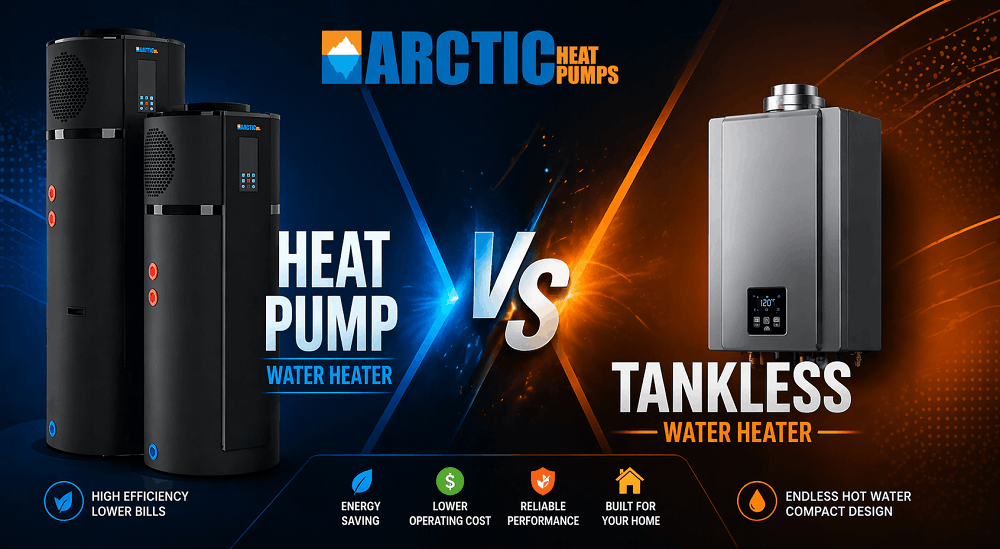
When it comes time to replace an aging water heater, homeowners are faced with a dizzying array of options. The days of simply buying a standard 50-gallon electric resistance tank are over. Today, the conversation almost always boils down to a high-stakes heavyweight match: the heat pump vs tankless water heater.
Both technologies promise massive upgrades over traditional models, but they achieve their results through completely different scientific principles. One provides endless hot water on demand, while the other uses advanced refrigeration technology to heat water for pennies on the dollar. But as utility rates climb and homeowners look to future-proof their homes, the ultimate question remains: which system actually keeps more money in your wallet?
In this comprehensive guide, we are going to break down the engineering, the true installation costs, the hidden electrical panel upgrades, and the real-world efficiency of both systems to give you a definitive answer.
Quick Answer: The Bottom Line
If you are looking for the short answer, here it is: Heat pump water heaters save more money long-term due to their exponentially higher energy efficiency, while tankless systems offer instant, endless hot water but come with higher operating costs.
Because a heat pump moves existing heat rather than generating new heat, it operates at an astonishing 300% to 400% efficiency. Over a standard 10-to-15-year lifespan, the massive reduction in your monthly utility bill will mathematically outpace the savings of a tankless unit, making the heat pump the undisputed champion of long-term financial return.
How Does a Tankless Water Heater Work?
To understand the financial implications, you first have to understand the mechanics. A tankless water heater (often called an on-demand water heater) completely eliminates the traditional storage tank. Instead of keeping 50 gallons of water piping hot 24 hours a day, it only springs into action the exact second you turn on a hot water faucet.
When you open the tap, a flow sensor detects the movement of water. This triggers the heating element, either massive electric coils or a high-powered gas burner. Cold water flows into the unit, passes through a highly efficient heat exchanger, and exits the unit as hot water, traveling directly to your shower or sink.
The Benefits of On-Demand Heating
- Zero Standby Heat Loss: Because there is no tank, you aren’t paying to keep water hot while you are sleeping or at work.
- Endless Supply: As long as you have electricity or gas, you will never run out of hot water. You can fill a massive soaking tub and run the dishwasher simultaneously (if the unit is sized correctly).
- Space Savings: These units are roughly the size of a suitcase and mount directly to the wall, freeing up valuable mechanical room space.
The Flow Rate Limitation
However, tankless systems are bound by the laws of physics and thermodynamics. Their performance is heavily dictated by flow rate (Gallons Per Minute or GPM) and the groundwater temperature in your specific climate. If you live in a northern climate where winter groundwater temperatures drop to 40°F (4°C), the tankless unit has to work incredibly hard to raise that water to 120°F (49°C) instantly. This drastically reduces the volume of hot water it can output per minute.
While efficient in short bursts, tankless systems consume more energy over time compared to heat pump systems. The sheer amount of instantaneous energy required to flash-heat freezing water is staggering, which directly impacts your utility bill.
How Does a Heat Pump Water Heater Work?
A heat pump water heater (often referred to as a hybrid water heater) operates on an entirely different plane of physics. Instead of creating heat through raw electrical resistance or burning fossil fuels, a heat pump acts like a refrigerator running in reverse.
The unit features a compressor, an evaporator coil, and a closed loop of eco-friendly refrigerant. A fan pulls in the ambient air surrounding the unit. The refrigerant absorbs the thermal energy from this air (even if the air feels relatively cool to you, it still contains extractable heat energy). The compressor then pressurizes the refrigerant, drastically raising its temperature. This super-heated gas is then pumped through a condenser coil that wraps around the water tank, transferring the heat directly into your water.
The Magic of Thermal Transfer
Because it is simply relocating heat from the air into the water, a heat pump can produce three to four units of heat for every one unit of electricity it consumes. Unlike tankless systems, heat pumps don’t generate heat, they move it. Making them far more energy-efficient.
Modern heat pump technology has evolved dramatically. While older models struggled in cooler basements, today’s advanced systems that utilize split-system architecture or cold-climate engineering can effectively extract heat and provide reliable domestic hot water even in highly demanding environments. For homeowners looking to decarbonize without sacrificing comfort, the heat pump is the pinnacle of modern HVAC engineering.
Are Tankless Water Heaters Good?
The short answer is yes; tankless water heaters are brilliant pieces of engineering. But being “good” does not mean being “good for everyone.”
Where Tankless Shines
Tankless heaters are exceptionally good for specific use cases. If you have a massive soaking tub that requires 80 gallons to fill, a traditional tank will run out halfway through. A tankless unit will fill it effortlessly. They are also phenomenal for very small homes, condos, or tight crawl spaces where a 60-inch tall tank simply cannot physically fit.
The Real-World Limitations
But the reality of living with a tankless heater comes with caveats that salespeople rarely mention:
- The “Cold Water Sandwich”: If you turn the shower off to lather up and turn it back on, you will get a blast of hot water, followed by a shock of cold water (the water that passed through before the burner ignited), followed by hot water again.
- Minimum Flow Rates: If you turn a faucet on to a slow trickle to shave or wash your hands, the flow sensor may not detect enough movement to ignite the burner, leaving you with cold water.
- High Installation Costs: Retrofitting a house for tankless is rarely cheap. Gas units often require wider gas lines and specialized stainless steel venting. Electric units are notorious for requiring massive electrical upgrades, often needing three or four dedicated 40-amp breakers.
While tankless systems work well for certain use cases, they may not be the most cost-effective long-term solution.
Looking for an energy-efficient solution? Explore cold-climate heat pump systems designed for maximum long-term savings, providing reliable hot water and home heating even in the harshest winter conditions.
Are Tankless Water Heaters Worth It?
Determining worth requires looking at both the immediate future and the distant horizon.
Short-term → Yes. If you frequently host large families and back-to-back showers leave the last person shivering, the immediate lifestyle upgrade of infinite hot water makes the high purchase price feel entirely worth it.
Long-term → It depends entirely on your energy rates and climate. If you install a gas tankless unit in a region with cheap natural gas, the math might balance out over a decade. However, if you attempt to install a whole-home electric tankless heater, the massive amp draw (sometimes up to 120 amps just for the heater) will not only require thousands of dollars in electrical panel upgrades but will also hit your electric bill hard every time it kicks on.
For long-term savings, heat pump water heaters are often the better investment. When you factor in the total lifecycle cost like purchase, installation, and a decade of utility bills, the tankless system almost always costs more to own.
Cost Comparison: The Real Math Behind the Machines
To truly answer the question of which saves more money, we have to look at the three phases of ownership: Upfront Costs, Installation Complexity, and Yearly Operational Costs.
| Cost Factor | Heat Pump Water Heater | Tankless (Gas/Electric) |
|---|---|---|
| Upfront Unit Cost | $1,400 to $2,800 | $600 to $2,000 |
| Installation & Labor | $500 to $1,200 (Standard plumbing) | $1,000 to $3,500 (Venting/Panel upgrades) |
| Estimated Yearly Energy Cost | $110 to $160 | $250 to $450+ |
| 10-Year Operational Cost | ~$1,500 | ~$3,500+ |
| Tax Credits & Rebates | Very High (Up to $2,000 via IRA in US) | Moderate to Low |
While the heat pump unit itself has a higher retail sticker price, the installation is generally straightforward because it uses standard 240v electrical connections (and newer 120v plug-in models are now hitting the market). Tankless systems often have hidden retrofit costs. When you calculate the incredibly low yearly operating cost of the heat pump and factor in massive government tax credits designed to promote electrification, the heat pump decisively wins the 10-year cost battle.
Energy Efficiency Comparison
In the world of water heating, efficiency is measured by the Uniform Energy Factor (UEF). The higher the UEF number, the more efficient the system.
- Standard Electric Tank: Operates at roughly 0.90 UEF. For every dollar of electricity you put in, you get 90 cents of heat, and 10 cents is lost to inefficiencies.
- Tankless Water Heaters: Highly efficient compared to old tanks, generally operating between 0.85 and 0.99 UEF. If you have a condensing gas tankless, it extracts almost all the heat from the combustion gases, putting it right at 99% efficiency.
- Heat Pump Water Heaters: Because of the Coefficient of Performance (COP) of thermal extraction, heat pumps boast UEF ratings between 3.0 and 4.0. This means they operate at 300% to 400% efficiency. For every dollar of electricity you put in, the heat pump harvests three to four dollars’ worth of ambient heat from the air.
According to the laws of science, even the best tankless system cannot be more than 100% efficient. It cannot produce more energy than it consumes. A heat pump circumvents this rule by moving existing energy, making it the undisputed king of efficiency.
Which Saves More Money?
If we strip away all the marketing buzzwords and look purely at the economics, the answer is categorical: Heat pump water heaters save more money over time due to lower energy consumption and operating costs.
Let’s paint a real-world scenario. A family of four using a traditional electric water heater might spend $600 a year heating water. Switching to an electric tankless might drop that bill to $450 by eliminating standby heat loss. But switching to a heat pump water heater will plunge that exact same bill down to roughly $150 a year.
That is $300 in pure cash savings every single year compared to the tankless unit. Over a 12-year lifespan, you have kept $3,600 in your bank account, completely paying for the cost of the heat pump unit multiple times over.
You can also explore real-world savings examples of heat pump systems here.
Pros & Cons: Head-to-Head
Heat Pump Water Heater
Pros:
- ✔ Massive Utility Savings: The lowest operating cost of any system on the market.
- ✔ Eco-Friendly: Drastically reduces your carbon footprint and grid strain.
- ✔ Dehumidification: As a byproduct of pulling heat from the air, it dehumidifies the space it’s in (great for damp basements).
- ✔ High Rebates: Qualifies for maximum federal, state, and provincial tax incentives.
Cons:
- ❌ Slower Recovery: Once the tank is empty, it takes longer to reheat than a standard electric element (though most have hybrid modes to compensate).
- ❌ Space Requirements: Requires adequate ambient air volume to draw heat from (usually a 1,000 cubic foot room or louvered doors).
Tankless Water Heater
Pros:
- ✔ Instant & Endless Water: You can take a 3-hour shower if you want to.
- ✔ Massive Space Savings: Mounts on the wall, freeing up floor space.
- ✔ Long Lifespan: High-quality units can last 20+ years if descaled and maintained properly.
Cons:
- ❌ Higher Long-Term Cost: The energy consumed during heating limits your financial ROI.
- ❌ Complex Retrofits: Often requires expensive upsizing of gas lines, venting, or main electrical panels.
- ❌ Annual Maintenance: Must be flushed with vinegar or descaling solution yearly to prevent hard water buildup in the heat exchanger.
Which One Should You Choose?
The right choice isn’t just about the machine; it is about your home’s infrastructure, your climate, and your ultimate goals.
- Instant need and large family demands → Tankless. If you have four teenagers who all shower in the morning while the washing machine is running, the endless supply of a tankless unit will prevent morning warfare over hot water.
- Save money and maximize ROI → Heat Pump. If you are playing the long game and want to insulate yourself against rising utility rates, there is no better investment for your mechanical room.
- Cold climate resilience → Heat Pump. (BIG PUSH) It is a myth that heat pump technology fails in the cold. Premium, cold-climate optimized heat pumps, specifically split-system hydronic setups are engineered to pull thermal energy from sub-zero air with remarkable efficiency. If you live in a northern climate, investing in a robust, cold-weather heat pump system protects your wallet year-round without the punishing flow-rate drops that tankless units suffer in winter.
Final Verdict
While both systems represent a massive leap forward from the archaic, energy-wasting tanks of the past, the math tells a clear story. Tankless water heaters provide unparalleled lifestyle luxury through endless hot water, but that luxury comes at a premium in both installation and operational costs.
If your goal is to save money, heat pump water heaters are the better long-term choice. Their ability to operate at 300%+ efficiency makes them the smartest financial move, the most eco-friendly option, and the ultimate upgrade for the modern, energy-conscious home.
Frequently Asked Questions (FAQs)
How does a tankless water heater work?
A tankless water heater eliminates the storage tank and uses high-powered gas burners or electric coils to instantly heat water as it flows through a heat exchanger. It only operates when a hot water faucet is opened, providing an endless supply of hot water without standby heat loss.
Are tankless water heaters good?
Yes, they are excellent for specific situations. They save space, provide endless hot water, and eliminate standby energy waste. However, they can suffer from reduced flow rates in cold climates and often require expensive electrical or gas line upgrades during retrofits.
Are tankless water heaters worth it?
In the short term, the luxury of endless hot water makes them worth it for large, busy households. However, in the long term, they consume more energy than heat pump systems, meaning they yield a lower financial return on investment over a 10-to-15-year period.
Which is cheaper long term: heat pump or tankless?
A heat pump water heater is significantly cheaper long term. Because it extracts heat from the air rather than generating it from scratch, it operates at 300% to 400% efficiency, cutting water heating utility bills by up to 70% compared to standard or tankless models.