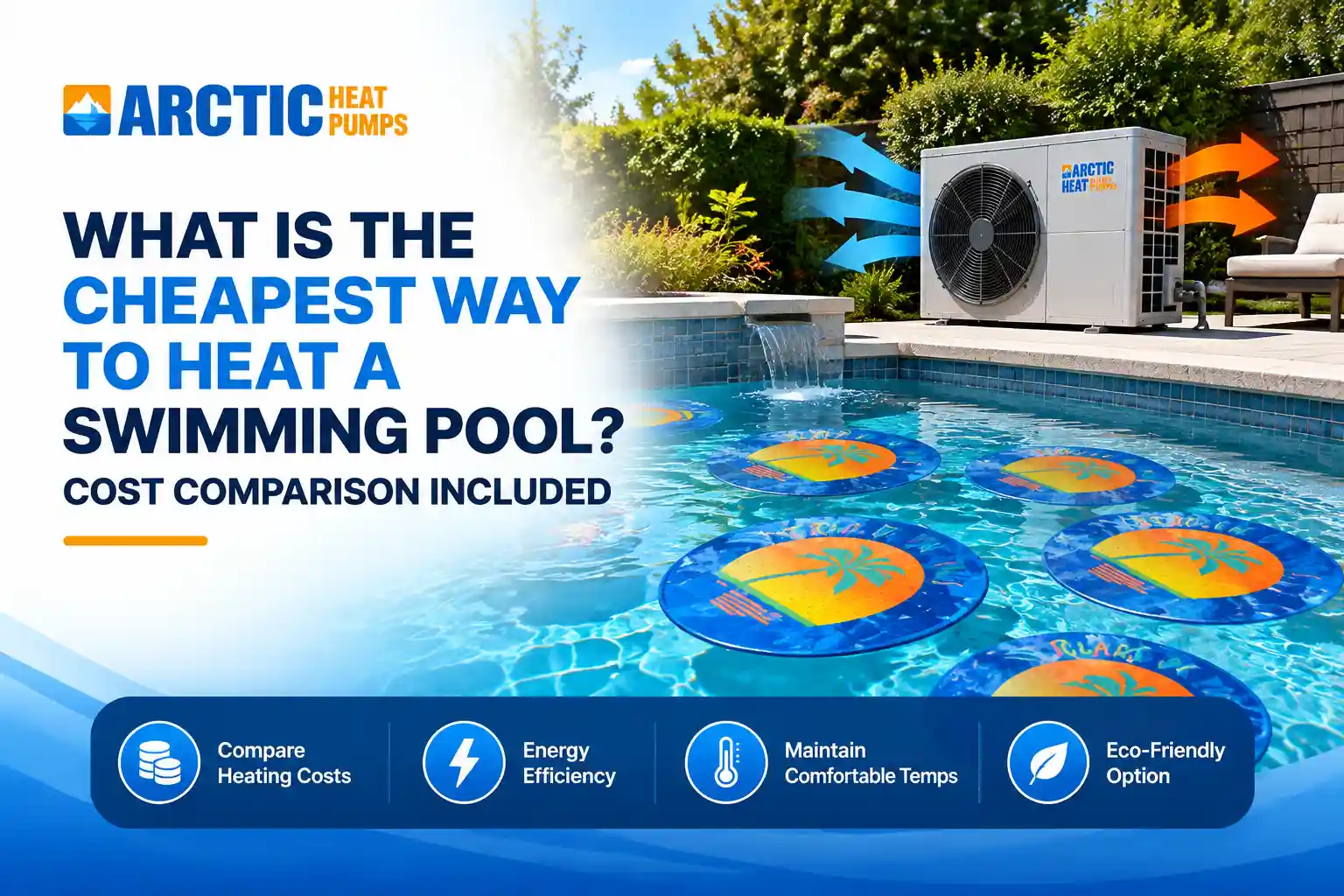
The cheapest way to heat a swimming pool is a two-part strategy: use a solar cover to stop heat loss, then add a pool heat pump for active heating. A cover alone cuts heating costs by 50 to 70 percent because evaporation is the largest source of pool heat loss.
For the heat you still need to generate, a heat pump delivers it at roughly $9 to $16 per million BTU, compared to about $14 or more for natural gas and $36 or more for propane at typical energy rates.
Free methods like sunlight, windbreaks, and dark surfaces help too, but they can’t maintain a set temperature on their own. In this article, I will show you what is the cheapest way to heat a swimming pool (from free to premium), show the actual cost per unit of heat, and explain which combination wins for your climate.
First, Understand Where Your Pool’s Heat Goes
You can’t pick the cheapest heating method until you know why pools get cold. According to the U.S. Department of Energy, evaporation is by far the largest source of pool energy loss. The physics are brutal: it takes just 1 BTU to raise a pound of water by one degree, but every pound of 80°F water that evaporates pulls roughly 1,048 BTU of heat out of your pool.
In practical terms, 50 to 70 percent of your pool’s heat escapes through evaporation from the surface. Wind speed, air temperature, and humidity all accelerate it.
This leads to the single most important insight in pool heating economics, the cheapest heat is the heat you don’t lose. Any money spent generating warmth in an uncovered pool is money you’re partially evaporating into the sky. That’s why every method below falls into one of two categories: stopping heat loss or generating heat efficiently.
What is The Cheapest Way to Heat a Swimming Pool? Explained From Free to Premium
Let me explain the cheapest way to heat a swimming pool, starting from free to premium.
Sunlight and Smart Pool Placement (Free)
Let the sun warm up your swimming pool. A pool in full sun absorbs meaningful solar energy every clear day. If you’re still planning your pool, position it away from shade trees and structures. For existing pools, trimming overhanging branches costs nothing and adds free heat all season.
Windbreaks (Free to Cheap)
Wind racing across your pool surface supercharges evaporation, which, as we’ve seen, is your biggest heat thief. Hedges, fencing, privacy screens, or strategic landscaping that block prevailing wind can noticeably slow heat loss. If you already have fencing, you may only need to fill gaps near the waterline.
Solar Cover/Pool Blanket ($50 to $300)
If you buy only one thing from this list, buy a solar cover/pool blanket. A bubble-style solar cover (pool blanket) floats on the surface, blocks evaporation, and lets sunlight through to warm the water. The Department of Energy identifies covering the pool as the single most effective way to reduce heating costs, with savings of 50 to 70 percent.
DOE modeling makes the point vividly: for a 1,000-square-foot outdoor pool in Minneapolis heated with gas, a season of heating can run around $1,800 to $3,000 uncovered, but only a few hundred dollars with a cover. Same pool, same heater, same city. The cover is the difference.
Solar Rings ($25 to $50 Each)
Solar rings are inflatable discs you float on the surface. They’re a drop-and-go alternative to a fitted cover, ideal for odd-shaped pools or people who won’t wrestle with a full blanket. However, covering an entire pool with rings usually costs more than one properly sized solar cover, and gaps between rings leak heat.
Liquid Solar Cover ($20 to $40 Per Month)
A liquid solar cover is a monthly-dosed, invisible fatty alcohol layer that sits on the water surface and slows evaporation. It’s completely hassle-free and swim-safe, but it’s the weakest option here, typically saving 15 to 40 percent of evaporation losses versus 50 to 70 percent for a physical cover. Best used as a supplement, or for pools where a physical cover isn’t practical.
Black Hose Trick (Under $100, DIY)
The classic DIY method: coil a long black garden hose in a sunny spot, connect it so pool water slowly circulates through it, and the sun-baked hose warms the water passing through. It genuinely works, but output is tiny relative to the volume of a full-size pool. Fun weekend project for an above-ground pool; not a real solution for warming an in-ground pool.
Run Heating During The Warmest Hours (Free Efficiency Gain)
If you use a heat pump, timing matters. Heat pumps extract warmth from the air, so running yours during the warmest part of the day (late morning through afternoon) means it works less to move more heat. Pairing this with time-of-use electricity rates, where available, compounds the savings.
Solar Thermal Pool Heating Panels ($2,500 to $6,000 Installed)
Roof-mounted solar collectors use your existing pool pump to push water through sun-heated panels. After installation, operating cost is essentially zero, and systems commonly last 20 to 25 years.
However, its performance depends entirely on sunshine; output is slow and seasonal, and a cloudy week means a cooling pool. In northern climates, solar panels alone rarely hold a comfortable temperature in May or September, exactly when you want help. They shine as a supplement in sunny regions.
Pool Heat Pump ($3,000 to $8,000 Installed)
Among all powered heaters, a pool heat pump is the cheapest way to heat a swimming pool per unit of heat delivered.
A heat pump doesn’t create heat; it moves it. A fan draws in outdoor air, refrigerant absorbs the air’s warmth, a compressor concentrates it, and a titanium heat exchanger transfers it into your pool water. Because moving heat takes far less energy than generating it, modern inverter pool heat pumps reach a COP (Coefficient of Performance) of 5 to 6 in warm air, meaning 5 to 6 units of heat for every 1 unit of electricity.
In monthly terms, heat pump owners typically pay $50 to $150 to maintain temperature where gas heater owners in the same climate pay $200 to $500. Over a full season, that difference often covers the heat pump’s price premium within two to four years, and heat pumps last 10 to 15 years versus roughly 5 to 10 for gas units.
Gas Heater ($1,500 to $4,000 installed)
Honesty matters here. If your question is really “what is the fastest way to heat a pool,” the answer is a natural gas or propane heater. Gas burns hot and doesn’t care about air temperature, so it can raise a cold pool 1 to 2 degrees per hour and have it party-ready by evening. A heat pump heats more gradually, typically needing 10 to 24 hours to bring a cold pool up to temperature, because it’s built for maintaining warmth efficiently, not sprinting.
But speed is expensive: gas costs roughly 50 percent more per BTU than a heat pump at COP 5, and propane costs nearly four times as much. If you only heat your pool for occasional weekends, gas can make sense. For regular swimming, it’s the costliest habit in pool ownership.
The Best Combination of How to Heat a Pool for the Least Money
The cheapest real-world setup isn’t one method; it’s a stack. Here’s the strategy we recommend after two decades of designing heating systems:
- Solar cover as the foundation. Cut your heat loss by 50 to 70 percent before generating anything. Every other investment works better with a cover.
- Heat pump as the engine. The lowest cost-per-BTU of any powered heater, sized correctly for your pool volume and climate.
- Free habits as multipliers. Run the heat pump during warm afternoon hours, block wind, keep the pool in the sun, and drop your target temperature by a degree or two. The DOE notes each degree of temperature rise adds 10 to 30 percent to heating costs, so 80°F instead of 84°F is real money.
A covered pool with a properly sized inverter heat pump routinely costs less per month to keep at 82°F than an uncovered gas-heated pool costs to keep at 78°F. Prevention plus efficient generation beats brute force every time. Try this free pool heat pump sizing tool models your pool size, location, and target temperature to estimate the right unit and your seasonal operating cost.
Cost Comparison: Tentative Pricing for Idea
Though I have given you a general idea about costs above, here’s a precise breakdown. Learn about the method, upfront cost, operating cost, and best role in detail.
| Method | Upfront Cost | Operating Cost | Best Role |
|---|---|---|---|
| Sunlight and Placement | Free | Free | Baseline for every pool |
| Windbreaks | Free to $500 | Free | Cuts evaporation |
| Solar Cover | $50 to $300 | Free | Essential; 50 to 70% savings |
| Solar Rings | $150 to $400 (Full Set) | Free | Odd-shaped pools |
| Liquid Solar Cover | Low | $20 to $40/month | Supplement only |
| Black Hose (DIY) | Under $100 | Free | Small above-ground pools |
| Solar Thermal Panels | $2,500 to $6,000 | Near zero | Sunny climates, supplement |
| Heat Pump | $3,000 to $8,000 | $50 to $150/month | Cheapest active heating |
| Gas Heater | $1,500 to $4,000 | $200 to $500/month | Fast heat, occasional use |
| Electric Resistance | $500 to $2,000 | Highest of all | Spas only |
Summing Up
Was our “What is the Cheapest Way to Heat a Swimming Pool” article helpful? The cheapest way to heat a swimming pool isn’t a gadget; it’s a strategy.
Stop the heat loss with a cover, generate what you need with the most efficient machine available, and if you live where winters bite, choose equipment engineered for it. That’s how you turn a three-month swim season into five or six without a shocking utility bill. Contact us for a free quote and system design, and learn more about your heating system.
Frequently Asked Questions
What is the cheapest way to heat a pool without a heater?
Use a solar cover every night, maximize sun exposure, block wind, and optionally add solar rings or a DIY black hose loop. Expect water a few degrees warmer than an unmanaged pool, but understand that no free method can maintain 80°F through cool weather.
What is the fastest way to heat a pool?
A natural gas or propane heater. Gas can raise pool temperature 1 to 2 degrees per hour regardless of air temperature, making it the quick way to heat a pool for a weekend or event. It’s also the most expensive method per degree, so it suits occasional rather than daily use.
Is it cheaper to leave the pool heater on all the time?
For heat pumps, maintaining a steady temperature (with a cover) usually costs less than repeatedly reheating a cooled pool, because heat pumps excel at slow, efficient top-ups. For gas heaters, heating only before use is cheaper. Either way, drop the setpoint or switch off during long gaps in use
Do pool heat pumps work in cold weather?
Standard units lose effectiveness below about 50°F air temperature. Cold climate models are different: Arctic pool and spa heat pumps operate down to -20°C (-4°F) with a COP of 3.72 at freezing, which makes efficient shoulder-season and even winter heating realistic in northern regions.
What temperature should I keep in my pool to save money?
The American Red Cross recommends 78°F for active swimming, and the DOE notes each additional degree adds 10 to 30 percent to heating costs. Setting 78 to 80°F instead of 84°F meaningfully cuts your bill, and covering the pool at night protects whatever you’ve paid for.