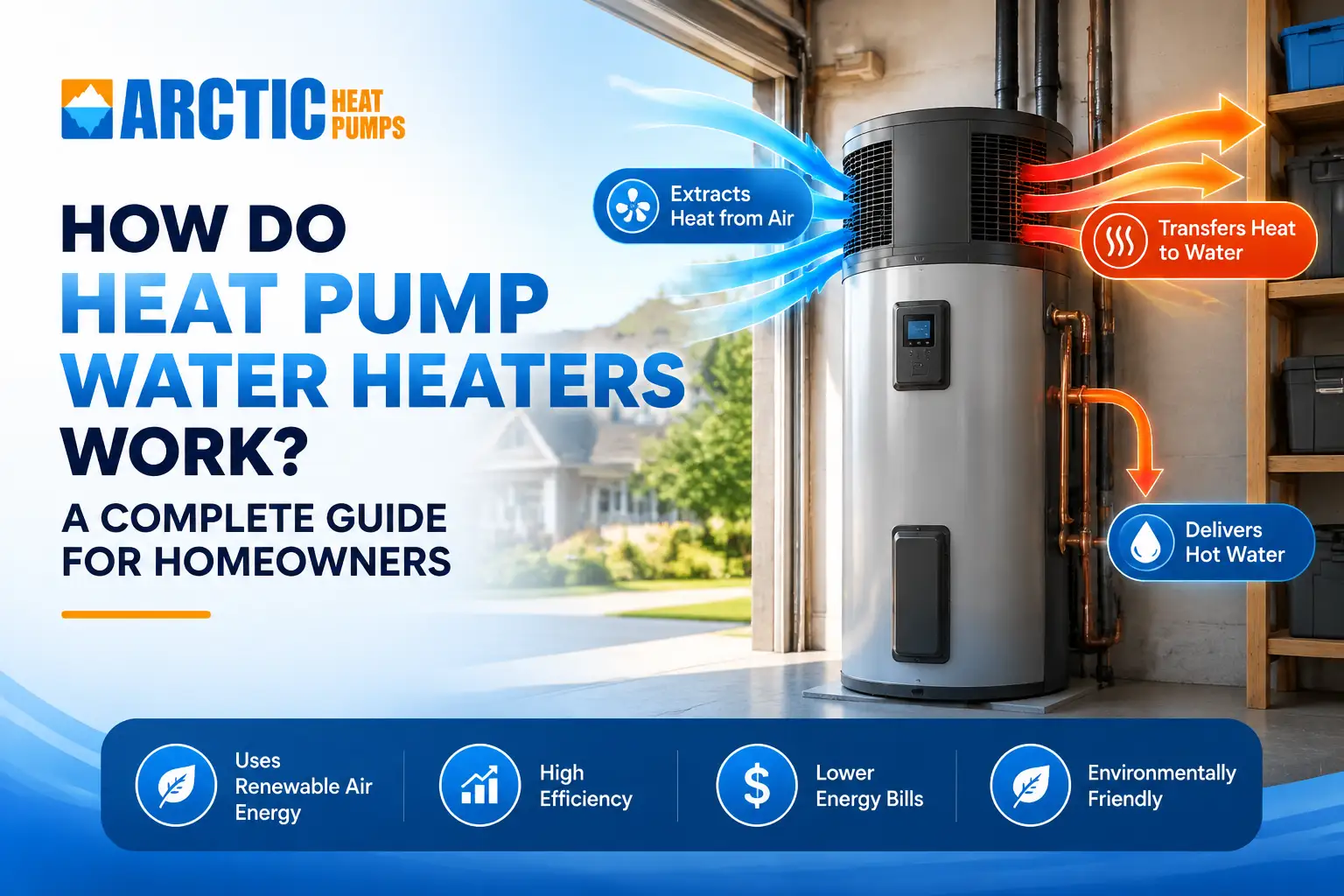
A heat pump water heater works by moving heat instead of creating it. A fan pulls in surrounding air; refrigerant inside an evaporator coil absorbs that heat; a compressor concentrates it to a higher temperature; and a condenser transfers it into the water in your storage tank. Because it transfers heat rather than generating it with an electric element or gas burner, it uses up to 70 percent less energy than a conventional water heater.
That’s the short version. In this article, I will explain how do heat pump water heaters work, explain why the technology is so efficient, cover the different types of hot water heat pump systems (including cold climate options most guides ignore), and show you how to choose the best hybrid heat pump water heater for your home. Let’s begin.
How Do Heat Pump Water Heaters Work? Step-by-Step Process
Every hot water heat pump system, from a compact integrated unit to a whole-home hydronic setup, heats water through the same four-stage refrigeration cycle.
Step 1: The Fan Draws in Air
A fan on top of the unit pulls ambient air across the evaporator coil. Even air that feels cool to you contains usable heat energy; air at 50°F holds enormous amounts of low-grade thermal energy that refrigerants can absorb.
Step 2: The Refrigerant Absorbs Heat in the Evaporator
Inside the evaporator coil, cold liquid refrigerant (much colder than the incoming air) absorbs heat from the airflow and evaporates into a low-pressure gas. Most current units use refrigerants such as R134a or R32, with newer low-GWP options like R290 (propane) and CO2 now emerging on the market. Newer R32 systems in particular offer higher efficiency and a lower global warming potential than older refrigerants.
Step 3: The Compressor Concentrates the Heat
The refrigerant vapor enters the compressor, which squeezes it to high pressure. Compressing a gas raises its temperature dramatically, so refrigerants that absorb heat from 50°F air can exit the compressor at well over 140°F. This is the step that makes the whole system possible: it upgrades low-temperature heat into high-temperature heat suitable for domestic hot water.
Step 4: The Condenser Transfers Heat into the Water
The hot refrigerant flows through a condenser (either coils wrapped around the tank or a double-wall heat exchanger), releasing its heat into the stored water. As it cools, the refrigerant condenses back into a liquid, passes through an expansion valve that drops its pressure and temperature, and returns to the evaporator to repeat the cycle.
How Efficient Are Heat Pump Water Heaters? UEF and COP Explained
Two numbers tell you how efficient a water heater really is:
Uniform Energy Factor (UEF) measures total hot water output per unit of energy consumed over a standardized daily usage test. A standard electric tank scores around 0.90 to 0.95. A gas tank scores 0.60 to 0.70. Heat pump water heaters typically score 2.8 to 4.0 or higher, with most current models above 3.0, meaning they deliver roughly three to four times more hot water per dollar of energy.
Coefficient of Performance (COP) is the instantaneous ratio of heat delivered to electricity consumed. A COP of 4.0 means 4 kW of heat delivered for every 1 kW of electricity used.
In real household terms, ENERGY STAR estimates a certified heat pump water heater saves a family of four roughly $550 per year compared with a standard electric tank, which adds up to several thousand dollars over its 10-to-15-year lifespan. Water heating is usually the second largest energy expense in a home after space heating, so this is one of the highest-impact efficiency upgrades available.
The Three Types of Hot Water Heat Pump Systems You Should Know
There are actually three, and choosing the right one depends on your climate, space, and goals.
Integrated (all-in-one) Units
The heat pump sits on top of a 50- to 80-gallon storage tank in a single appliance, typically installed in a basement, garage, or utility room. These pull heat from indoor air and are the most common residential option.
However, they have limitations as well. They need surrounding air between roughly 40°F and 90°F and about 1,000 cubic feet of air space (or ducting) to operate efficiently, and they cool the room they sit in.
Stand-alone (Split) Heat Pump Water Heaters
In this setup, the heat pump is a separate unit connected to a storage tank. A stand-alone heat pump water heater can be retrofitted to an existing tank, offers larger capacity, and gives you flexibility in where each component lives. This configuration is popular for larger households and light commercial applications.
Air-to-Water (Combi) Systems
The most powerful option is an air-to-water hot water heat pump system that handles domestic hot water and home heating together. An integrated hybrid hot water system uses one outdoor unit to heat radiant floors, fan coils, a pool, and your domestic hot water via an indirect tank or buffer tank.
Because the outdoor unit extracts heat from outside air, it never cools your living space, and a cold climate model keeps producing hot water in weather that would shut a standard unit down.
How to Choose the Best Hybrid Heat Pump Water Heater
Shopping for the best hybrid heat pump water heater comes down to matching six factors to your household rather than chasing a single “top pick”:
- Capacity and first-hour rating: A family of four typically needs a 65 to 80 gallon tank, because heat pump recovery is slower than resistance heating. Oversizing the tank lets the unit stay in efficient heat pump mode longer.
- UEF rating: Higher is better; look for 3.0 and above. Every decimal point compounds into real savings over a 10 to 15 year lifespan.
- Climate fit: If the unit will live in a space that dips below 40°F, or you want hot water from an outdoor system, a cold climate EVI unit is the deciding factor, not a nice-to-have.
- Refrigerant: R32, R290, or CO2 models offer lower global warming potential and, in many cases, higher efficiency than older R134a designs.
- Electrical compatibility: Confirm whether you need a 240V circuit or whether a 120V plug-in model suits your panel and usage.
- Warranty and support: Compressors and sealed systems are the costly components; favor manufacturers that back them for 5+ years and offer real technical support.
Heat Pump Water Heater Troubleshooting and Maintenance Tips
Heat pump water heaters are reliable, but like any appliance, they can act up. Run through these checks before calling for service.
The Unit Won’t Turn On
Check the breaker first; a tripped 240V breaker is the most common culprit. Verify the display has power, the unit isn’t in vacation mode, and any condensate overflow switch hasn’t tripped (a full or blocked condensate line will shut many units down as a safety measure).
The Water Stays Lukewarm
If the compressor and fan run but water never gets properly hot, suspect airflow or refrigerant. A clogged air filter is the number one cause and takes two minutes to clean. Also check that the intake and exhaust aren’t blocked and the surrounding air isn’t too cold. If airflow is fine, a low refrigerant charge from a leak requires a certified technician.
Keep in mind that slow heating is not always a fault. In heat pump-only mode, recovery is deliberately gradual: the compressor typically restores 8 to 20 gallons per hour, far slower than a resistance element. If the water eventually reaches temperature, the unit is working as designed.
The Water Doesn’t Reach the Set Temperature
Heavy back-to-back usage may simply be outpacing recovery, which is why hybrid mode exists. If the problem is constant, check the mode setting, the thermostat calibration, and sediment buildup in the tank, which insulates the water from the heat exchanger. Flushing the tank annually prevents this.
Warning Signs Worth Acting On
Watch for: steadily rising energy bills (the backup element may be doing all the work), grinding or rattling from the compressor, frequent icing on the evaporator coil, rusty water, or moisture around the base. Most units last 10 to 15 years; if yours is past that and showing several symptoms, replacement usually beats repair.
When to Call a Professional
Anything involving refrigerant, the sealed compressor system, or electrical faults beyond a breaker reset needs a certified technician. Arctic Heat Pumps provides technical support for troubleshooting and system design on every system we sell.
To Wrap Up
Heat pump water heaters work by moving heat from the surrounding air into your water tank rather than creating heat with a traditional electric element. That simple difference is what makes them so efficient. From the evaporator and compressor to the condenser and storage tank, the refrigeration cycle allows the system to deliver hot water while using significantly less electricity than conventional electric water heating.
The right system, however, depends on more than efficiency alone. Tank size, hot water demand, recovery time, available space, electrical requirements, climate, operating temperature, and the type of heat pump all matter. For colder climates or whole-home applications, choosing equipment designed for low-temperature operation can be especially important.
With the right sizing and installation, a heat pump water heater can reduce water-heating energy use while providing reliable hot water for years to come. If you’re considering an upgrade, the next step is to look at your home’s hot water needs and find a system that fits your space, climate, and budget. Contact us to get our free hot water heat pump sizing tool and estimate your capacity requirements.
Frequently Asked Questions
What is a heat pump water heater in simple terms?
It’s an electric water heater that works like a refrigerator in reverse. Instead of generating heat with an element, a fan pulls heat out of the surrounding air, refrigerant carries it through a compressor that concentrates it, and a heat exchanger transfers it into the water tank. Moving existing heat uses far less electricity than generating new heat.
What's the difference between a heat pump water heater and a hybrid water heater?
Usually nothing; the terms describe the same appliance. “Hybrid” refers to the built-in electric resistance elements that back up the heat pump during heavy demand, and nearly all integrated residential units include them.
Do heat pump water heaters work in winter?
Standard indoor units work fine in winter if installed in a space that stays above about 40°F. For unheated spaces or outdoor systems, cold climate EVI heat pumps are engineered to produce hot water down to -35°C (-31°F).
How long does a heat pump water heater take to heat water?
Longer than a resistance element. A fully depleted 50-gallon tank typically takes 3 to 6 hours in heat pump-only mode, depending on the surrounding air temperature. In hybrid mode, the electric elements kick in during heavy demand, so most households rarely notice. Partial recovery after a shower usually takes well under an hour.
Do heat pump water heaters use a lot of electricity?
No, that’s their main advantage. They use up to 70 percent less electricity than a standard electric water heater because they move heat rather than create it.
Why is my heat pump water heater not heating water properly?
The most common causes are a clogged air filter, blocked airflow, surrounding air that is too cold, or low refrigerant. Clean the filter and check the space temperature first; refrigerant issues need a technician.
What maintenance does a heat pump water heater need?
Clean the air filter every few months, keep the condensate drain clear, flush the tank annually to remove sediment, and have a professional inspection once a year.